

Nootropics for Entrepreneur Productivity: 2026 Guide
TL;DR:
- Natural and synthetic nootropics can enhance entrepreneur cognitive functions like attention, stress resilience, and working memory without dependency risks. Compounds such as creatine, ashwagandha, Magtein®, and caffeine plus L-theanine have clinical support for specific demands, but require consistent use over weeks to see measurable benefits. Building an effective stack involves identifying cognitive bottlenecks, timing supplementation appropriately, and tracking task-specific outcomes with transparent ingredients.
Nootropics for entrepreneur productivity are natural or synthetic compounds that improve specific brain functions, including attention, working memory, and stress resilience, without the dependency risks of traditional stimulants. Compounds like creatine monohydrate, ashwagandha root extract, Magtein® (magnesium L-threonate), and the caffeine plus L-theanine combination each target distinct cognitive subdomains that matter most to founders, operators, and executives. Recent 2026 randomized controlled trials confirm measurable improvements in selective attention, cortisol reduction, and sleep-dependent cognition from these compounds. The practical question is not whether nootropics work, but which ones work for which demands, and how to build a regimen that holds up across a 60-hour work week.
What does the science say about nootropics for entrepreneur productivity?
The evidence base for cognitive enhancers in business has matured considerably. Four compounds now have strong, recent clinical support for the specific cognitive demands entrepreneurs face daily.
Creatine monohydrate is the most underrated brain supplement in the productivity space. A single dose at 0.2 g/kg reduces cognitive decline during 21 hours of sleep deprivation by up to 12%. That figure matters because entrepreneurs routinely push through late nights before product launches, investor meetings, or quarterly closes. Creatine works by replenishing phosphocreatine stores in the brain, buffering the energy deficit that accumulates under fatigue. It is not a stimulant. It does not raise heart rate or blood pressure. It simply keeps the brain’s energy supply from bottoming out.
Ashwagandha root extract addresses the stress side of the equation. A 300 mg twice daily protocol over 8 weeks significantly reduced serum cortisol and improved anxiety scores in a 141-person randomized controlled trial. Chronically elevated cortisol is one of the most direct cognitive performance killers for entrepreneurs. It impairs prefrontal cortex function, the exact region responsible for planning, decision-making, and impulse control.
Magnesium L-threonate, sold as Magtein®, is the only form of magnesium shown to cross the blood-brain barrier efficiently. Over 6 weeks, Magtein® improved working memory and reaction time, and reduced estimated brain cognitive age by 7.5 years in adults with self-reported poor sleep. For entrepreneurs running on disrupted sleep schedules, that is a meaningful recovery tool.
Caffeine plus L-theanine remains the most studied nootropic stack for entrepreneurs. The combination at 75 mg caffeine and 50 mg L-theanine outperforms caffeine alone on sustained attention and verbal working memory, with fewer side effects including headache and blood pressure elevation. L-theanine smooths the stimulant curve without blunting the alertness benefit. You get sharper focus with less physiological cost.
- Creatine: targets energy-dependent cognition under fatigue
- Ashwagandha: reduces cortisol and stress-related cognitive interference
- Magnesium L-threonate: improves working memory and reaction time over weeks
- Caffeine plus L-theanine: sharpens acute attention with fewer side effects than caffeine alone
Stimulant-free multi-ingredient stacks also show promise. A 2026 crossover study found that a stimulant-free formulation matched caffeine in improving selective attention and executive function, though it did not replicate caffeine’s sustained-attention benefits. That distinction matters: selective attention is the ability to filter distractions during a focused task, while sustained attention is the ability to stay alert over hours. Most entrepreneurs need both, which is why stacking compounds is more effective than relying on any single ingredient.
How do key nootropics compare in safety, efficacy, and onset?
Choosing the right cognitive enhancer for business requires understanding not just what each compound does, but when it works and for whom.

| Compound | Primary cognitive target | Onset | Duration | Key safety note |
|---|---|---|---|---|
| Creatine monohydrate | Energy-dependent cognition under fatigue | Acute (single dose) | 4 to 6 hours | Safe at 0.2 g/kg; kidney concerns only at very high doses |
| Ashwagandha extract | Stress resilience, cortisol reduction | 4 to 8 weeks | Sustained with consistent use | Avoid in pregnancy; consult physician with thyroid conditions |
| Magtein® (magnesium L-threonate) | Working memory, reaction time, sleep quality | 4 to 6 weeks | Sustained | Well tolerated; loose stools possible at high doses |
| Caffeine plus L-theanine | Selective and sustained attention | 30 to 60 minutes | 4 to 6 hours | Avoid late in the day; tolerance builds with daily use |
| Multi-ingredient stimulant-free stack | Selective attention, executive function | 60 to 90 minutes | 3 to 5 hours | Varies by formulation; check for proprietary blends |
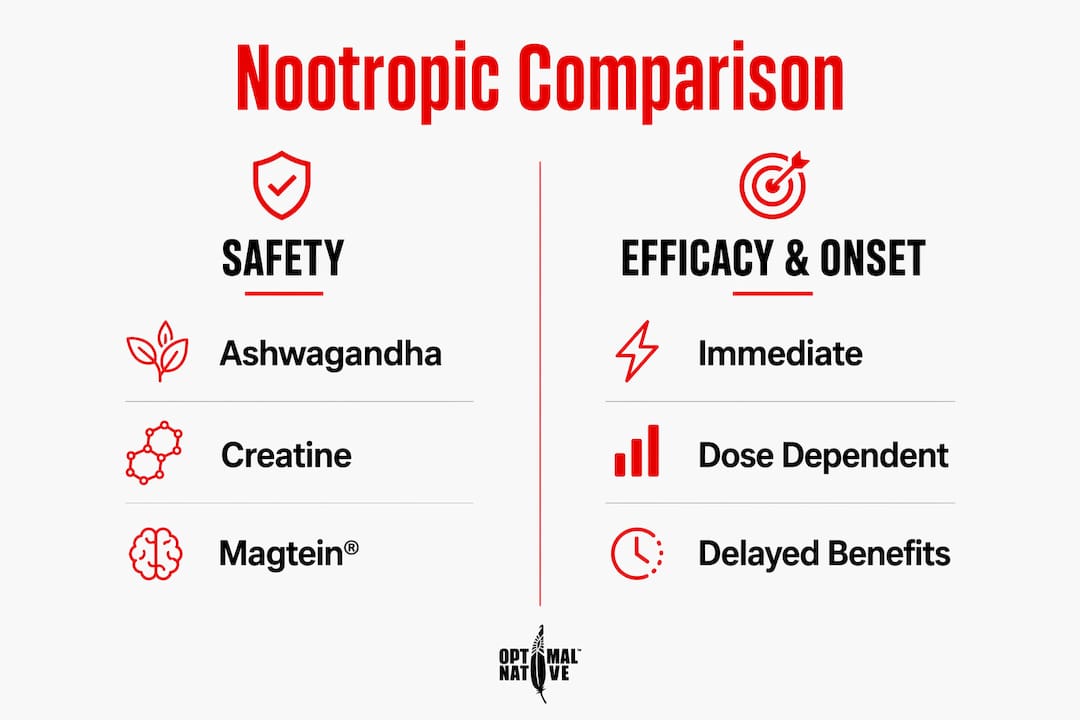
The most important takeaway from this comparison is timing. Creatine’s cognitive benefits are dose-dependent and best deployed around expected fatigue windows, such as the afternoon slump after a short night. Ashwagandha and Magtein® are chronic compounds. You take them daily and measure results at 6 to 8 weeks, not 6 to 8 hours. Caffeine plus L-theanine is your acute tool for high-stakes mornings or critical meetings.
Sex differences also matter. Females in the creatine trial showed greater improvements in logic and processing speed under sleep deprivation than males. This is not a reason to avoid creatine if you are male. It is a reason to track your own response rather than assuming population averages apply to you.
Pro Tip: Avoid taking caffeine plus L-theanine after 2 p.m. if you struggle with sleep. Caffeine’s half-life is roughly 5 to 6 hours, meaning a 3 p.m. dose still has significant activity at 9 p.m., which undermines the sleep quality that Magtein® is trying to protect.
Anyone with cardiovascular conditions, thyroid disorders, or who is pregnant should consult a physician before starting any nootropic regimen. This is not a formality. Several adaptogens interact with hormone pathways in ways that are clinically relevant.
How to build a nootropic stack for entrepreneurs
Building an effective nootropic stack for entrepreneurial productivity is a structured process, not a shopping cart exercise. The goal is to match compounds to your specific cognitive demands and measure whether they are working.
-
Identify your primary cognitive bottleneck. Are you losing focus during deep work? Burning out by 3 p.m.? Struggling to make clear decisions under pressure? Each problem maps to a different compound. Decision fatigue and stress map to ashwagandha. Afternoon cognitive drops after poor sleep map to creatine. Distraction during focused tasks maps to caffeine plus L-theanine or a stimulant-free stack.
-
Start with one compound for four weeks. Adding three new supplements simultaneously makes it impossible to know what is working. Begin with the compound that addresses your biggest bottleneck. Ashwagandha at 300 mg twice daily and Magtein® at 2 g daily are the lowest-risk starting points for most entrepreneurs avoiding stimulants.
-
Add creatine around fatigue events. If you know a late night is coming, take creatine monohydrate at 0.2 g/kg body weight beforehand. A 75 kg entrepreneur takes 15 g. This is not a daily supplement in the same way as ashwagandha. It is a targeted intervention for known high-fatigue periods.
-
Introduce caffeine plus L-theanine as an optional acute layer. If you want the focus sharpness of caffeine without the jitter and crash, the 75 mg caffeine plus 50 mg L-theanine ratio is the research-supported starting point. Read more about how L-theanine calms focus before adding this to your morning routine.
-
Track outcomes with task-specific metrics. Subjective “I felt focused today” is not enough. Use a daily log that records your output on a specific task type, such as words written, decisions made, or problems solved. Measure the same task type at the same time of day across your trial period.
-
Reassess at 8 weeks. Adaptogens like ashwagandha require at least 8 weeks of consistent use to show their full cortisol-lowering effect. If you stop at week three because you do not feel different, you are quitting before the compound has had time to work.
Pro Tip: Pair your nootropic regimen with morning routine optimization to compound the cognitive benefits. Sleep, hydration, and light exposure before your first dose significantly affect how well any nootropic performs.
Lifestyle factors are not optional add-ons to a nootropic stack. They are the substrate the compounds act on. A creatine dose on top of chronic dehydration and four hours of sleep will underperform compared to the same dose on top of seven hours of sleep and adequate hydration.
What misconceptions about nootropics hurt entrepreneur results?
The biggest mistake entrepreneurs make with brain supplements for productivity is treating them like caffeine. They are not.
-
Nootropics are not instant alertness pills. Ashwagandha and Magtein® work over weeks by modifying physiology, not by stimulating the central nervous system. Expecting to feel a difference on day one leads to premature abandonment of compounds that would have worked by week six.
-
Selective attention is not the same as sustained attention. Stimulant-free stacks improve selective attention but do not fully replicate caffeine’s all-day alertness effect. If your work requires hours of unbroken vigilance, a stimulant-free stack alone may not be sufficient. Combining it with caffeine plus L-theanine gives you both domains.
-
Stress management through nootropics is gradual. Ashwagandha reduces cortisol through physiological adaptation, not through sedation or immediate calming. Entrepreneurs who take it expecting to feel calm within an hour will be disappointed and will miss the genuine benefit that accumulates over two months.
-
Nootropics do not replace sleep, exercise, or nutrition. They work within the constraints of your biology. A well-designed nootropic stack for entrepreneurs amplifies a healthy baseline. It does not compensate for a broken one.
-
Proprietary blends without disclosed dosages are a red flag. If a supplement label lists “nootropic blend 500 mg” without specifying how much of each ingredient is included, you cannot verify whether the doses match what the clinical trials used. Transparency in formulation is the minimum standard for evidence-based supplementation.
“The most effective cognitive enhancers for business are not the ones that feel the strongest on day one. They are the ones that are still working on day 60 because you built a regimen around evidence, not marketing.”
What I have learned from years of watching entrepreneurs use nootropics
The pattern I see most often is entrepreneurs who cycle through high-stimulant products, burn out on the dependency, and then dismiss all nootropics as ineffective. That conclusion is wrong, but it is understandable. Stimulant-based products are designed to feel powerful immediately. Stimulant-free compounds are designed to work sustainably.
The entrepreneurs who get the most from a nootropic stack for entrepreneurs are the ones who treat it like a training protocol, not a quick fix. They pick compounds with clinical backing, use them consistently, and measure specific outcomes. They also understand that caffeine dependency reduces productivity over time, which is why the stimulant-free or stimulant-adjacent approach is worth the patience it requires.
My honest observation is that Magtein® and ashwagandha together form the most underutilized foundation in entrepreneur mental performance. Neither feels dramatic. Both produce real, measurable changes in working memory, stress resilience, and cognitive age over six to eight weeks. The entrepreneurs who stick with them consistently report the kind of steady, reliable mental clarity that no energy drink has ever delivered.
The caution I always add: do not trust any formulation that cannot tell you exactly how much of each ingredient it contains. Dosage transparency is not a nice-to-have. It is the difference between a product that replicates clinical results and one that uses clinical language to sell underdosed ingredients.
— Optimal Native
How Optimal Native supports your cognitive performance goals
Optimal Native builds its performance pouch system around the exact compounds this article covers, including the caffeine plus L-theanine combination, in a nicotine-free, crash-free format designed for entrepreneurs who need clean, sustained energy across a full workday. With 4.9 out of 5 stars from over 300 verified reviews, users consistently report improved focus and energy without jitters.
If you are ready to move beyond energy drinks and build a real cognitive performance protocol, the Optimal Native bundle gives you the key compounds in one convenient purchase. For ongoing use, the subscribe and save option makes consistent supplementation easier and more affordable. Consistency is what separates results from experiments.
FAQ
What are the best nootropics for entrepreneur focus?
The caffeine plus L-theanine combination at 75 mg and 50 mg respectively is the most research-supported option for acute focus. Magtein® and ashwagandha address working memory and stress resilience over longer timeframes.
How long before nootropics improve productivity?
Acute compounds like caffeine plus L-theanine work within 30 to 60 minutes. Ashwagandha requires 8 weeks of consistent use to show significant cortisol reduction, and Magtein® shows measurable cognitive improvements after 6 weeks.
Can nootropics replace caffeine for entrepreneurs?
Stimulant-free stacks match caffeine on selective attention and executive function but do not fully replicate its sustained-attention benefits. Most entrepreneurs get the best results by combining stimulant-free compounds with a lower-dose caffeine plus L-theanine stack rather than replacing caffeine entirely.
Is creatine a nootropic for cognitive performance?
Creatine monohydrate at 0.2 g/kg reduces cognitive decline during sleep deprivation by up to 12%, making it a targeted cognitive tool for entrepreneurs facing fatigue-heavy work periods. It is not a daily alertness supplement but a strategic intervention for high-demand periods.
Are nootropic stacks safe for daily use?
Ashwagandha, Magtein®, and creatine have strong safety profiles at clinical doses. Anyone with thyroid conditions, cardiovascular issues, or who is pregnant should consult a physician before starting. Avoid proprietary blends with undisclosed ingredient dosages.
Key takeaways
Effective nootropics for entrepreneur productivity work by targeting specific cognitive subdomains, not by delivering broad stimulant-like alertness, and require consistent use to produce measurable results.
| Point | Details |
|---|---|
| Match compound to cognitive need | Creatine targets fatigue-driven decline; ashwagandha targets stress; Magtein® targets working memory and sleep. |
| Expect gradual results from adaptogens | Ashwagandha and Magtein® require 6 to 8 weeks of daily use before full benefits appear. |
| Use caffeine plus L-theanine acutely | The 75 mg caffeine and 50 mg L-theanine ratio improves focus with fewer side effects than caffeine alone. |
| Track task-specific outcomes | Measure output on a defined task type daily rather than relying on subjective energy ratings. |
| Demand dosage transparency | Only use formulations that disclose exact ingredient amounts to verify clinical dose alignment. |