

The Role of L-Theanine Calming Focus Explained
TL;DR:
- L-theanine is a naturally occurring amino acid in green tea that promotes focused relaxation without causing drowsiness. It enhances alpha brain wave activity, reduces anxiety, and works synergistically with caffeine to improve attention and calmness. Regular dosing and proper timing make it an effective daily stress and focus support tool, especially for cognitive anxiety and high-pressure tasks.
Most people assume that anything labeled “calming” will make them drowsy. That assumption stops a lot of students and professionals from ever trying l-theanine, which is genuinely unfortunate. The role of l-theanine calming focus is unlike anything a sedative or antihistamine produces. L-theanine is an amino acid found naturally in green tea leaves, and it does something rare: it quiets mental noise without putting you to sleep. If you have ever wanted to feel sharp and relaxed at the same time, this is worth understanding.
Table of Contents
- Key Takeaways
- How l-theanine creates calming focus in the brain
- What clinical research actually shows
- L-theanine alone versus l-theanine with caffeine
- Dosing, timing, and what to look for on the label
- My perspective on l-theanine for calm under pressure
- Upgrade your daily focus routine with Optimalnative
- FAQ
Key Takeaways
| Point | Details |
|---|---|
| Alpha wave activation | L-theanine raises alpha brain wave activity within 30-40 minutes, producing relaxed alertness without sedation. |
| Proven anxiety reduction | Clinical trials at 200-400 mg daily show significant reductions in anxiety scores with no serious side effects. |
| Caffeine synergy | The 2:1 l-theanine to caffeine ratio sharpens attention while removing jitteriness from caffeine alone. |
| Timing matters | Lower doses (50-200 mg) suit daytime focus; higher doses (200-400 mg) work better for evening relaxation. |
| Quality varies widely | Suntheanine® is the patented form used in most clinical trials. Always check for third-party purity testing. |
How l-theanine creates calming focus in the brain
L-theanine reaches the brain faster than most people expect. After you take it orally, it crosses the blood-brain barrier within about 30 minutes, where it begins interacting with several key neurotransmitter systems simultaneously.
The compound modulates GABA, serotonin, and dopamine while also reducing glutamate activity. Glutamate is your brain’s primary excitatory signal. Too much of it, especially under stress, creates that frantic, scattered feeling you get before a big presentation or during a deadline crunch. L-theanine turns that signal down without suppressing your alertness circuits at the same time. That is the mechanism that separates it from sedatives.
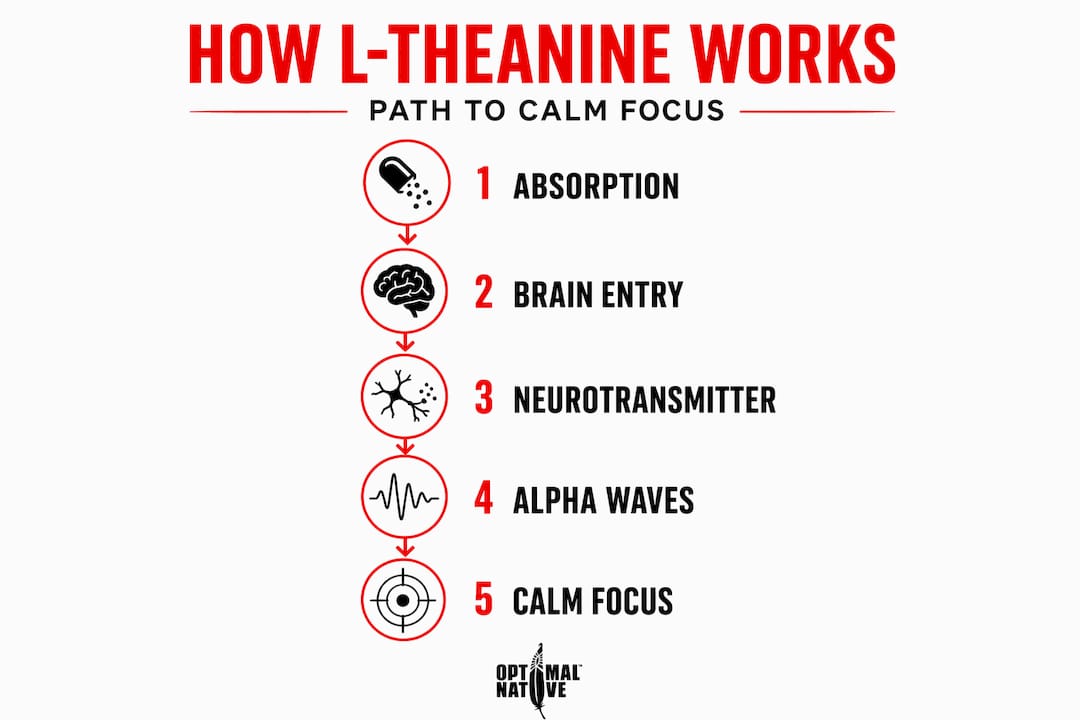
The most measurable effect is the increase in alpha brain wave activity in the 8 to 13 Hz range. Alpha waves are the same waves your brain produces during meditation. They represent a state of wakeful, effortless concentration — the mental equivalent of being in flow. L-theanine reproduces that state pharmacologically, which explains why so many users describe feeling focused without trying hard. Calm focus effects stem directly from this alpha wave increase, making the experience feel intuitive rather than forced.
The timing of these effects matters for practical use. EEG studies show alpha waves measurable within 30-40 minutes post-dose, with effects lasting approximately 2 to 3 hours. This means l-theanine is not a background supplement you take once and forget. It is a targeted tool you time to your work sessions.
Pro Tip: Take l-theanine about 30 minutes before a high-focus task like writing, coding, or studying. You will hit the window of peak alpha wave activity right when you need it most.
What clinical research actually shows
The science on l-theanine is more rigorous than most supplement research. Eleven randomized controlled trials have examined its effects on anxiety and focus, and the results are consistent enough to draw real conclusions.
On the anxiety side, 200-400 mg daily reduces anxiety inventory scores in healthy adults without producing serious adverse events. One trial of 30 healthy adults showed measurable reductions in anxiety scores after just four weeks at 200 mg per day. L-theanine reduces cortisol levels, which is the hormone most directly tied to the stress response, and it does so without the blunting effect you get from prescription anxiolytics.
The cognitive improvements are real but specific. Here is what the data shows:
| Cognitive Domain | Effect Observed | Population Studied |
|---|---|---|
| Attention | Improved sustained attention and reaction time | Healthy adults |
| Working memory | Modest improvements under stress conditions | Adults with mild anxiety |
| Executive function | Better task-switching and mental flexibility | General population |
| Anxiety reduction | Significant decrease in self-reported anxiety | Adults with baseline stress |
| ADHD symptoms | Preliminary positive signals; more research needed | Children and adolescents |
One distinction worth making: l-theanine produces subjective relaxed alertness reliably and objective cognitive improvement more selectively. You will almost certainly feel calmer and more focused. Whether a standardized test captures that improvement depends on the task and your baseline stress level. People who start with higher anxiety tend to show bigger measurable gains because the calming effect removes a cognitive drag that was holding them back.
Clinical efficacy is strongest for baseline stress reduction rather than acute panic relief. If you are looking for l-theanine for anxiety during a crisis, you will be disappointed. If you want a daily mental wellness tool that keeps stress from compounding over time, the research genuinely supports it.
L-theanine alone versus l-theanine with caffeine
Most people who use l-theanine do not use it alone. The combination with caffeine is one of the most studied and practically validated nootropic pairings available, and understanding the difference between the two approaches matters.
Caffeine on its own sharpens attention and speeds up reaction time. The problem is that caffeine also increases cortisol, raises heart rate, and triggers the exact overstimulation that creates jitters and post-coffee anxiety. For people with caffeine sensitivity, this effect can completely undercut the cognitive benefits.
L-theanine addresses this directly. The 2:1 l-theanine to caffeine ratio is the most studied combination, and research shows it improves multitasking performance by over 10% compared to caffeine alone. In practice, this means 200 mg of l-theanine paired with 100 mg of caffeine. The l-theanine smooths the arousal curve that caffeine produces, keeping attention sharp while removing the anxious edge.
Here is a practical comparison:
| Approach | Focus Quality | Anxiety Risk | Duration | Best Use Case |
|---|---|---|---|---|
| L-theanine alone | Calm, soft focus | Very low | 2-3 hours | Stress management, evening work |
| Caffeine alone | Sharp but edgy | Moderate to high | 4-6 hours | Short burst tasks |
| L-theanine plus caffeine | Sharp and calm | Low | 3-5 hours | Deep work, studying, high-stakes tasks |
One thing the research makes clear: caffeine doses above moderate levels cannot be fully offset by l-theanine. If you are taking 400 mg of caffeine from multiple sources, adding 200 mg of l-theanine will not save you from the crash. The synergy requires restraint on the caffeine side. Think one cup of coffee, not three.
Pro Tip: If you want to explore jitter-free focus without building your own stack from scratch, check out performance pouches vs. energy drinks to see how pre-formulated options handle this combination.
Dosing, timing, and what to look for on the label
Getting the dose right is more practical than it sounds. L-theanine is forgiving compared to most nootropics, but the dose you choose should match what you are trying to accomplish.
For daytime focus and l-theanine and concentration support, doses in the 100 to 200 mg range work well. These are low enough to avoid any grogginess while still producing a clear shift in mental state. For evening relaxation or managing a particularly stressful day, doses up to 400 mg are appropriate and well-tolerated.
Here are the key practical points for using l-theanine responsibly:
- Choose the right form. Suntheanine® is the patented, enzymatically produced form used in most clinical trials. Many market products contain synthetic versions with variable purity. Check labels carefully.
- Look for third-party testing. Purity verification from an independent lab is the single most important quality marker when buying any l-theanine supplement.
- Time your dose intentionally. Effects begin within 30 minutes and last about 2 to 3 hours. Plan around your schedule, not around habit.
- Check for interactions. L-theanine is generally safe and carries no serious side effects or dependency risk. If you take blood pressure medication or sedatives, consult a physician before adding it.
- Expect a subtle shift, not a dramatic one. People who take l-theanine expecting an immediate alertness surge often miss the actual effect. The experience is quieter and more functional than stimulants.
The benefits of l-theanine accumulate with consistent use. Daily supplementation over several weeks consistently outperforms single-dose experiences in clinical data.
My perspective on l-theanine for calm under pressure
I have spent years thinking about what actually works for focus and stress management, and l-theanine stands out for one specific reason: it does not trade one problem for another.

Most things that calm you down also slow you down. Most things that sharpen your focus also tighten your chest. L-theanine is one of the few compounds that genuinely does both at once, and I think the alpha wave mechanism explains why it feels so natural. You are not being sedated. You are being put into a state your brain already knows how to use.
That said, I am honest about the limits. L-theanine is not a replacement for sleep, exercise, or real stress management. It is best understood, as the research confirms, as a brain stress response modulator that supports clarity in high-pressure environments. It works best when your foundations are already solid.
What I find underappreciated is how well it works for people whose anxiety is specifically cognitive. Not emotional panic, but the mental static of too many open loops and too much stimulation. That is the sweet spot where l-theanine can l-theanine improve focus in a way nothing else quite matches. If that sounds like your experience, it is worth trying systematically rather than occasionally.
— Optimal
Upgrade your daily focus routine with Optimalnative
If you are serious about calm, sustained focus without the crashes and jitters that come from typical energy products, Optimalnative was built exactly for that. Our nicotine-free performance pouch system combines nootropics and adaptogens, including the l-theanine and caffeine synergy discussed above, in precisely calibrated ratios. Every pouch is designed around your body’s natural biochemical states so you get clean energy that lasts. Over 300 customers rate us 4.9 out of 5 stars and report exactly the focused, jitter-free experience the research promises.
Start with the Optimal Native bundle to find the right combination for your routine, or lock in savings with our subscribe and save program for consistent daily support.
FAQ
What is the role of l-theanine in calming focus?
L-theanine increases alpha brain wave activity, which produces a state of relaxed alertness similar to meditation. This allows you to stay focused and mentally clear without stimulant-driven overarousal.
How much l-theanine should I take for focus?
For daytime focus, 100 to 200 mg is the standard effective range. Pairing 200 mg of l-theanine with 100 mg of caffeine offers sharper attention while reducing jitters.
Can l-theanine improve focus without caffeine?
Yes. L-theanine alone produces calm, soft focus by raising alpha waves and modulating GABA and dopamine. The effect is subtler than the caffeine combination but well-suited for stress-sensitive tasks or evening use.
Does l-theanine help with anxiety?
Clinical trials at 200 to 400 mg daily show significant reductions in anxiety scores in healthy adults. It works best as a daily stress management tool rather than acute relief for panic episodes.
Is l-theanine safe to take every day?
L-theanine carries no serious side effects and no risk of dependency, and it holds GRAS status with the FDA. Daily use is well-supported by human trial data, though anyone on blood pressure medication or sedatives should check with a physician first.