

Why Energy Crashes Hurt Focus and How to Fix It
TL;DR:
- Energy crashes are caused by biochemical factors like adenosine buildup, blood sugar swings, and sleep debt, not laziness or willpower.
- Managing sleep, timing caffeine, and stabilizing blood sugar can significantly improve focus and reduce reaction time impairments.
You reach for a second coffee at 2 PM, hoping to recover the sharp thinking you had at 9. But by 3:30, you feel worse than before. That is not a coincidence. Why energy crashes hurt focus is deeply rooted in brain chemistry, not willpower, and the fixes most people reach for often make the cycle worse. This article breaks down the real science behind energy dips, what they do to your cognitive performance, and what you can actually do about it starting today.
Table of Contents
- Key takeaways
- Why energy crashes hurt focus: the biology behind the drop
- How energy dips affect concentration and brain performance
- Common sources of energy crashes
- Practical strategies to prevent energy crashes
- My take on the real cost of ignoring energy crashes
- How Optimalnative supports steady energy and focus
- FAQ
Key takeaways
| Point | Details |
|---|---|
| Crashes are biochemical, not personal | Energy dips are driven by adenosine buildup, blood sugar swings, and sleep debt, not laziness. |
| Caffeine delays then amplifies fatigue | Caffeine blocks adenosine temporarily, causing a harder crash when it wears off after 5 to 6 hours. |
| Sleep loss kills focus fast | Just 5 to 6 hours of sleep lowers attention scores by 26% and processing speed by 29%. |
| Brain fuel stability drives mental clarity | The brain stores almost no energy reserves, so even small glucose fluctuations impair focus and mood. |
| Timing beats volume | Strategically timed caffeine, balanced meals, and sleep quality matter more than total consumption. |
Why energy crashes hurt focus: the biology behind the drop
Your brain is the most energy-hungry organ in your body, consuming roughly 20% of your total energy despite being only 2% of your body weight. What makes it uniquely fragile is that it stores almost no energy reserves. Every fluctuation in your blood glucose or sleep quality hits your brain directly and immediately.
Three primary mechanisms cause energy crashes:
- Adenosine accumulation: Adenosine is a byproduct of brain activity that builds up throughout the day. The longer you are awake, the more adenosine accumulates, and the stronger the pressure to sleep becomes.
- Blood sugar volatility: Rapid drops in blood glucose, even when levels stay above the clinical hypoglycemia threshold, trigger a cascade of stress hormones and cognitive slowdown.
- Sleep debt: Chronic mild sleep restriction impairs the brain’s ability to clear adenosine overnight, meaning each day begins with a higher baseline of fatigue.
The circadian afternoon dip (roughly 1 to 3 PM) is a natural, genetically programmed drop in alertness. But metabolic crashes driven by caffeine rebounds or blood sugar swings are different. They hit harder and recover more slowly because they involve actual biochemical disruption, not just a predictable rhythm.
Pro Tip: If your energy crash comes with anxiety, shakiness, or irritability, that is likely a blood sugar event. If it comes with heavy eyelids and a general mental fog, adenosine or sleep debt is the more likely culprit. Knowing the difference tells you how to respond.
How energy dips affect concentration and brain performance
The effects of energy crashes are not just about feeling tired. They fundamentally change how your brain operates. When fuel availability becomes unstable, the brain shifts from analytical processing toward a reactive, survival-based mode. That shift explains why you feel distracted, snappy, and unable to finish sentences during a crash.
Here is what the research shows about cognitive metrics during energy instability:
| Cognitive function | With stable energy | During energy crash |
|---|---|---|
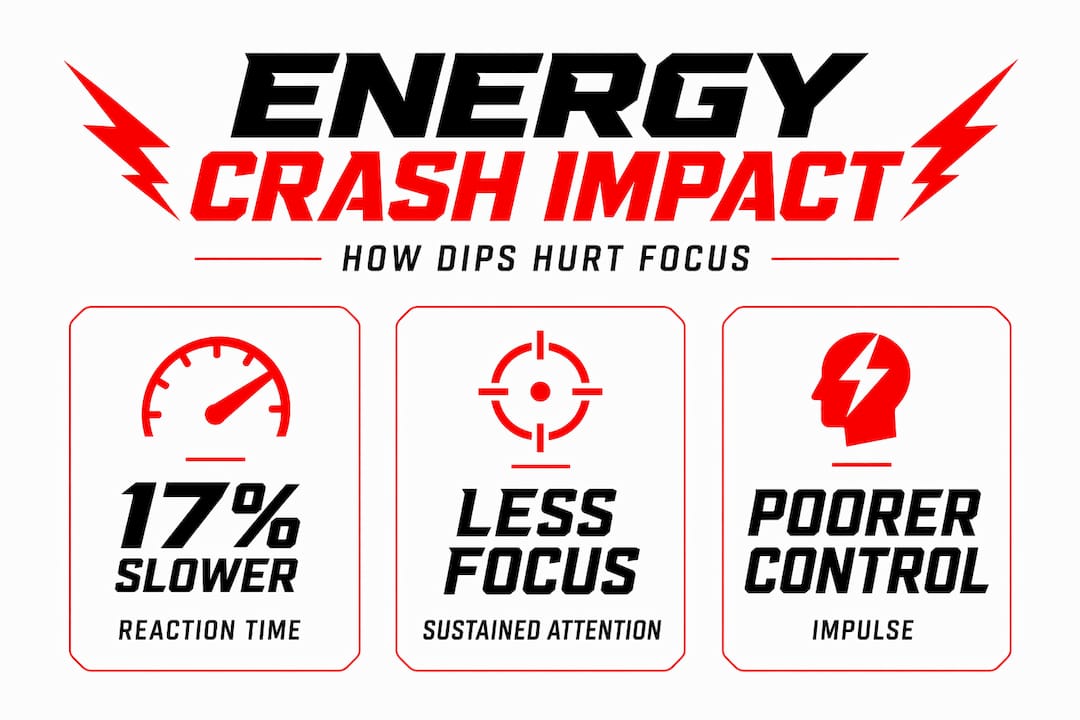
| Sustained attention | Baseline | Down 20 to 30% |
| Processing speed | Baseline | Down 29% with sleep restriction |
| Simple reaction time | Baseline | 14% slower with 6 hours of sleep |
| Impulse control | Consistent | Markedly reduced |
| Mood stability | Stable | Increased irritability and anxiety |
The reaction time data is particularly striking. A 14 to 17% increase in reaction time sounds abstract until you consider that most knowledge work depends on split-second decision-making, composing responses, catching errors, and shifting between tasks. A crash does not just make you slower. It makes you less accurate and more emotionally reactive at the same time.
One of the most underappreciated effects is what happens to impulse control. When the brain is in survival mode due to fuel volatility, the prefrontal cortex (the seat of rational decision-making) goes offline first. You become more reactive, less patient, and far more likely to make decisions you would not make at full capacity. The impact of fatigue on focus is not just cognitive. It is behavioral.
People who get 6 hours of sleep for 14 consecutive days perform as poorly as someone who has been awake for 48 straight hours on reaction time tests. Most of them feel only slightly tired. That self-blindness to impairment is one of the most dangerous aspects of chronic energy crashes. You do not know how compromised you are.
Common sources of energy crashes
Understanding why energy levels and mental clarity are connected starts with identifying what is triggering your specific crashes. The three most common culprits are caffeine metabolism, poor sleep, and reactive hypoglycemia. Each operates through a distinct mechanism.
The caffeine rebound trap
Caffeine does not give you energy. It borrows it. Caffeine works by blocking adenosine receptors temporarily, but adenosine keeps accumulating while those receptors are blocked. When caffeine’s half-life of 5 to 6 hours runs out, all that accumulated adenosine floods your receptors at once, causing a crash that feels more intense than natural fatigue would have been.

Chronic daily caffeine use makes this worse over time. The brain responds to constant receptor blockade by growing more adenosine receptors, which means baseline fatigue becomes stronger when caffeine is absent. You need more caffeine just to feel normal, and the crashes get deeper.
There is also a hydration angle. Caffeine has a mild diuretic effect, and even 1 to 2% dehydration leads to measurable drops in cerebral blood flow and cognitive performance, compounding the crash.
Sleep restriction’s underestimated damage
Most people know sleep matters. Few people grasp how quickly partial sleep loss destroys cognitive performance. Individuals sleeping 5 to 6 hours score 26% lower on attention tasks than those getting 7 to 8 hours. That is not a marginal penalty. That is the cognitive equivalent of being moderately impaired.
It is not just total hours. Sleep quality matters just as much. Fragmented sleep from temperature fluctuations or disruptions can reduce next-day attention by up to 18% and decision-making performance by 20%, even when total hours look adequate on paper.
Reactive hypoglycemia
This one catches a lot of people off guard. Reactive hypoglycemia causes rapid blood sugar drops 2 to 5 hours after eating, triggering energy crashes even when glucose levels technically stay above 70 mg/dL. The trigger is the rate of decline, not the absolute number.
When glucose drops rapidly, the body releases adrenaline in response. That stress hormone surge explains why shakiness, anxiety, and irritability are classic symptoms. You are not just tired. Your body is in a mild stress response, and your brain is right in the middle of it.
Pro Tip: Notice your crash timing. If it hits 2 to 3 hours after a high-carbohydrate meal, reactive hypoglycemia is likely involved. Shifting to meals with more protein, fiber, and healthy fat slows glucose absorption and dramatically reduces the spike and subsequent crash.
Practical strategies to prevent energy crashes
The goal is not to eliminate rest signals from your brain. It is to avoid the artificial volatility created by poor sleep habits, caffeine dependency, and blood sugar spikes. Here is how to approach it systematically:
-
Anchor your sleep schedule. Go to bed and wake up at the same time every day, including weekends. Consistency stabilizes your circadian rhythm and reduces adenosine buildup going into each morning. Cool your bedroom to around 65 to 68°F, since temperature stability directly protects sleep quality and next-day cognitive outcomes.
-
Time caffeine strategically. Avoid caffeine in the first 90 minutes after waking. Your cortisol is naturally elevated at that point and provides alertness on its own. Consuming caffeine then builds tolerance without giving you a real edge. Cut off caffeine by 1 to 2 PM to prevent it from blocking the adenosine clearance your brain needs to sleep deeply that night.
-
Stabilize blood sugar with meal composition. Front-load meals with protein and fat before adding carbohydrates. This flattens the glucose response curve and makes your energy more predictable across the day. Avoid ultra-processed snacks between meals, which spike blood sugar quickly and accelerate the reactive crash cycle.
-
Use micro-breaks deliberately. A 5-minute mental break every 50 to 60 minutes reduces cognitive fatigue without losing momentum. Stand up, look away from screens, and do something with no cognitive load. This is not laziness. It is preventing the sustained-attention burnout that accelerates afternoon crashes.
-
Hydrate ahead of the crash. Drink 16 to 20 oz of water in the hour before your typical crash window, usually mid-morning and mid-afternoon. Since even mild dehydration worsens cognitive performance, getting ahead of it is one of the lowest-effort, highest-impact habits you can build.
-
Consider adaptogens and nootropics. Certain compounds like Rhodiola rosea, L-theanine, and ashwagandha support the stress-response pathways that make energy crashes more severe. Unlike caffeine, they work with your brain’s biochemistry rather than temporarily overriding it.
Pro Tip: If you are a high-caffeine user, do not go cold turkey. Reduce by one drink every 3 to 4 days to give your adenosine receptor count time to normalize. This prevents the brutal withdrawal crashes that derail most people’s attempts to reduce dependency.
My take on the real cost of ignoring energy crashes
I have worked with entrepreneurs and high-performers who describe their afternoons as a write-off. They are not dramatic. They are accurate. What I have seen repeatedly is that people treat crashes as background noise. They push through, grab another coffee, eat something fast, and wonder why their output quality drops by 3 PM every single day.
The counterintuitive lesson is that masking fatigue makes the underlying problem worse. Every time you use caffeine to bypass a crash, you are adding to the adenosine debt your brain will collect on later. The body does not forget. You are borrowing cognitive performance from your future self, and the interest rate compounds.
What actually works is respecting the signal. Crashes are not weakness. They are precise biological feedback telling you that something in your fuel management is off. The people I have seen make the most sustainable gains in mental clarity did not find a stronger stimulant. They cleaned up their sleep, fixed their meal timing, and stopped treating caffeine as a substitute for recovery.
The brain does not perform well under duress. It performs well when it has what it needs. That is worth building your whole day around.
— Optimal
How Optimalnative supports steady energy and focus
If you have fixed your sleep, timed your caffeine better, and cleaned up your meals but still feel the pull of the afternoon crash, the problem might be what you are not giving your brain rather than what you are doing wrong. That is exactly the gap Optimalnative was built to fill.
Optimalnative’s Morning Energy pouch delivers a curated blend of nootropics and adaptogens designed to support stable cognitive energy without the spike-and-crash cycle that comes with traditional stimulants. There is no nicotine, no jitters, and no rebound. Just clean support that works with your natural biochemistry instead of fighting it. The Cool Mint option gives you the same formulation in a format that fits any part of your day.
Over 300 users have rated Optimalnative 4.9 out of 5 stars, and the most consistent feedback is the absence of the crash. Not reduced. Gone. If you want to build that kind of consistency into your routine, the subscribe and save option makes it easy and more affordable to stay on top of your energy management every day.
FAQ
Why does tiredness reduce productivity so sharply?
Fatigue directly impairs the prefrontal cortex, the brain region controlling attention, planning, and impulse control. Even moderate sleep restriction lowers processing speed by 29% and attention by 26%, making meaningful work significantly harder.
What are the main effects of energy crashes on focus?
Energy crashes reduce sustained attention, slow reaction time by 14 to 17%, and shift the brain from analytical to reactive mode, making it harder to concentrate, solve problems, and stay emotionally steady.
How do caffeine crashes differ from natural fatigue?
Caffeine blocks adenosine receptors without stopping adenosine buildup, so when the caffeine clears after 5 to 6 hours, the accumulated adenosine floods receptors all at once, producing a crash that feels more intense than natural tiredness would.
Can blood sugar cause the same focus problems as sleep loss?
Yes. Reactive hypoglycemia triggers rapid glucose drops 2 to 5 hours after eating, releasing stress hormones like adrenaline that cause shakiness, irritability, and cognitive fog, symptoms that closely mirror the focus impairment seen in sleep deprivation.
What is the fastest way to recover mental clarity after an energy crash?
Step away from demanding tasks for 5 to 10 minutes, drink water, and eat a small protein-based snack rather than a sugary one. Avoiding caffeine at this point prevents worsening the adenosine rebound cycle and allows your brain to stabilize naturally.