

Theacrine Supplement Guide for Smooth Energy and Focus
A night-shift nurse reaches for another coffee at 3 a.m. The first cup helped, the second brought restless energy, and the third may leave the next sleep window out of reach. A remote developer faces a similar tradeoff during deep work, while a former nicotine-pouch user may want the familiar oral ritual without nicotine.
A theacrine supplement enters this conversation as a caffeine-like option associated with smoother perceived energy and a different tolerance profile. It isn't a guaranteed caffeine replacement, a proven exercise enhancer, or a shortcut around sleep. Its most credible role is narrower: a potentially useful ingredient for people who value steady subjective alertness and want to understand delivery, timing, and stimulant combinations before choosing a routine.
The important details sit beyond the ingredient name. A capsule and a buccal pouch don't deliver compounds in the same way. Caffeine can change theacrine exposure, a long-lasting compound can interfere with late-day sleep, and a favorable feeling of energy isn't the same as improved performance on a controlled test. The guide below separates those questions so shift workers, biohackers, and focused professionals can judge theacrine without relying on marketing shorthand.
Table of Contents
- Introduction to the Theacrine Supplement and Why It Matters Now
- How Theacrine Works in the Brain and Body
- Key Benefits Energy Focus and Tolerance Profile
- Theacrine vs Caffeine and Other Stimulants Compared
- Dosage Safety and Smart Stacking Strategies
- Real World Use Cases From Shifts to Deep Work
- Choosing Your Theacrine Approach and Next Steps
Introduction to the Theacrine Supplement and Why It Matters Now
Theacrine is often presented as a newer cousin of caffeine. The comparison makes sense at a broad level because both compounds have stimulant-like effects and interact with pathways involved in alertness. It becomes misleading when theacrine is described as “caffeine without the downsides,” because the human evidence remains limited and some practical questions are still unresolved.
Theacrine's modern safety evidence was established largely through an 8-week randomized, placebo-controlled human study involving 60 healthy adults. Participants received placebo, 200 mg per day, or 300 mg per day of TeaCrine, a branded form of theacrine. The study reported no clinically significant safety-related changes in heart rate, blood pressure, or blood chemistry, and it found no evidence of habituation or tachyphylaxis during the study period. The full human trial is available through the National Library of Medicine.
That finding matters most to people who use stimulants repeatedly. Caffeine may feel less noticeable after regular use, while theacrine's studied subjective effects did not show the same decline during that trial. Still, the study doesn't establish that theacrine prevents dependency, withdrawal, or every form of tolerance.
The questions that deserve careful answers
A useful evaluation asks four separate questions:
- Does it feel energizing? Small controlled trials suggest that it can improve self-reported energy and reduce perceived fatigue.
- Does it improve cognition? Evidence for objective attention, reaction time, and test performance is weaker and mixed.
- Does it improve exercise output? A neutral evidence review rates theacrine evidence as weak, and a controlled trial didn't support improved physical performance. The evidence review explains those limitations.
- Is it practical for daily use? Timing, delivery format, caffeine exposure, sleep sensitivity, and medical history all matter.
Theacrine may suit a person who wants a portable daytime routine without nicotine and who doesn't need a rapid, forceful lift. It may be less suitable for someone seeking a proven pre-workout effect or a dependable substitute for caffeine. The right decision depends on the outcome being pursued, not on whether the label says “smooth energy.”
How Theacrine Works in the Brain and Body
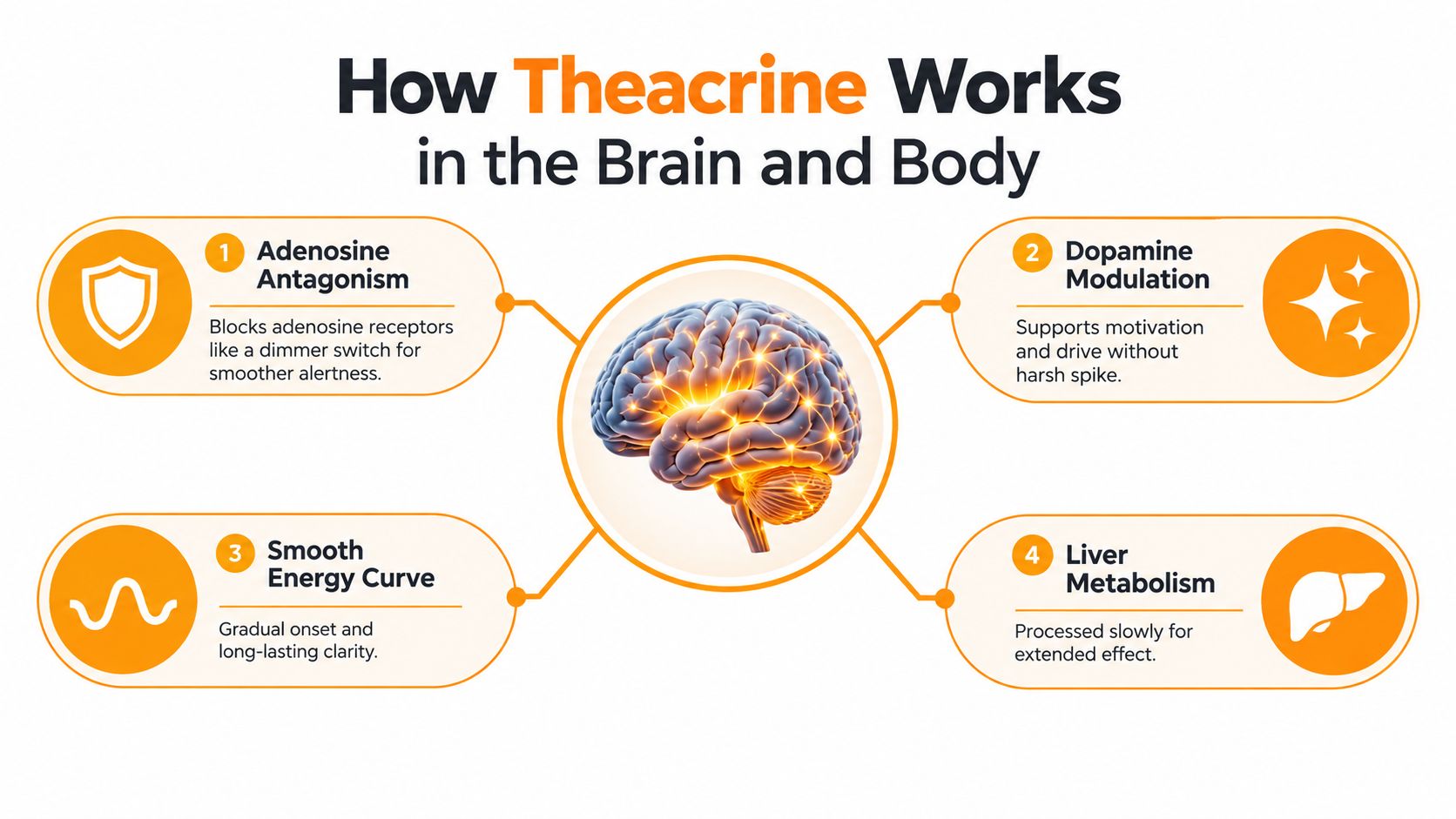
The simplest useful model starts with adenosine, a chemical signal that accumulates with wakefulness and contributes to sleep pressure. Caffeine blocks adenosine receptors, reducing the brain's ability to register that pressure for a time. Theacrine appears to have overlapping adenosine-related activity, but the precise receptor mechanism in humans isn't established well enough to describe it as a fully mapped process.
A dimmer switch offers a better analogy than an on/off button. Caffeine can feel like a rapid increase in brightness for some users. Theacrine may feel more gradual or less forceful, although individual responses vary and the evidence doesn't prove a universal “smooth curve.” The sensation depends on dose, baseline fatigue, caffeine intake, food, sleep, and the delivery format.
From alertness to motivation
Dopamine also enters the discussion, but claims need careful wording. Early research indicates that dopamine signaling contributes to theacrine's stimulant-like effects, yet that doesn't demonstrate that theacrine directly stimulates dopamine receptors in humans. A reasonable plain-language interpretation is that the compound may influence pathways linked with motivation and drive, while the exact pharmacology remains incomplete.
The practical result is a distinction between feeling ready to work and performing better on a task. A person may report more energy or willingness to begin a difficult assignment without producing a measurable improvement in reaction time or accuracy. That difference is central to judging theacrine fairly.
Why delivery changes the experience
A capsule travels through the digestive system before its contents become available for absorption. A buccal pouch holds ingredients against the tissues inside the mouth, so the product experience can differ in onset and consistency. That doesn't automatically make a pouch more effective, and product-specific delivery claims need product-specific evidence. It does mean that a person shouldn't assume a capsule dose and a pouch dose will feel identical.
Formulation details such as micronization and pH can affect how a product is designed to release and absorb its active ingredients. The practical lesson is simple: theacrine isn't experienced in isolation from its delivery system. A slow capsule taken with food may feel different from an oral pouch used during the first hour of a shift.
A long residence in the body also makes timing important. The available pharmacokinetic research is small, and individual variation is substantial, so late-day dosing can remain relevant even when the initial sensation seems mild. Theacrine and caffeine can also interact, with caffeine potentially increasing theacrine exposure. A clinical medical reference discusses the interaction and practical safety uncertainties.
For a visual explanation of the compound's proposed pathways, the following video can complement the written model:
Key Benefits Energy Focus and Tolerance Profile
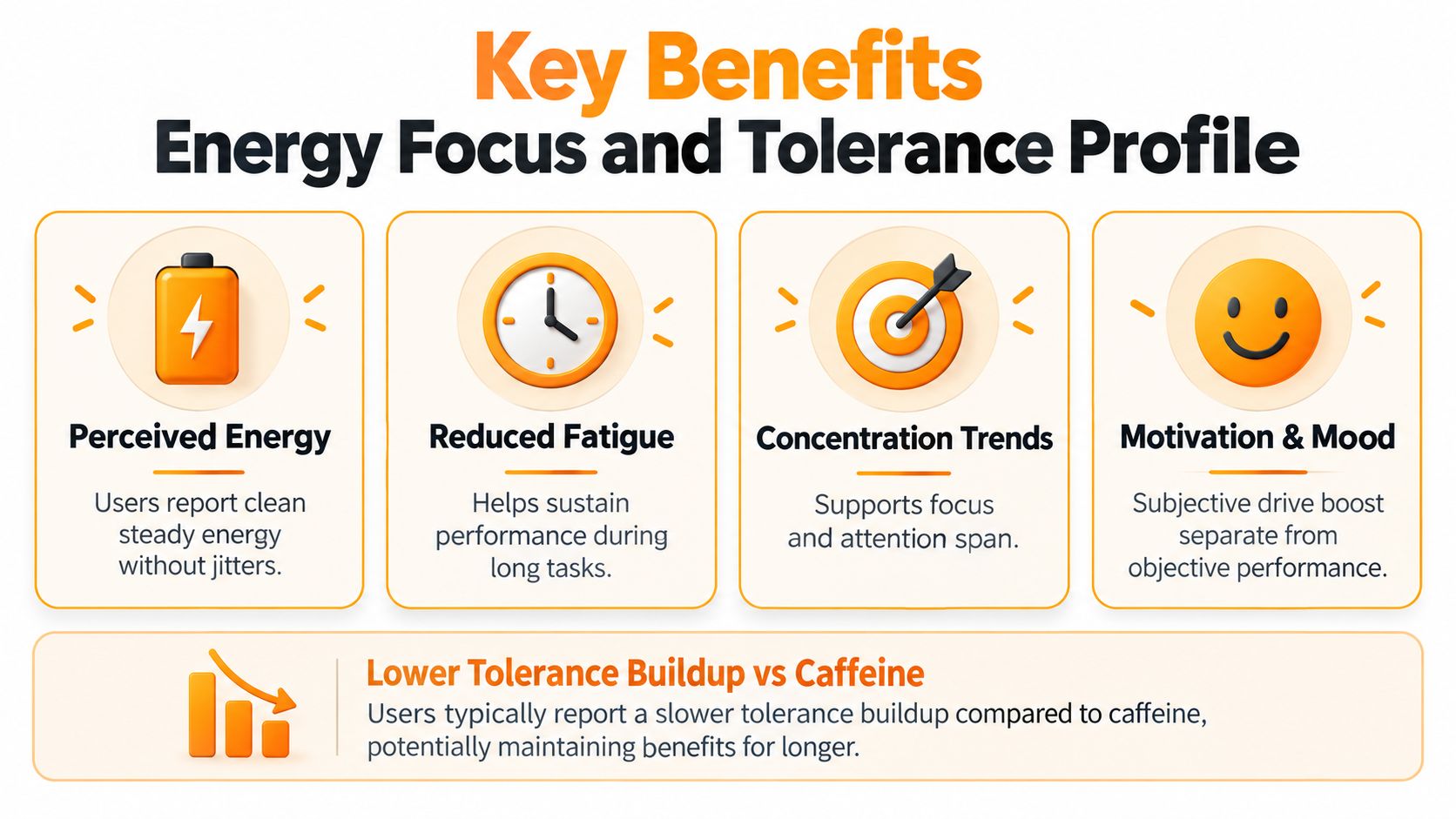
The strongest human signal for theacrine is subjective experience. In an early randomized, placebo-controlled, double-blind crossover study involving 15 participants, a 200 mg dose improved self-reported energy by 8.6%, compared with a 5.7% decline with placebo, and reduced fatigue by 6.7%, compared with a 5.8% increase with placebo. The study also reported a trend toward better concentration. The research record is available through the patent publication.
A separate double-blind crossover pilot study reported the same energy and fatigue figures for a single 200 mg TeaCrine dose, alongside a positive trend for concentration. A small repeated-dose subset also reported moderate-to-large effect sizes across subjective energy, fatigue, concentration, anxiety, exercise motivation, and libido over 7 days. These outcomes describe how participants felt, not proof that theacrine reliably improves objective work or athletic performance. The pilot study is published in the Journal of the International Society of Sports Nutrition.
Perceived energy isn't proven performance
A person can feel more alert without scoring better on a reaction-time test. That distinction prevents a common error in supplement writing, where a self-reported lift becomes a claim about cognition, productivity, or physical output.
The neutral evidence review cited earlier describes theacrine evidence as weak and says current human data don't justify positioning it as a dependable substitute for energy, focus, or exercise output. A 2022 controlled trial also found that its findings didn't support improved physical performance. Those limitations don't erase the subjective energy findings, but they narrow the claim that responsible educators should make.
Core takeaway: Theacrine's most defensible benefit is a possible change in perceived energy and fatigue. Improved objective performance remains unsettled.
Why tolerance attracts daily users
The tolerance finding is more distinctive. In the 8-week study of 60 healthy adults, participants taking 200 mg or 300 mg per day didn't show evidence of habituation or tachyphylaxis, and the study reported no clinically significant safety changes in heart rate, blood pressure, or blood chemistry. The result is encouraging for people who dislike the cycle of increasing caffeine intake, but it doesn't prove that every user will experience the same response indefinitely.
Shift workers may care about this difference because their schedule can already make energy management difficult. A compound that feels less prone to losing its perceived effect could support a more deliberate routine, provided the person still tracks sleep, anxiety, gastrointestinal comfort, and total stimulant exposure. For readers building a broader concentration routine, practical flow state techniques for focus can matter as much as the supplement itself.
Theacrine vs Caffeine and Other Stimulants Compared
Theacrine and caffeine shouldn't be treated as contestants in a simple winner-takes-all comparison. Caffeine has a deeper human evidence base for alertness and several performance outcomes. Theacrine attracts attention because its subjective profile and tolerance findings may differ, particularly for users who want longer coverage without repeatedly increasing caffeine.
| Feature | Theacrine | Caffeine |
|---|---|---|
| Primary practical appeal | Potentially steady subjective energy and a different tolerance profile | Faster, more familiar alertness |
| Onset | May feel gradual, with delivery format affecting the experience | Often more noticeable sooner, depending on dose and individual response |
| Duration | Can persist for a long period, so timing deserves attention | Usually experienced as a shorter stimulation window |
| Tolerance evidence | No habituation or tachyphylaxis was reported during the studied 8-week trial | Regular users commonly report reduced perceived effect over time |
| Cardiovascular findings | No clinically significant changes were reported in the main human safety study at studied doses | Sensitive users may experience unwanted stimulation |
| Objective performance | Evidence remains weak and mixed | Stronger evidence exists for several alertness and performance outcomes |
| Main caution | Long-lasting exposure, limited long-term data, and caffeine interaction | Jitters, sleep disruption, and tolerance for some users |
Matching the compound to the job
A fast start before an urgent task often favors caffeine, especially for someone who already knows how they respond. A longer, less forceful daytime routine may make theacrine worth considering, either alone or alongside a modest caffeine amount. Evening workers face a harder calculation because the absence of an early buzz doesn't guarantee that a long-lasting compound won't affect later sleep.
Theobromine and synthetic nootropics add more complexity rather than a clear answer. They can differ in onset, duration, mechanism, and evidence quality, so placing them in one broad “stimulant” category hides important distinctions. A label comparison should identify the active ingredients, total caffeine, delivery route, and intended timing instead of relying on a single marketing word.
People comparing formulations can review theacrine and caffeine differences in more detail, then use a personal decision rule:
- Choose caffeine alone when rapid, familiar alertness is the main goal and tolerance or sleep disruption isn't a current problem.
- Consider theacrine alone when a person wants to test subjective energy without adding more caffeine.
- Consider a combination cautiously when the person understands that caffeine may increase theacrine exposure and accepts the need for lower starting amounts.
- Avoid chasing a performance claim when the actual goal is exercise output, because theacrine's evidence in that area remains unconvincing.
The most useful comparison isn't “which stimulant wins?” It's “which response does the person need, and what tradeoff can the schedule tolerate?”
Dosage Safety and Smart Stacking Strategies
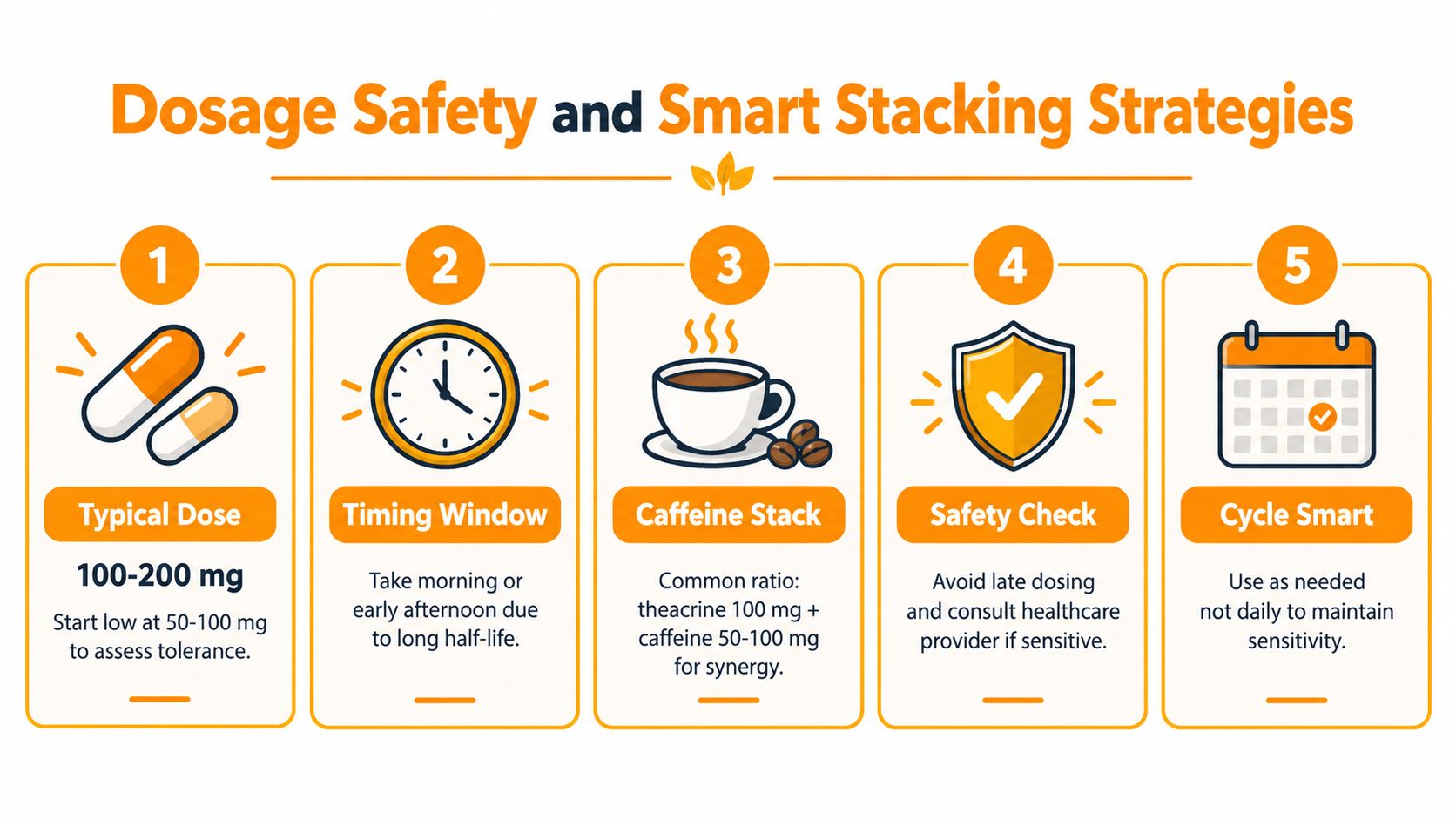
Research doesn't establish one universal dose for every person, product, or delivery system. Human studies have centered on 200 mg and 300 mg per day, while practical formulations may use less, particularly when theacrine is combined with caffeine or delivered through a pouch. The sensible approach is to start below the intended target, assess the response on a normal workday, and avoid adding several new stimulants at once.
A cautious setup
A basic protocol can follow this sequence:
- Read the complete label. Identify theacrine, caffeine, tea extracts, synthetic stimulants, and any ingredients that may affect sleep or medication response.
- Start with a low exposure. A person who is sensitive to caffeine, has irregular sleep, or has never used theacrine should avoid beginning at the highest labeled amount.
- Use it early enough to observe the full day. Theacrine may remain present well after the initial sensation fades, so late dosing deserves more caution than a short-lived energy boost.
- Change one variable at a time. If caffeine, L-theanine, or a delivery format changes together, the user won't know which factor caused a benefit or side effect.
- Track sleep and discomfort. Insomnia, nervousness, gastrointestinal discomfort, and an unusual increase in heart rate or blood pressure are reasons to stop and reassess.
Why stacking changes the calculation
Caffeine and theacrine may feel complementary, but combining them isn't a free smoothing mechanism. Neutral safety guidance warns that caffeine may increase theacrine levels, which can raise the likelihood of unwanted effects. A smaller combined dose may therefore be more appropriate than taking a full amount of each ingredient.
L-theanine is often paired with caffeine to support a calmer subjective experience. A frequently used formulation principle is a 2 to 1 L-theanine-to-caffeine ratio, but that ratio is a design convention, not a guarantee of safety or focus for every user. Theacrine can change the duration and perceived shape of the stack, so a person should evaluate the entire formula rather than isolate one ratio.
Buccal pouches versus capsules
Buccal delivery can be useful for adherence because a pouch is portable, discreet, and doesn't require water. It may also produce a different onset from a capsule, particularly when the formulation is designed around oral absorption, pH, and particle size. That difference makes it even more important to follow the product label rather than transfer a capsule dose directly to a pouch.
A person with cardiovascular conditions, pregnancy or breastfeeding concerns, medication questions, pronounced caffeine sensitivity, or a history of insomnia should consult a qualified healthcare professional before experimenting. The main human safety evidence supports studied use only through 8 weeks and up to 300 mg per day, so long-term daily use isn't an established fact. A practical review of theacrine and caffeine combination considerations is available here.
Real World Use Cases From Shifts to Deep Work
A paramedic starting an early shift may want a portable option that doesn't require carrying another coffee. A developer beginning a demanding block of code may prefer a less abrupt sensation than an energy drink. A former nicotine-pouch user may care less about a dramatic stimulant effect and more about preserving a familiar oral routine without nicotine.

Three schedules, three decisions
Frontline shift performer: A nurse, firefighter, or security worker can anchor any stimulant-containing product near the beginning of the active shift, then avoid repeating it close to the planned sleep period. A pouch may be easier to use during a short break than a capsule that requires water, but convenience shouldn't encourage automatic redosing.
Focused professional: A designer or analyst can test theacrine during a defined deep-work block rather than using it as background stimulation all day. Pairing the supplement with blocked notifications, a clear task list, and deliberate breaks gives the perceived energy a job to support. A practical guide to improving focus at work can help build that non-supplement structure.
Nicotine-free pouch switcher: Someone leaving nicotine pouches may value the hand-to-mouth and oral placement ritual. A nicotine-free pouch can preserve part of that routine, but it doesn't reproduce nicotine's pharmacology and shouldn't be marketed as a withdrawal treatment.
Biohackers, gamers, and creators
Biohackers often test ingredients systematically, but the same discipline applies to a gamer or streamer preparing for a long session. The person can define the desired outcome, use one consistent timing point, record sleep and subjective energy, and avoid interpreting a productive feeling as proof of faster reaction time.
A three-stage day can be useful as a behavioral framework:
- Morning activation: Use the least complicated stimulant routine early, with food, hydration, and a clear stop point.
- Daytime flow: Reserve any second exposure for a defined work need, not automatic habit.
- Evening wind-down: Stop stimulant experimentation early enough to protect the next sleep period, especially when the compound may last well beyond the initial feeling.
Theacrine may fit one of these schedules, but the schedule determines whether its duration is helpful or inconvenient. A pouch improves portability and ritual consistency, while a capsule may suit someone who prefers a slower, more familiar supplement routine.
Choosing Your Theacrine Approach and Next Steps
The most defensible choice begins with the goal. Someone seeking a rapid lift may prefer caffeine. Someone testing smoother subjective energy may trial theacrine alone. Someone combining both should use a conservative total stimulant plan because caffeine may increase theacrine exposure.
A one-week experiment can stay simple:
- Define the outcome: perceived energy, fatigue, focus, or ease of starting work.
- Keep the timing consistent: use the same part of the day rather than comparing random doses.
- Track unwanted effects: sleep quality, nervousness, stomach discomfort, and unusual cardiovascular sensations.
- Don't add multiple new products: a clean test produces more useful information.
- Pause when the result is negative: no supplement deserves priority over sleep or medical safety.
People who want a broader framework can review responsible approaches to stacking energy supplements, but a larger stack doesn't automatically create a better outcome. Theacrine remains promising for perceived energy and tolerance management, yet its evidence for objective cognition and physical performance needs stronger, independent replication.
Optimal Native offers nicotine-free oral pouches built around morning energy, daytime focus, and evening recovery, including theacrine-containing daytime options and a separate wind-down formula. Readers considering a timed delivery routine can visit Optimal Native to compare the available products and choose a schedule that matches their shift, focus block, and sleep window.
Optimal Native's nicotine-free pouch system gives shift workers, focused professionals, and former nicotine users a practical way to organize daytime energy and evening recovery without relying on nicotine. Visit Optimal Native to explore the three-stage protocol and find the pouch format that fits the day.