

Theacrine and Caffeine Together: A 2026 Stack Guide
At 2 p.m., a knowledge worker may have already finished two cups of coffee and still face four demanding hours of calls, analysis, or deep work. Another coffee can bring a sharper pulse, restless attention, or the familiar feeling of being stimulated without being productive. That tension explains why theacrine and caffeine together have attracted interest among supplement users, shift workers, gamers, and high-output professionals.
Theacrine is a caffeine-related alkaloid associated with kucha tea and Camellia assamica. It now appears in pre-workouts, nootropic blends, and focus products. The proposed appeal is straightforward: caffeine supplies a noticeable lift, while theacrine may provide a longer, less abrupt stimulant profile. The evidence is promising in places, but it remains limited, especially for repeated use during sleep restriction.
Table of Contents
- Why People Are Stacking Theacrine With Caffeine in 2026
- How Theacrine and Caffeine Work in Your Brain
- What the Pharmacokinetic Research Shows
- The Tolerance and Stimulation Smoothness Question
- Smart Dosing for a Theacrine and Caffeine Stack
- Safety, Side Effects, and Honest Limitations
- Building a Day-Long Energy Protocol Around the Stack
- Practical Questions Answered Before You Try It
Why People Are Stacking Theacrine With Caffeine in 2026
At the start of a long shift, caffeine can make the first hours feel manageable. By afternoon, another serving may bring restlessness instead of useful focus. That experience has encouraged supplement users, shift workers, gamers, and high-output professionals to pair caffeine with theacrine, hoping to support alertness without increasing caffeine exposure.
Theacrine is a methylxanthine-related compound associated with kucha tea and Camellia assamica. Caffeine remains the familiar, faster-acting stimulant. Theacrine is usually presented as a slower, longer-lasting companion. For someone handling overnight work, a demanding project, or extended gaming, the appeal is a different time profile rather than a promise of unlimited energy.
The promise and the evidence
Early human pharmacokinetic work is examined in detail below. In that acute research, combining the compounds changed some theacrine exposure measures without producing a clear change in caffeine handling or theacrine's half-life. The tested doses also did not produce meaningful heart-rate or blood-pressure changes in that small, short-term setting. Those findings describe immediate pharmacokinetics, not long-term safety during repeated use or sleep loss.
Later studies tested theacrine within a broader performance formula rather than as an isolated ingredient. A crossover trial in 50 young male gamers used 125 mg caffeine, 75 mg Dynamine, and 50 mg TeaCrine, and reported improvements in cognition and vigilance outcomes (crossover trial in male gamers). A separate placebo-controlled study in 50 young male eGamers assessed the same formula and reported effects involving reaction time, attention, and sustained alertness (eGamer performance study).
These results help explain the interest, but they leave practical gaps. The formulas included other stimulatory ingredients, and the participants do not represent every shift worker or sleep-deprived professional. Acute trials can show what happens during one test session. An eight-week study, where available, still cannot establish what happens after years of stacking, especially when sleep debt is treated as something to work around.
The useful questions are therefore concrete: how do the compounds differ, what does the pharmacokinetic evidence show, and does the combination feel smoother without encouraging more stimulation? Theacrine may complement caffeine, but it does not erase caffeine's risks, replace sleep, or prove long-term safety.
How Theacrine and Caffeine Work in Your Brain
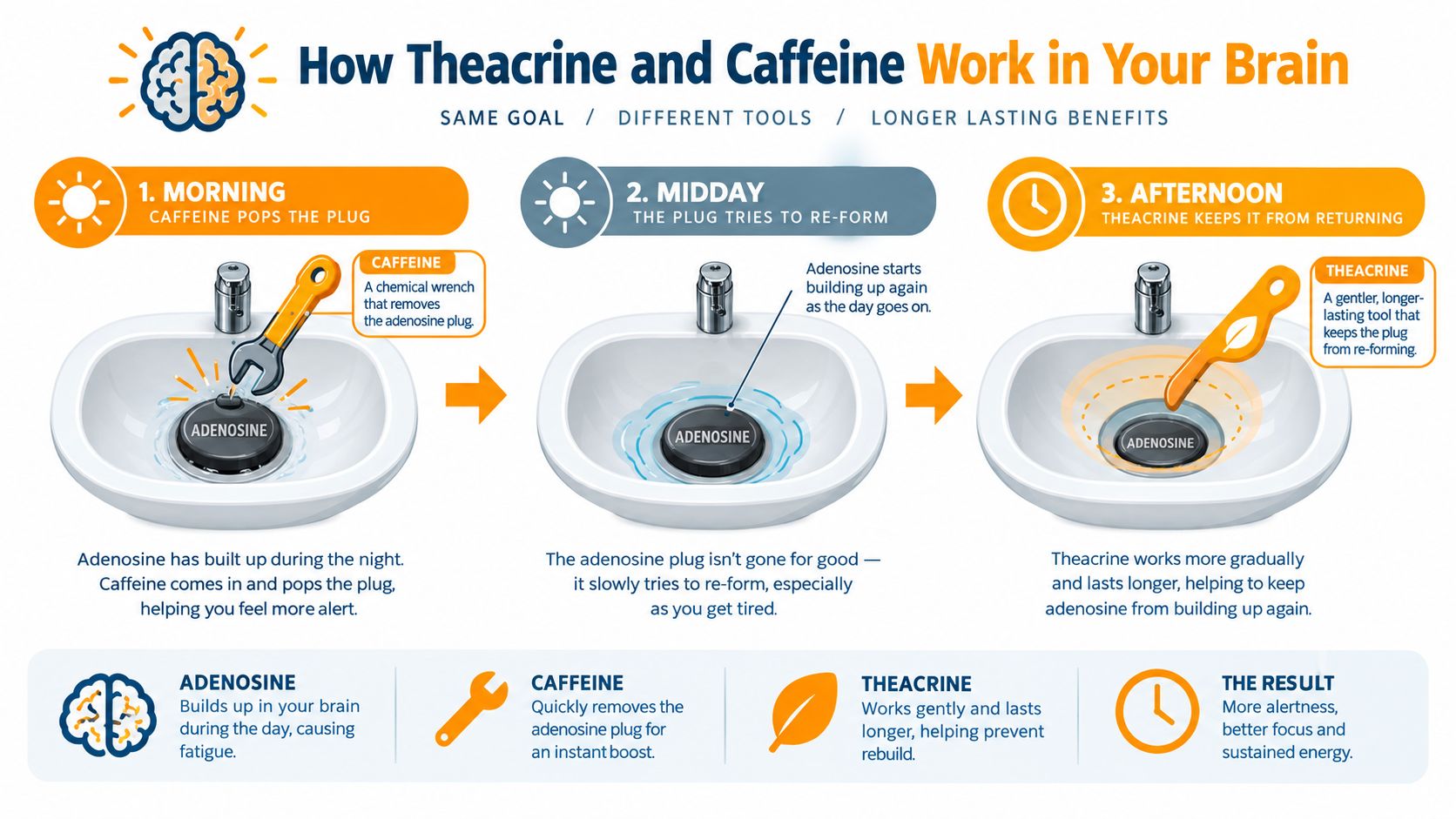
A useful analogy starts with a sink. During the day, adenosine acts like a slow-draining plug that gradually contributes to the sensation of fatigue. Caffeine works like a chemical wrench that pops the plug out of the way, so the brain's sleepiness signal becomes less prominent for a while.
Caffeine is a competitive antagonist at the A1 and A2A adenosine receptors. In plain language, it occupies receptor sites that adenosine would otherwise use. This blockade can indirectly influence alertness-related signaling involving dopamine and norepinephrine. For readers interested in how coffee chemistry shapes everyday stimulation, a specialty coffee showdown 2026 provides useful context about the beverage source, though coffee choice doesn't determine the entire pharmacology of a supplement stack.
Theacrine is often described as a methylxanthine cousin of caffeine, chemically known as 1,3,7,9-tetramethyluric acid. It also interacts with adenosine-related pathways, but its receptor profile and time course differ. Research discussions commonly focus on effects involving A1 and A2A receptors, dopamine D1 and D2 modulation, and mild A2B signaling. Those mechanisms are more complicated than the simple “caffeine plus caffeine” description suggests.
Where the compounds overlap
Both compounds can reduce the functional impact of adenosine-driven fatigue, so their effects may overlap. Caffeine tends to feel more immediate, while theacrine is generally discussed as producing a flatter, more extended activity curve. The extra methyl group changes the molecule's behavior, but it doesn't automatically make theacrine stronger or safer.
A practical explanation of the stack is therefore not “two identical stimulants.” Caffeine helps create the early lift, and theacrine may help support a steadier background of alertness. The detailed ingredient background is covered in this guide to what theacrine is, including its identity and common supplement context.
Together, they can raise baseline alertness through overlapping adenosine-related mechanisms while theacrine may smooth the sharper curve associated with caffeine alone. That is a plausible formulation rationale, not a guarantee that every user will experience a calm or crash-free result.
What the Pharmacokinetic Research Shows
A small human pharmacokinetic study offers the clearest direct test of combining these compounds. In the 2017 randomized, double-blind, four-arm crossover study in eight healthy adults, participants received theacrine at 25 mg and 125 mg, caffeine at 150 mg, and a combination of 125 mg theacrine plus 150 mg caffeine (the full 2017 study).
The main result concerned drug exposure rather than a dramatic cardiovascular response. Caffeine raised theacrine's maximum plasma concentration and area under the curve. In practical terms, participants showed a higher observed theacrine peak and greater overall exposure when the two were taken together. Theacrine did not alter caffeine or paraxanthine pharmacokinetics, and the tested doses produced no meaningful changes in heart rate or blood pressure.
A careful reading of the data
| Parameter | Theacrine | Caffeine |
|---|---|---|
| Tested combination | 125 mg | 150 mg |
| Interaction observed | Caffeine increased maximum plasma concentration and overall exposure | Theacrine didn't alter caffeine or paraxanthine pharmacokinetics |
| Half-life interaction | Caffeine didn't change theacrine half-life | No theacrine-driven change reported |
| Acute cardiovascular result | No meaningful heart-rate or blood-pressure changes at tested doses | No meaningful heart-rate or blood-pressure changes at tested doses |
The findings describe one acute experiment in healthy adults. They do not establish universal safety, prove a stronger subjective effect, or show that combining the compounds prevents a later crash. Blood concentration is only one part of the experience. Receptor activity, brain distribution, metabolism, personal sensitivity, sleep status, and expectations can all shape how the same serving feels.
That distinction matters for shift workers and high-output routines. A higher theacrine exposure could affect how long the combination remains relevant during a long work period, but the study does not test repeated dosing across a shift, sleep debt, or performance after several poor nights. It also does not show what happens when the stack is used every day.
The study provides early controlled evidence that the compounds could be coadministered without obvious acute cardiovascular disruption in healthy volunteers, while caffeine increased theacrine exposure. Its small sample, single-dose design, and lack of a chronic arm limit the conclusion. The data should guide cautious experimentation, not function as a long-term safety certificate.
The Tolerance and Stimulation Smoothness Question
A morning shift can begin with caffeine feeling sharp, then end with the same serving barely covering fatigue. That pattern reflects adaptation, not proof that theacrine will prevent it. Repeated caffeine use can reduce the noticeable effect of adenosine-receptor blockade, encouraging some users to increase intake or treat caffeine as maintenance.
Theacrine has a different evidence profile. In a separate repeat-dose study, theacrine did not show clear habituation or withdrawal across an eight-week period. That finding is informative, but it does not establish that a daily theacrine-and-caffeine stack prevents tolerance. Caffeine remains caffeine, even when theacrine is present.
Why the experience can differ
Caffeine may arrive as the faster signal, while theacrine may contribute a longer, flatter background. That combination could feel like cleaner focus, fewer jitters, or a less abrupt decline for some users. Others may experience more stimulation, especially after adding the stack to coffee, tea, energy drinks, or pre-workout products.
The gamer studies add performance context without answering the long-term tolerance question. One compared 125 mg caffeine alone with 125 mg caffeine, 75 mg Dynamine, and 50 mg TeaCrine, using one-week washouts between sessions. Both that stack and 300 mg caffeine alone improved cognitive performance before and after fatiguing exercise in the controlled trial. A separate eGamer study found better reaction-time and attention-related outcomes with the caffeine, Dynamine, and TeaCrine formula than with caffeine alone and placebo. These acute results do not test daily stacking during sleep debt or repeated night shifts.
| Attribute | Caffeine Alone | Theacrine + Caffeine |
|---|---|---|
| Early sensation | Often more noticeable and rapid | May feel less abrupt for some users |
| Tolerance concern | Caffeine habituation remains relevant | Theacrine does not remove caffeine habituation |
| Evidence setting | Broad everyday familiarity | Human research is more limited and formula-specific |
| Personal variability | Sensitivity differs widely | Response still differs widely |
“Smoother” can describe duration, subjective sensation, or metabolism. Those are different ideas, as this discussion of a paraxanthine smoother energy boost explains. A planned caffeine tolerance reset may address caffeine adaptation, but it does not make theacrine unnecessary or prove that long-term stacking remains comfortable. For high-output routines, the practical question is whether the extra stimulation supports work without borrowing further from sleep. Acute studies and an eight-week theacrine study cannot answer that under sustained sleep loss.
Smart Dosing for a Theacrine and Caffeine Stack
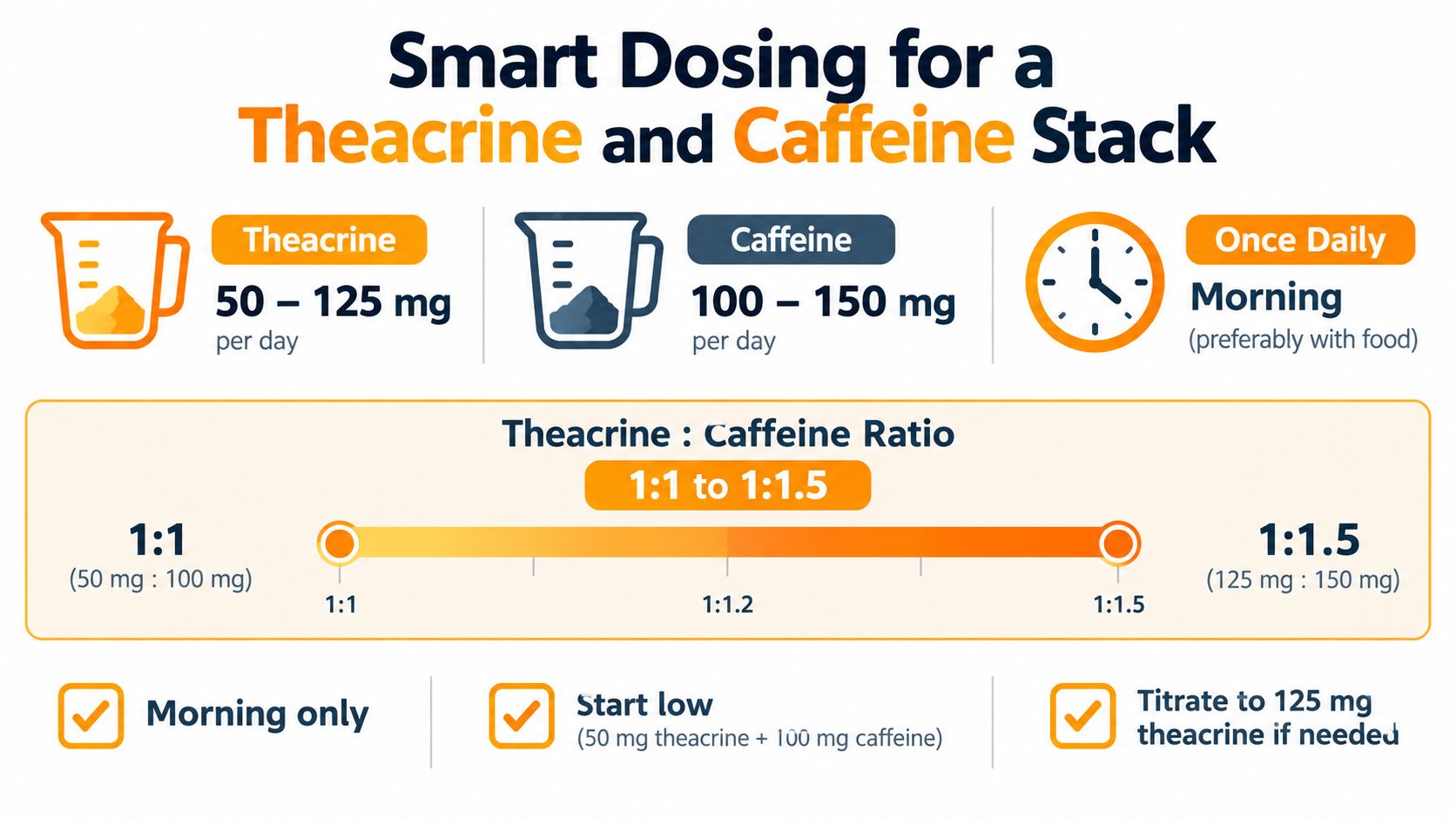
A first trial should answer one practical question: does the combination support your work without disturbing the following night? Human studies provide a starting range, not a universal prescription. As tested in the studies summarized above, that range is 50 to 125 mg theacrine paired with 100 to 150 mg caffeine, generally taken once in the morning. The gamer studies used 50 mg TeaCrine with 125 mg caffeine, while the earlier pharmacokinetic study used 125 mg theacrine with 150 mg caffeine.
A useful way to apply those findings is to begin with the lower tested amounts, then change only one variable at a time. Someone trying the stack for an early shift could use 50 mg theacrine plus 100 mg caffeine, record alertness, anxiety, headache, and bedtime, and avoid adding another stimulant during that trial.
A conservative operating plan
- Start with less: Use the lower-entry format before considering the higher amounts tested in research.
- Use the morning window: A single morning serving makes effects easier to interpret and limits the chance that persistent stimulation affects the evening.
- Keep theacrine stable: If a second serving is considered, a smaller theacrine-only or low-caffeine adjustment is easier to evaluate than escalating both ingredients repeatedly.
- Respect sleep: Theacrine's persistence means its effects may remain relevant after the noticeable lift fades.
- Skip under strain: Poor sleep, high anxiety, dehydration, or an unusually intense training session can make a new stack harder to assess safely.
Track total caffeine, not only the amount printed on the stack label. For example, 100 mg caffeine from the stack plus coffee and a caffeine pouch all belong in the same daily calculation. If the coffee supplies more caffeine than expected, the combined intake can exceed your planned trial even though the theacrine dose stayed unchanged. The guide to how many milligrams of caffeine is too much can help identify less obvious sources.
Food may improve tolerability for people who experience stomach discomfort, while hydration helps distinguish headache or fatigue from simple fluid needs. L-theanine is sometimes paired with caffeine for a calmer subjective profile, but its amount is an individual experiment, not a required part of this stack.
The graphic is a visual summary, not a substitute for reading the label. Products can use different forms, extraction standards, or added stimulants, so assess the complete formula rather than viewing the theacrine and caffeine amounts in isolation.
Safety, Side Effects, and Honest Limitations
Two stimulants don't automatically equal double the risk, but the combination does create a more complicated exposure pattern. In the acute human study, the tested theacrine and caffeine doses didn't produce meaningful changes in heart rate or blood pressure in healthy adults (acute cardiovascular and subjective-feeling study).
That finding is reassuring within its boundaries. It doesn't describe people with cardiovascular disease, uncontrolled hypertension, panic symptoms, pregnancy, medication interactions, severe sleep deprivation, or high baseline stimulant intake. It also doesn't show what happens when the combination is repeated daily for months.
What remains unknown
The evidence gap is especially relevant to frontline and high-output users. A nurse working irregular shifts, a first responder finishing a long overnight duty period, or an executive traveling across time zones may use stimulants under conditions that differ sharply from a rested volunteer in an acute trial.
The main unanswered questions involve:
- Repeated stacking: Published human evidence is mostly short-term, and the separate eight-week theacrine repeat-dose evidence doesn't fully answer how the combination behaves during chronic use.
- Sleep debt: There isn't enough evidence to define the effects of stacking while someone is already sleep-restricted.
- Multiple stimulants: The combination hasn't been adequately characterized alongside ingredients such as synephrine or yohimbine.
- Higher-risk groups: Evidence is insufficient for pregnant people, cardiac populations, and many medication combinations.
Possible mild complaints include stomach upset, headache, nervousness, or sleep disruption. A headache after a long work block may reflect low fluid intake, inadequate food, sleep loss, or excessive stimulant exposure, so symptoms shouldn't automatically be blamed on one ingredient.
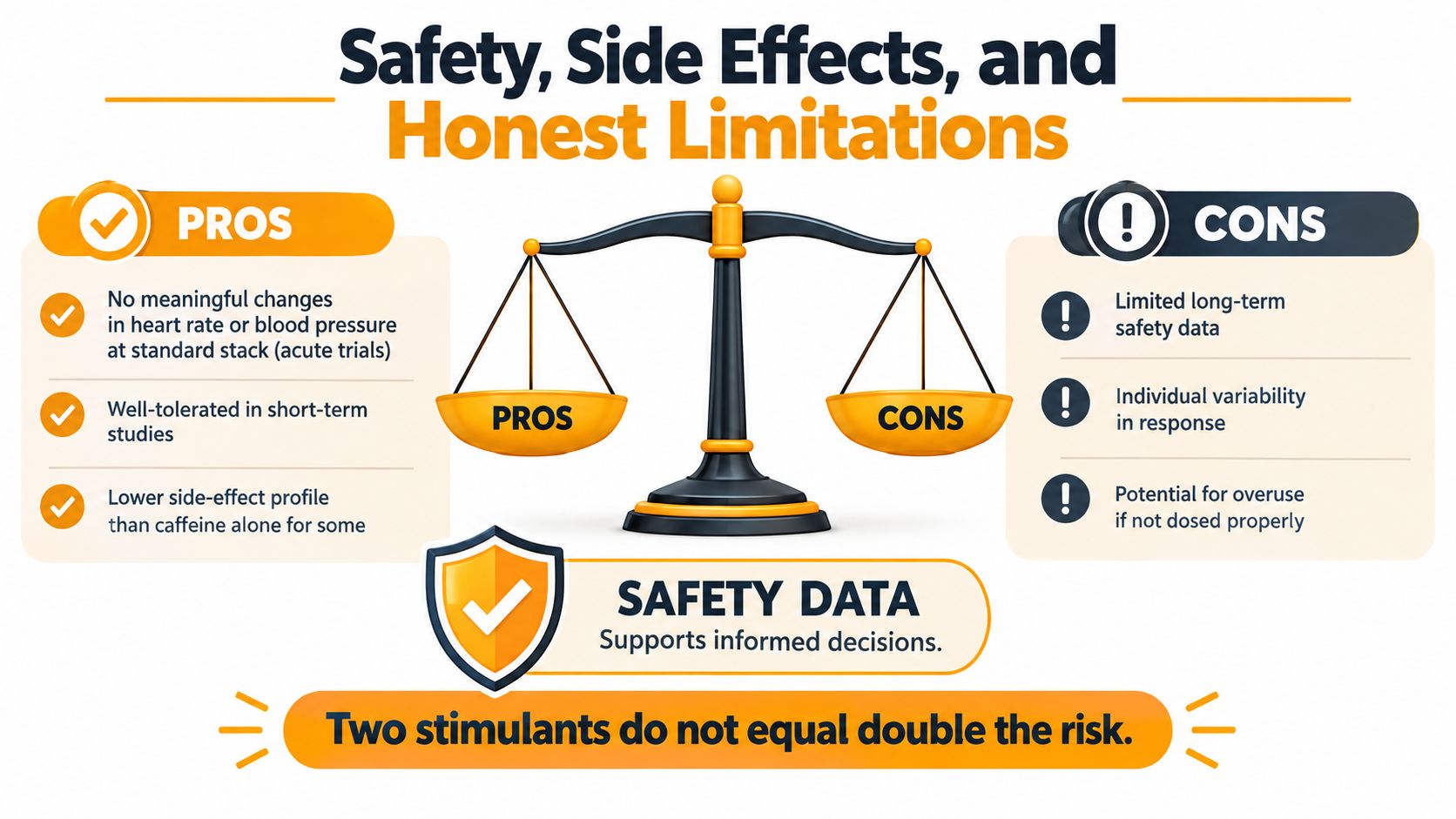
Safety rule: Anyone with uncontrolled hypertension, a significant heart condition, pregnancy, severe anxiety, or stimulant medication use should seek clinical guidance before experimenting with this combination.
Readers who are also evaluating non-stimulant cognitive ingredients should keep categories separate. For example, a lion's mane dosage for adults discussion concerns a different supplement question and shouldn't be used to infer safety or dosing for theacrine and caffeine. Ingredient familiarity doesn't eliminate interaction risk.
Building a Day-Long Energy Protocol Around the Stack
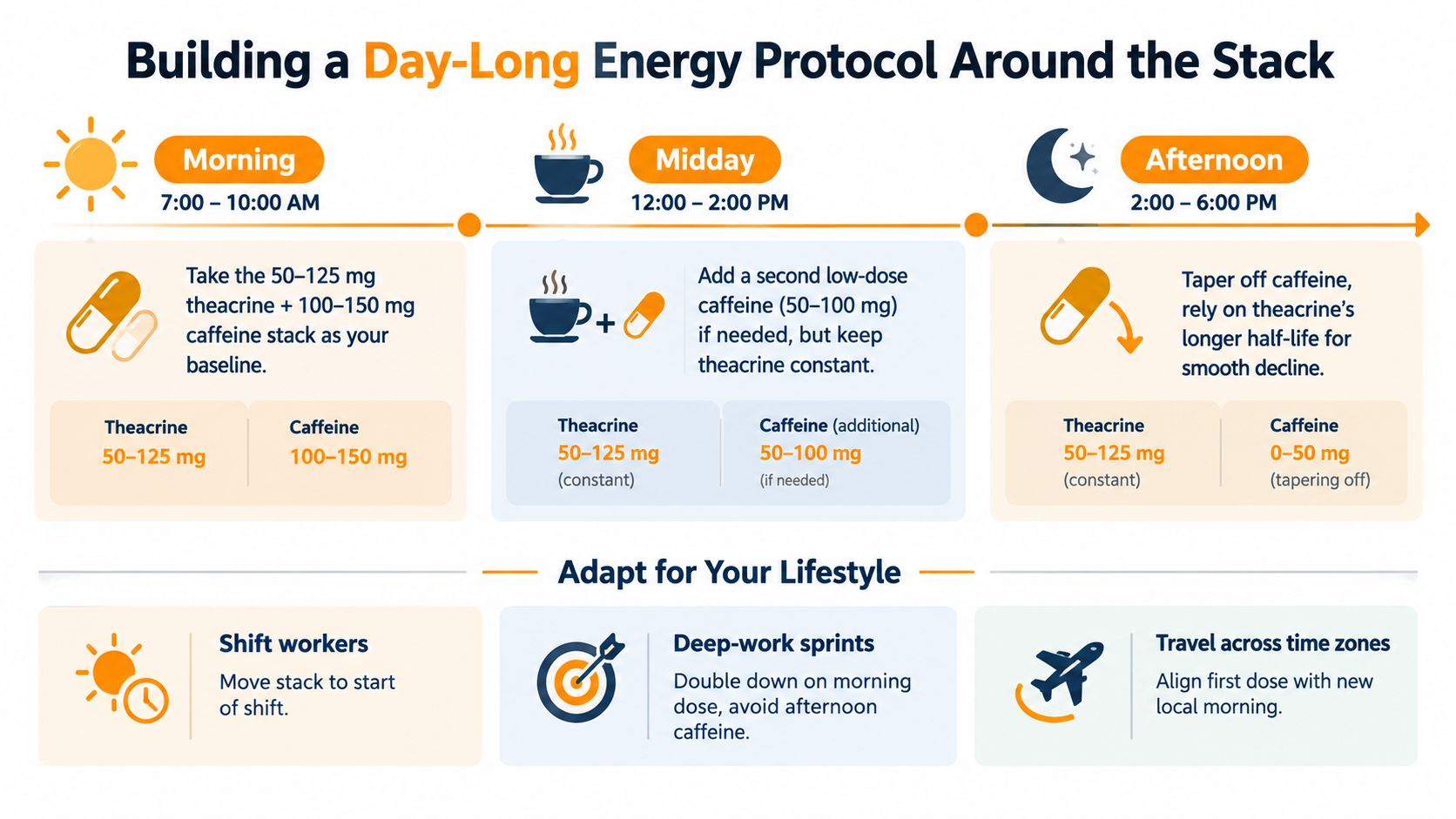
A long workday works better when the stack follows a schedule instead of reacting to every energy dip. Caffeine can provide the earlier lift, while theacrine may contribute to a more persistent effect. The aim is a defined period of support, not stimulation that continues from waking until bedtime.
For a morning worker, a hypothetical 6:30 a.m. serving of 100 mg caffeine plus 75 mg theacrine with a protein-rich breakfast falls within the studied ingredient ranges. The 2017 pharmacokinetic study summarized above can inform the timing logic, but it does not establish that this exact routine suits every person. Use the first serving before meetings, analysis, training, or another demanding block, then judge the day by concentration and later sleep rather than by intensity alone.
One protocol, several schedules
- Morning deep work: Take the primary serving after waking. Add food, water, daylight, and movement before considering another stimulant.
- Midmorning focus: If attention fades while alertness remains adequate, check for dehydration, boredom, or frequent task switching first. A longer-lasting theacrine component makes an automatic second dose less sensible.
- Early afternoon: Try a meal, hydration, or a short walk before adding caffeine. A cutoff around 2 p.m. is a conservative behavioral rule, not a clinical standard.
- Night shift: Set the primary serving relative to the shift's start, not a conventional daytime clock. Plan the work block around the expected effect, and avoid redosing because the shift has become repetitive.
- Travel: Anchor the first dose to the new local waking period. Repeated doses taken to chase each time-zone dip can turn a schedule problem into an intake problem.
Shift workers can also use environmental cues to make the protocol more predictable. Brighter light and movement may support alertness during the intended work period, while a darker, quieter wind-down routine can help mark the transition out of it. Melatonin timing and the available sleep window require individual planning, so the research does not provide a universal night-shift schedule.
Keep a simple log of total caffeine, serving times, task demands, sleep quality, anxiety, and blood-pressure concerns. High-output users should define success as productive work followed by a usable recovery period, not merely a longer-feeling afternoon.
Practical Questions Answered Before You Try It
When should the stack be taken? Start after waking, preferably early enough to observe how it affects the rest of the day. A light meal may improve comfort if stimulants feel harsh on an empty stomach. Add coffee, tea, energy drinks, and pre-workout products to the same caffeine total.
Does L-theanine belong in the formula? L-theanine is often paired with caffeine for a calmer subjective experience. You can assess it as a separate part of the formula, but its presence does not prove that theacrine is safer, more effective, or free from tolerance concerns.
Should users cycle the stack? A planned break can show whether caffeine still improves performance and whether sleep quality is shifting. Evidence from separate theacrine research does not establish the safety of chronic combined use, particularly during ongoing sleep loss.
Who should avoid it? People with uncontrolled hypertension, anxiety disorders, pregnancy, significant cardiac concerns, or stimulant medication use should consult a clinician before experimenting. Anyone using medicines that may interact with stimulant metabolism should give the prescriber a complete list of supplements and caffeine sources.
The foundation still matters: No stimulant combination compensates for inadequate sleep, insufficient food, dehydration, or a work schedule that leaves no real recovery window.
For a first trial, use a low serving early in the waking period and avoid extra caffeine. Record the dose time, sleep latency that night, anxiety, resting or usual heart rate, palpitations, headache, and next-day energy for the following 24 hours. A useful response supports productive work without making recovery harder. If symptoms or sleep worsen, stop rather than increase the serving.
Optimal Native offers nicotine-free oral pouches combining caffeine, theacrine, L-theanine, and related daytime ingredients, including Morning Energy and Day Flow, plus an Evening Relax option for a separate wind-down routine. Readers can review the Optimal Native formulas and timing approach, then compare ingredient amounts with their coffee, supplements, and shift-work habits.