

Amount of Caffeine in Coffee vs Green Tea: Full Comparison
An 8 oz cup of brewed coffee typically delivers about 95 to 96 mg of caffeine, while the same size of green tea usually provides about 28 to 29 mg. That means the amount of caffeine in coffee vs green tea isn't a close contest on a standard serving basis. Coffee usually carries about 3.3 times the caffeine load per cup, but the story sits in dose per ounce, brew variability, and the effect profile created by tea's L-theanine.
Most articles stop at “coffee has more caffeine.” That's accurate, but it's not useful enough for someone holding a 14 oz travel mug, ordering a double shot, or trying to avoid a sharp caffeine spike during a long work block.
A better way to think about the amount of caffeine in coffee vs green tea is as an engineering problem. Start with mg per ounce, scale that to the actual vessel in hand, then ask a second question most comparisons ignore: how will that caffeine feel once it's in the body?
Table of Contents
- The Caffeine Numbers Most People Get Wrong
- Serving Size Benchmarks From Espresso to Tumbler
- What Drives Caffeine Levels in Each Cup
- Why Green Tea Feels Different From Coffee at Half the Dose
- Choosing Coffee or Green Tea for Common Scenarios
- Pouch and RTD Alternatives Worth Comparing
- A Practical Decision Rule for Your Daily Routine
The Caffeine Numbers Most People Get Wrong
A single ratio explains the baseline. Brewed coffee usually delivers about 95 to 96 mg per 8 oz, while green tea usually delivers about 28 to 29 mg per 8 oz, or roughly a 3.3 to 1 difference on equal volume, as summarized in Healthline's green tea vs coffee comparison.
Per-ounce math is the more useful unit.
| Beverage | Caffeine per 8 oz (mg) | Caffeine per oz (mg) | Ratio to green tea |
|---|---|---|---|
| Brewed coffee | 95–96 | about 12 | about 3.3x |
| Green tea | 28–29 | about 3.6 | 1x |
Those numbers change the question from “Which drink has more caffeine?” to “How many milligrams does this container deliver?” That shift matters because volume changes total intake faster than labels like cup, mug, or tumbler suggest.
Why per-ounce math beats average-cup advice
An 8 oz coffee works out to about 12 mg per ounce. An 8 oz green tea works out to about 3.6 mg per ounce. Scale either drink up, and the total dose rises linearly with the vessel size.
That is where casual caffeine comparisons usually break down.
Two errors show up repeatedly:
- Treating “a cup” as a fixed dose: Many home mugs and cafe servings exceed 8 oz, so total caffeine climbs even if brew strength stays similar.
- Mixing up concentration and intake: Espresso has higher concentration per ounce, but total caffeine still depends on the final number of ounces consumed, a distinction reflected in caffeine reference data from the USDA FoodData Central database.
Practical rule: Volume drives more day-to-day caffeine variation than serving size alone suggests.
The implication for real dosing
Coffee versus green tea is partly a concentration question and partly a formulation question. On caffeine alone, one standard coffee often approximates the intake from about three standard cups of green tea using the benchmark values above. In practice, though, the experience is not just caffeine multiplied by ounces. Green tea also contains L-theanine, which changes the perceived stimulation profile. That interaction matters later because equal milligrams do not always feel equal in a workday routine.
Serving Size Benchmarks From Espresso to Tumbler
A 20 oz tumbler can turn an ordinary caffeine choice into a very different dose. Using the working benchmarks established above, brewed coffee scales at about 12 mg per ounce and green tea at about 3.6 mg per ounce. That means vessel size matters more than the label on the drink for many daily-use decisions.
Published reference ranges support using a density-based estimate instead of a vague "cup" standard. Brewed coffee is commonly cited at 90 to 200 mg per 8-ounce cup, while green tea is often listed at 20 to 50 mg per 8 ounces. Standardized food composition comparisons point in the same direction, with filtered coffee around 45 mg per 100 mL and green tea around 15 mg per 100 mL, as summarized in Healthline's caffeine in tea vs coffee analysis.
| Serving size | Coffee caffeine (mg) | Green tea caffeine (mg) | Notes |
|---|---|---|---|
| 1 oz | about 12 | about 3.6 | Density benchmark only |
| 6 oz | about 72 | about 22 | Smaller home pour |
| 8 oz | 95–96 | 28–29 | Standard reference size |
| 12 oz | about 143 | about 43 | Common cafe serving |
| 16 oz | about 191 | about 58 | Large mug |
| 20 oz | about 239 | about 72 | Full tumbler |
How to scale any mug size
The math is simple and useful:
- Measure the drink volume in ounces
- Apply the mg-per-ounce benchmark
- Multiply to estimate total intake
A 10 oz mug of brewed coffee lands around 120 mg on this model. A 14 oz bottle of green tea lands around 50 mg. The advantage of this method is portability. It works across home brews, cafe orders, and office kettles without forcing every drink into an 8 oz template.
Where espresso fits
Espresso has the highest concentration in the coffee category, so it often gets misread as the highest total dose in every case. In practice, delivered caffeine still depends on how many ounces of espresso end up in the drink. A single shot and a milk-heavy latte do not create the same intake profile, even if both "contain espresso." Readers who want shot-by-shot estimates can use this espresso caffeine guide from Optimal Native.
A useful rule follows from the table. A small, dense coffee can outdose a much larger green tea because concentration and volume both matter. Bottled coffee and RTD tea are the main exception, since labeled products can sit far above or below brewed-drink benchmarks.
What Drives Caffeine Levels in Each Cup
Average numbers are useful for orientation, but they don't explain why one homemade mug feels ordinary and the next feels like a hard stimulant dose. The missing piece is variability.
A useful overview sits below.
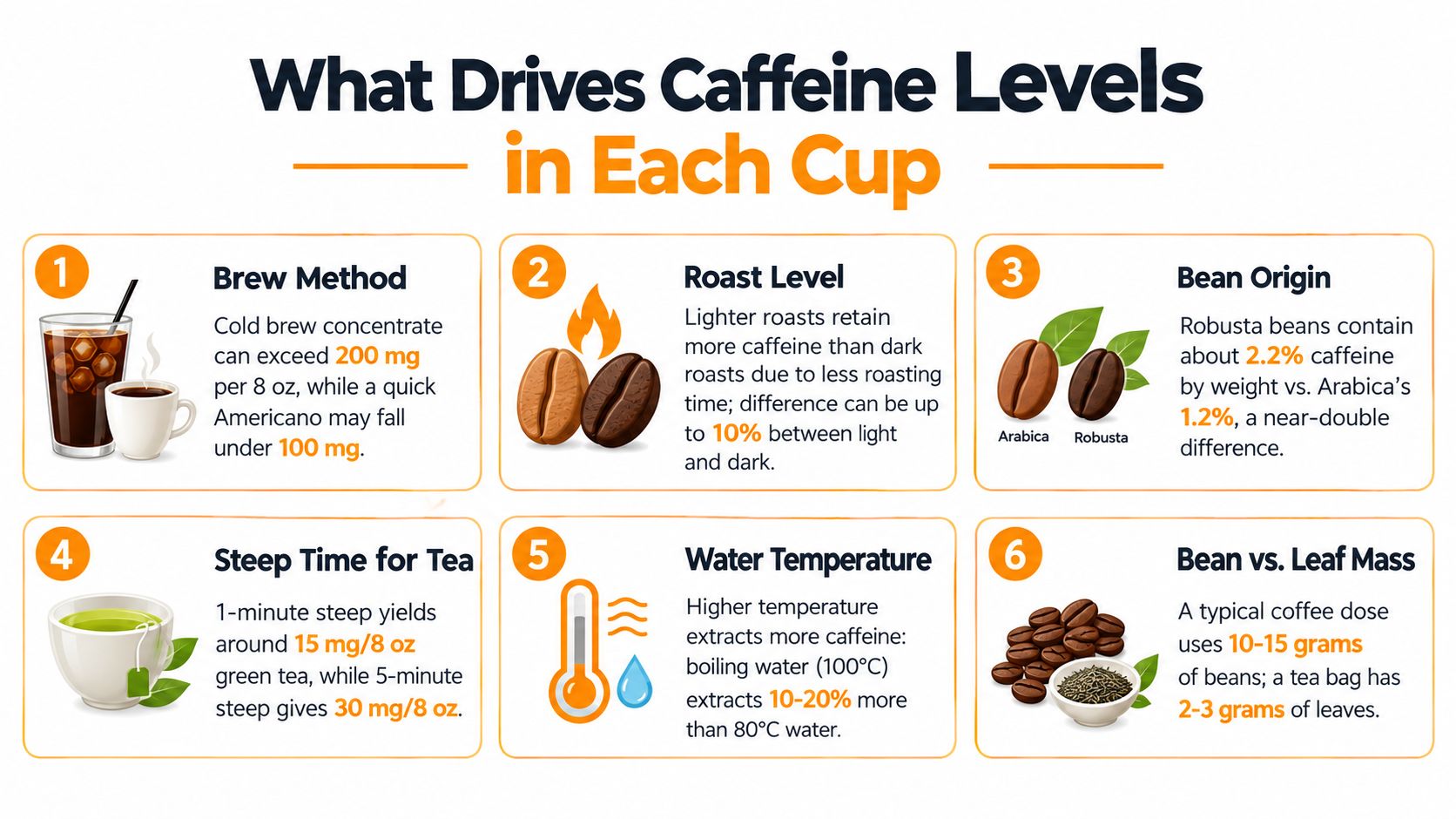
Across home-prepared drinks, caffeine can swing much wider than “average cup” articles admit. One dataset summarized by ScienceDaily's report on tea and coffee variation found tea ranging from 8 to 91 mg per cup and coffee ranging from 29 to 176 mg per cup. That spread explains why two people can both say they had “one cup” and still have very different stimulant exposure.
Coffee variables that move the number
Coffee's caffeine level changes with several operational inputs:
- Brew method: Filtered coffee, French press, Americano, and concentrate don't behave the same.
- Bean-to-water ratio: More coffee mass per ounce of water usually means a stronger cup.
- Grind size and contact time: Extraction shifts when water spends more or less time in contact with the grounds.
- Preparation style: A rushed weak brew and a dense home pour-over can produce very different outcomes.
For people exploring lower-acid or slower extraction methods, this guide to cold brew tea is useful because it frames how extraction style can change both caffeine feel and flavor profile across tea formats.
Green tea variables that matter more than most people think
Tea looks simpler, but its caffeine output is also highly adjustable.
- Leaf grade: Different green teas don't start from the same point.
- Leaf-to-water ratio: More leaf mass raises extraction potential.
- Steep time: Longer contact usually pushes the number up.
- Water temperature: Hotter water tends to pull more compounds, including caffeine.
A person asking whether tea can “replace coffee” is often really asking whether a specific tea, brewed a specific way, can deliver enough caffeine for the job. Sometimes it can. Sometimes it won't come close.
Later in the preparation chain, packaged products diverge even more. Freshly brewed tea, powdered tea formats, and bottled tea don't belong in the same mental bucket.
A concise visual walkthrough helps reinforce that point.
Why Green Tea Feels Different From Coffee at Half the Dose
The sensory difference between coffee and green tea isn't explained by caffeine alone. Coffee usually delivers a higher dose, but green tea also contains L-theanine, which changes the shape of the experience. That's why green tea often feels smoother even when it still improves alertness.
Coffee's effect profile is simpler. It acts like direct stimulant delivery. For many people, that creates a more obvious rise, a sharper edge, and a more noticeable downturn later. Green tea tends to arrive with less force because its caffeine load is lower and its companion compounds soften the feel.
L-theanine changes the conversation
L-theanine matters because the amount of caffeine in coffee vs green tea doesn't tell the whole functional story. Two drinks can both support focus, yet one may feel narrower and punchier while the other feels flatter and steadier.
That distinction matters for anyone choosing between fast activation and sustained concentration. Readers comparing stack design can review how L-theanine and caffeine interact in practical use.
Green tea isn't just “lower caffeine coffee.” It's a different stimulation profile.
Green tea also appeals to people trying to keep stress and focus support in the same conversation. For a broader non-beverage framework, this review of top adaptogens for stress relief is useful because it places L-theanine alongside other compounds often used for calmer cognitive support.
Why this matters in real routines
In practice, coffee is often better when someone wants a cleaner line between tired and alert. Green tea is often better when someone wants a smaller dose that doesn't dominate the next few hours.
That's an important distinction for analysts, developers, traders, students, and shift workers. A person doesn't just consume milligrams. That person consumes a curve. Coffee tends to produce a steeper curve. Green tea tends to produce a flatter one.
The result is that caffeine quantity and caffeine feel can't be treated as the same metric.
Choosing Coffee or Green Tea for Common Scenarios
The right beverage depends less on identity and more on task design. Morning wake-up, deep work, training, and late-day maintenance call for different caffeine shapes.
| Scenario | Recommended Beverage | Target Dose (mg) | Approx. mg/oz | Key Reason |
|---|---|---|---|---|
| Morning activation | Brewed coffee | Higher end of routine | Higher | Faster, more obvious lift |
| Deep work | Green tea | Moderate | Lower | Smoother stimulation profile |
| Pre-workout | Coffee or espresso-based drink | Higher end of routine | Higher | Dense stimulant delivery |
| Mid-afternoon | Green tea | Lower to moderate | Lower | Easier to keep dose controlled |
| High sensitivity | Green tea | Lower | Lower | Softer entry point |
| Portable no-brew option | Pouch or labeled RTD | Product-specific | Product-specific | Less brew variability |
When coffee usually wins
Coffee fits best when the goal is strong activation from a relatively small volume. That makes it practical for:
- Early morning starts: A smaller drink can still produce a substantial intake.
- Pre-training use: Higher caffeine density reduces liquid volume before movement.
- Compressed schedules: Coffee reaches a meaningful dose quickly.
When green tea usually wins
Green tea fits routines where the person wants stimulation without turning the whole next block into a caffeine event.
- Deep work blocks: Lower dose density makes the beverage easier to scale.
- Late-day use: A smaller stimulant load is easier to keep contained.
- Sensitivity management: It's simpler to stay in a lighter dose band.
Readers weighing the broader tradeoffs can compare formats through this article on whether green tea is better than coffee, which approaches the question from a use-case angle rather than a simple winner-loser frame.
A useful substitution rule
If a person knows the target effect but not the right drink, start with dose density:
- Choose coffee when the task needs more caffeine in less liquid.
- Choose green tea when the task needs more control and a gentler feel.
- Choose a labeled product when precision matters more than brewing ritual.
That last category includes products such as Optimal Native Day Flow, a nicotine-free oral pouch positioned for daytime focus using caffeine with L-theanine in a portable format. It belongs in the comparison because it removes brew variability, not because it replaces brewed drinks in every routine.
Pouch and RTD Alternatives Worth Comparing
Brewed beverages aren't the only way people consume caffeine anymore. RTD cans, concentrated coffee products, and oral pouch formats all compete with the traditional mug. The comparison gets clearer when each format is judged on three engineering variables: dose density, consistency, and effect shaping.
What changes outside brewed drinks
Brewed coffee and green tea are variable by nature. The same beans, leaves, water temperature, and contact time don't always show up every day in exactly the same way. Packaged formats reduce that uncertainty because the manufacturer usually defines the serving.
That doesn't automatically make them better. It makes them more predictable.
| Format | Typical Serving | Caffeine (mg) | mg/oz | L-Theanine (mg) | Estimated Onset (min) |
|---|---|---|---|---|---|
| Brewed coffee | 8 oz cup | Varies within benchmark ranges | Higher | None naturally meaningful in routine terms | Varies |
| Green tea | 8 oz cup | Varies within benchmark ranges | Lower | Present naturally | Varies |
| RTD coffee | Label-defined | Check label | Product-specific | Product-specific | Product-specific |
| RTD tea | Label-defined | Check label | Product-specific | Product-specific | Product-specific |
| Oral pouch | Pouch-defined | Check label | Not directly comparable to liquid ounce math | Product-specific | Product-specific |
Why pouches matter in a caffeine comparison
Pouch formats are interesting because they solve a different problem than coffee or tea. They don't try to preserve ritual. They try to reduce friction.
For someone on rounds, in transit, on a call-heavy day, or moving between meetings, a pouch offers a fixed serving without kettle time, brew drift, or cafe variability. That matters most when consistency is more valuable than beverage enjoyment.
The strongest argument for pouches isn't potency. It's control.
Where RTDs fit
RTD coffee and tea sit between brewed beverages and pouches. They preserve a drink format while reducing preparation variability. But they also break the assumptions people bring from home brewing. A bottle of tea may not resemble steeped green tea. A canned coffee may overshoot a standard mug.
The practical rule is simple:
- Use brewed coffee or tea when ritual and adjustability matter
- Use RTDs when label-based consistency matters
- Use pouches when portability and precision matter most
In other words, the amount of caffeine in coffee vs green tea is still the right starting question. It just isn't the last one.
A Practical Decision Rule for Your Daily Routine
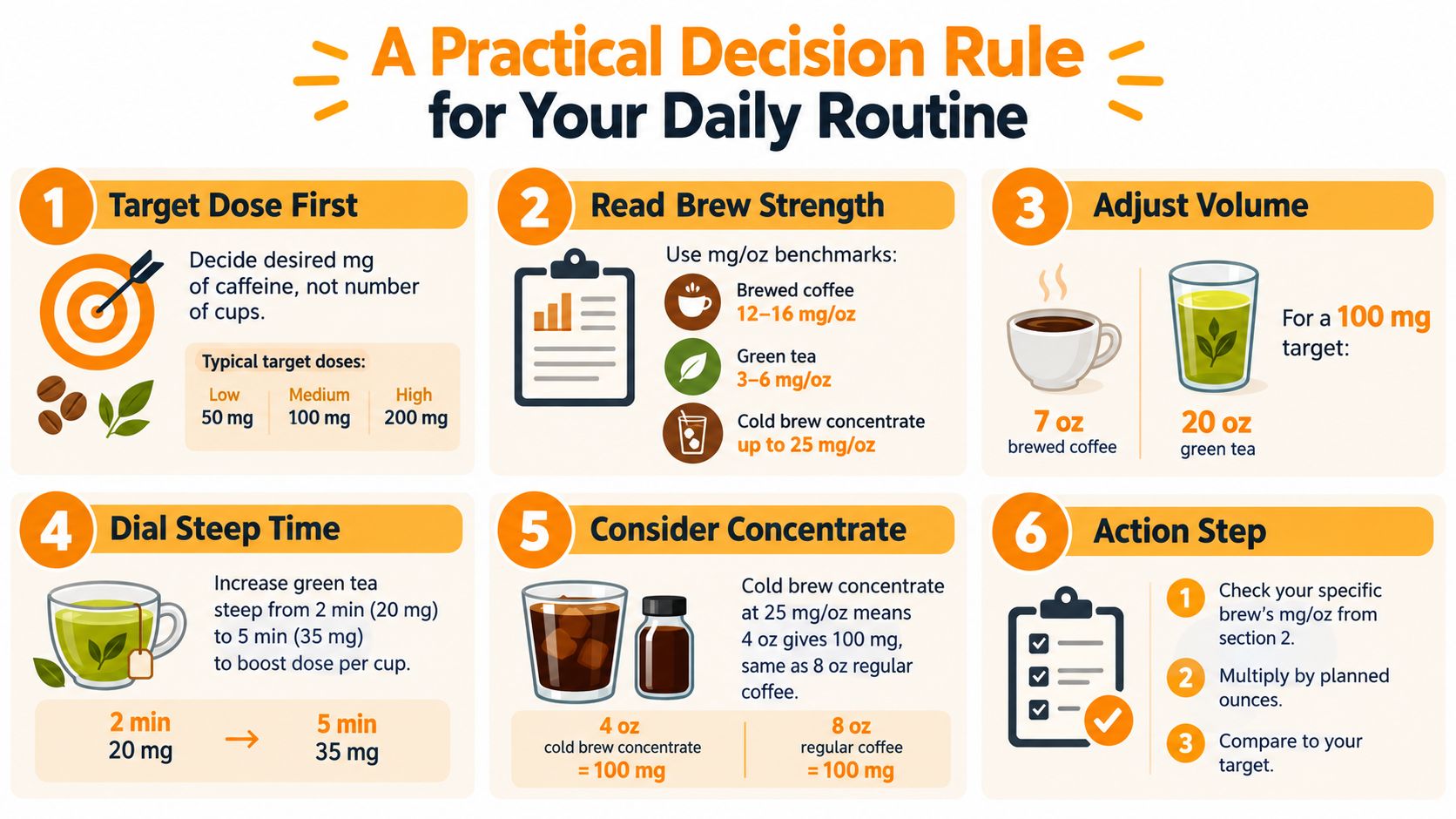
A 16 ounce mug can turn a moderate caffeine plan into a high-dose one fast. The fix is simple. Set caffeine in milligrams first, then back into ounces.
A practical routine starts with dose density, not beverage identity. Coffee and green tea are not just different drinks. They are different caffeine delivery systems, with different mg-per-ounce ranges and different effect profiles once L-theanine enters the picture.
The three-step rule
-
Set the milligram target first
Pick the dose that fits the next block of work, not the drink you happen to want. -
Choose the delivery profile
Coffee works better when you want more caffeine per ounce. Green tea works better when you want a lower caffeine load and a calmer feel from naturally occurring L-theanine. -
Scale by ounces, not by “cups”
Use the beverage's approximate mg-per-ounce range and multiply by the volume you will drink.
That approach reduces the two common errors in daily caffeine use: underestimating large coffee servings and assuming every tea is too weak to matter.
The habits that matter most
Three routine habits improve control more than arguing over which drink is “better”:
- Measure the vessel: A mug, tumbler, and cafe cup can deliver very different totals.
- Note the preparation style: Brew method and steep time change dose per ounce.
- Track the full day: Coffee, tea, RTDs, and pouches all count toward the same caffeine budget.
The practical implication is straightforward. A larger coffee can accumulate caffeine faster than many people expect, while green tea gives more room to adjust intake upward or downward in smaller steps. That makes green tea easier to fit into long workdays where the goal is stable attention, not the highest possible stimulant hit in one serving.
The bottom line
Use coffee when the next few hours justify higher caffeine density. Use green tea when you want lower mg per ounce and a smoother feel at a lower dose.
The better system is not loyalty to one beverage. It is matching target milligrams, actual ounces, and how the drink feels in practice to the task in front of you.
Optimal Native offers nicotine-free nootropic pouches built around different parts of the day, including morning energy, daytime focus, and evening wind-down. For readers who want a portable alternative to another coffee or a more controlled caffeine-plus-L-theanine routine, Optimal Native is worth reviewing alongside brewed drinks, RTDs, and other labeled formats.