

Is Green Tea Better Than Coffee for Energy and Focus
You're standing in the kitchen before work, already checking messages, already behind, and you've got three options on the counter. Coffee will hit fast. Green tea will feel smoother. A modern nootropic pouch sits in a different category altogether, built for control rather than ceremony. If you're asking whether green tea is better than coffee, the honest answer is that “better” depends on whether you need a hard launch, a calmer work curve, or a more portable protocol.
| Option | Typical caffeine per 8 oz | What it usually feels like | Best fit |
|---|---|---|---|
| Coffee | About 96 mg | Faster, more noticeable stimulation | Immediate alertness, long shifts, early starts |
| Green tea | About 29 mg | Gentler stimulation, steadier feel | Deep work, lower sensitivity, afternoon focus |
| Controlled pouch format | Varies by product | Portable, structured stimulation | Users who want timing and consistency |
If you also care about bean quality and preparation, the practical lens matters more than the food-label debate. Tips from PureHQ Inc. are useful because freshness, grind, and brew style change how coffee performs in a day, not just how it tastes. For a morning routine that feels less improvised, this energy guide is a useful companion to the beverage decision.
Table of Contents
- Choosing Your Daily Stimulant in a Real-World Routine
- Caffeine Content and Stimulant Profiles Compared
- Cognitive Effects, Jitters, and Sleep Disruption
- Long-Term Health Signals and Mortality Data
- Which Option Fits Your Daily Performance Profile
- Practical Brewing, Dosing, and Stacking Strategies
- Building Your Personalized Energy and Focus Protocol
Choosing Your Daily Stimulant in a Real-World Routine
A nurse on a night shift does not want a “wellness beverage.” She wants to be alert when the floor gets busy, then stay steady when the workload stretches past midnight. A consultant, by contrast, may want a cleaner ramp into a two-hour writing block without the harsher edge that can make a second cup feel like a mistake. Those are different jobs, so they deserve different stimulant choices.
Coffee is the blunt instrument. Green tea is the smoother tool. A controlled buccal pouch, for someone who likes predictable timing and portability, sits closer to the “scheduled dose” side of the map than the beverage side.
Practical rule: choose the stimulant that matches the day's hardest moment, not the one that sounds healthiest in theory.
The comparison gets clearer when you stop treating “energy” as one thing. There's wakefulness, which is mostly about raw stimulation. There's focus, which is about staying usable over time. There's also tolerance, which shows up when yesterday's good dose feels flat today.
That's why the question of whether green tea is better than coffee keeps splitting into two answers. If your priority is speed and punch, coffee usually wins. If your priority is less edge and more control, green tea often makes more sense. If your priority is repeatable timing with less reliance on brewing, a pouch protocol can fit better than either beverage.
In daily life, that means the best choice changes by hour. A 5:30 a.m. alarm, a 1 p.m. coding block, and a late-evening drive home are not the same scenario. Treating them as if they are leads to overcaffeinating in one moment and underperforming in another.
Caffeine Content and Stimulant Profiles Compared
The dose difference drives the experience
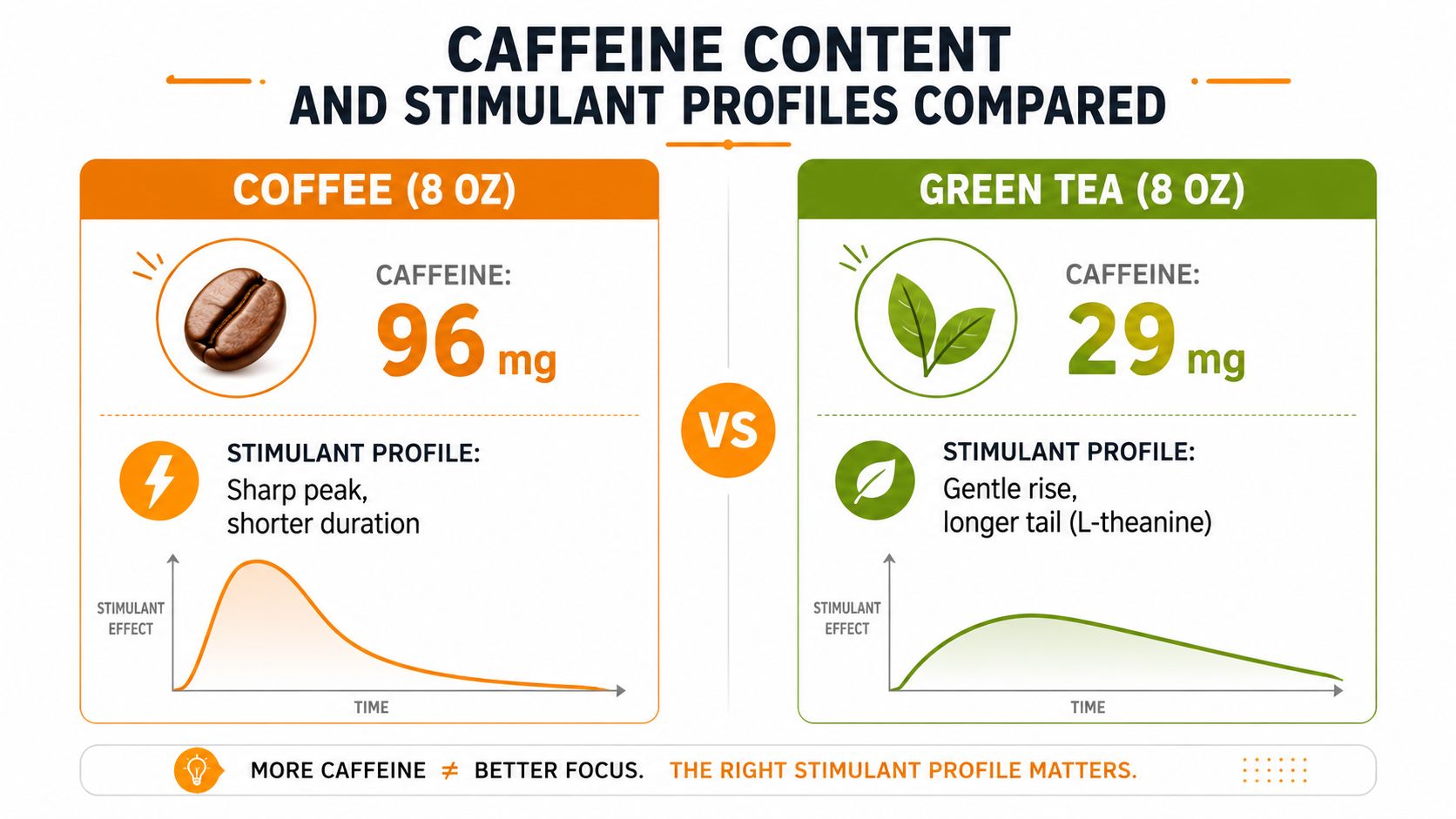
A standard 8-ounce cup of coffee contains about 96 mg of caffeine, while the same volume of green tea contains about 29 mg. That makes coffee deliver roughly 3.3 times as much caffeine per cup, which is why it usually lands with more force and green tea tends to feel softer Healthline. A practical benchmark for acute stimulation says drip coffee often sits around 80 to 100 mg per 8 oz serving, while brewed green tea is about 25 to 50 mg per serving Tea Trade.
Those numbers matter because the body does not experience caffeine abstractly. It experiences dose, timing, and context. Coffee is the more efficient tool when you need a sharper alertness bump. Green tea is the easier choice when you want milder stimulation that's less likely to feel aggressive.
Daily planning is really dose planning
To reach 200 to 300 mg of caffeine, you're usually looking at about 2 to 3 cups of coffee, but closer to 7 to 10 cups of green tea at the cited levels Healthline. That's the hidden reason green tea and coffee don't behave like interchangeable products. Even if both are “caffeinated,” the volume required to match a stimulant target can be very different.
Coffee is the easier lever when the day needs a clear switch from tired to on.
For someone trying to manage tolerance, that difference also shapes habit design. A beverage that delivers more caffeine per serving is easier to overshoot with. A milder option can help you stay closer to the minimum effective dose, especially if you're sensitive to stimulants or trying to keep afternoon intake modest. Green tea is not stronger in any practical stimulant sense, but it can be better for people who value pacing over force.
The takeaway is simple. Coffee is usually the better stimulant for immediate alertness. Green tea is usually the better fit for gentler focus and lower-intensity routines. The right choice depends on whether your day needs a launch or a glide.
Cognitive Effects, Jitters, and Sleep Disruption
Coffee and green tea can both help you feel more awake, but they don't feel the same in the nervous system. Coffee tends to feel direct. Green tea tends to feel softer. That difference matters most when your workday already includes stress, late hours, or a second caffeine decision.
Alertness is not the same as comfort
If you need to wake up fast, coffee is usually the cleaner answer. If you need to stay functional for a longer stretch without feeling spun up, green tea is often easier to live with. Tea's gentler profile is one reason people who dislike the “too much too fast” feeling often drift toward it.
Green tea also contains L-theanine, the compound most commonly discussed as the reason tea feels calmer than coffee. In practice, that means some people notice less of the edgy rise they associate with heavier caffeine intake. Coffee, by contrast, is more likely to feel like a direct push because it lacks that tea-specific counterweight.
Jitters and sleep are timing problems
The best way to think about jitters is not as a moral issue, but as a signal that the dose or timing no longer fits the day. If coffee makes your hands feel shaky, your thoughts too fast, or your afternoon crash harder, that is a cue to reduce the dose or shift the timing. For a practical walkthrough on that problem, this guide on how to stop caffeine jitters is worth keeping nearby.
Sleep disruption is the same kind of problem. A stimulant that helps at 8 a.m. can still be a bad fit at 4 p.m. if you're sensitive. Green tea often gives more room to work because the dose is smaller, but it can still interfere with sleep if you push it late enough.
Best use case: coffee for the first hard task of the day, green tea for a later block when you want fewer side effects and less cognitive whiplash.
The most useful question is not “Which one is healthier in the abstract?” It's “Which one keeps me productive without borrowing from tonight's sleep?” That framing usually leads disciplined users to make different choices on different days instead of forcing one beverage to solve every problem.
Long-Term Health Signals and Mortality Data
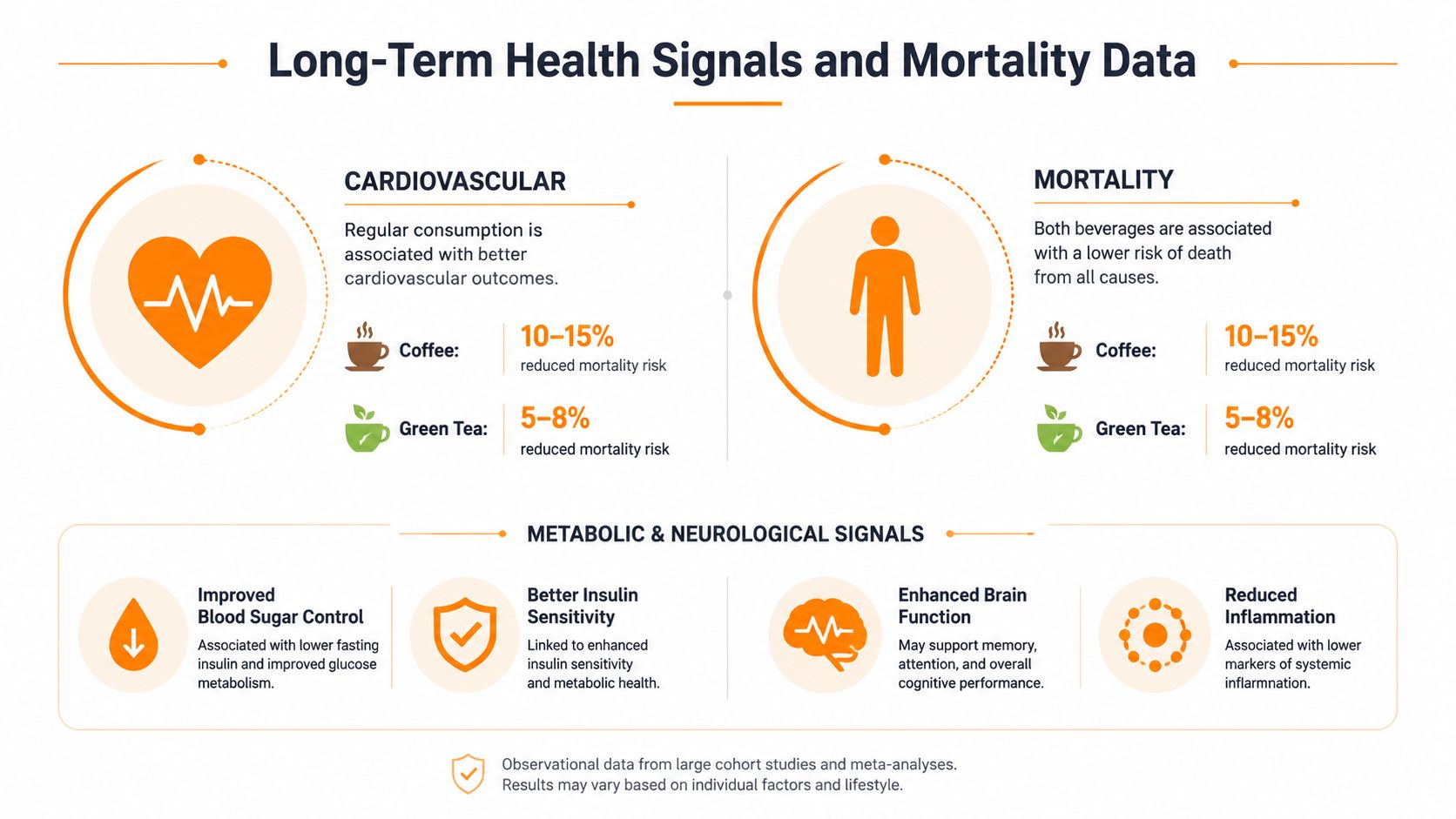
Long-term data never gives a perfect winner, but it does give useful signals. Harvard reports that compared with people who drank none, those who drank the most coffee or green tea had much lower premature-death risk, including about 40% lower for people drinking either 2 cups of coffee or 4 cups of tea per day, and 63% lower for people drinking both 4 cups of tea plus 2 cups of coffee per day Harvard Health. That does not prove cause and effect, but it does show that both beverages have credible observational links to longevity.
Why green tea often gets the longevity edge
Green tea often looks slightly better in longevity conversations because the same Harvard summary also points to stronger observational support around cardiovascular outcomes Harvard Health. A systematic review and network meta-analysis in the British Journal of Nutrition found that green tea drinking was associated with a mean weight-loss effect of –1.23 kg versus placebo and –1.61 kg versus water, though the certainty of evidence was rated low to very low British Journal of Nutrition. That's modest, not dramatic, but it's enough to keep green tea in the conversation for people thinking about daily habits rather than one-off stimulation.
The diabetes angle points in the same direction. Harvard notes that a recent large observational study found 200 to 300 mg of caffeinated tea or coffee per day was associated with a lower risk of diabetes, coronary artery disease, and stroke Harvard Health. Green tea can take a lot more volume to reach that caffeine range, which makes it less intense and more gradual as a habit.
Coffee still holds its own
Coffee is not the weaker health choice by default. The same Harvard data shows strong associations for both beverages, and coffee remains a serious contender when the question includes broad mortality outcomes rather than just metabolic theory Harvard Health. In a real routine, that means the healthiest beverage is often the one you can use consistently without overdoing it.
The most grounded conclusion is this. If you want a lower-caffeine habit with encouraging observational links to longevity, green tea has the edge. If you want stronger stimulation and still want long-term associations that look favorable, coffee remains highly competitive.
Which Option Fits Your Daily Performance Profile
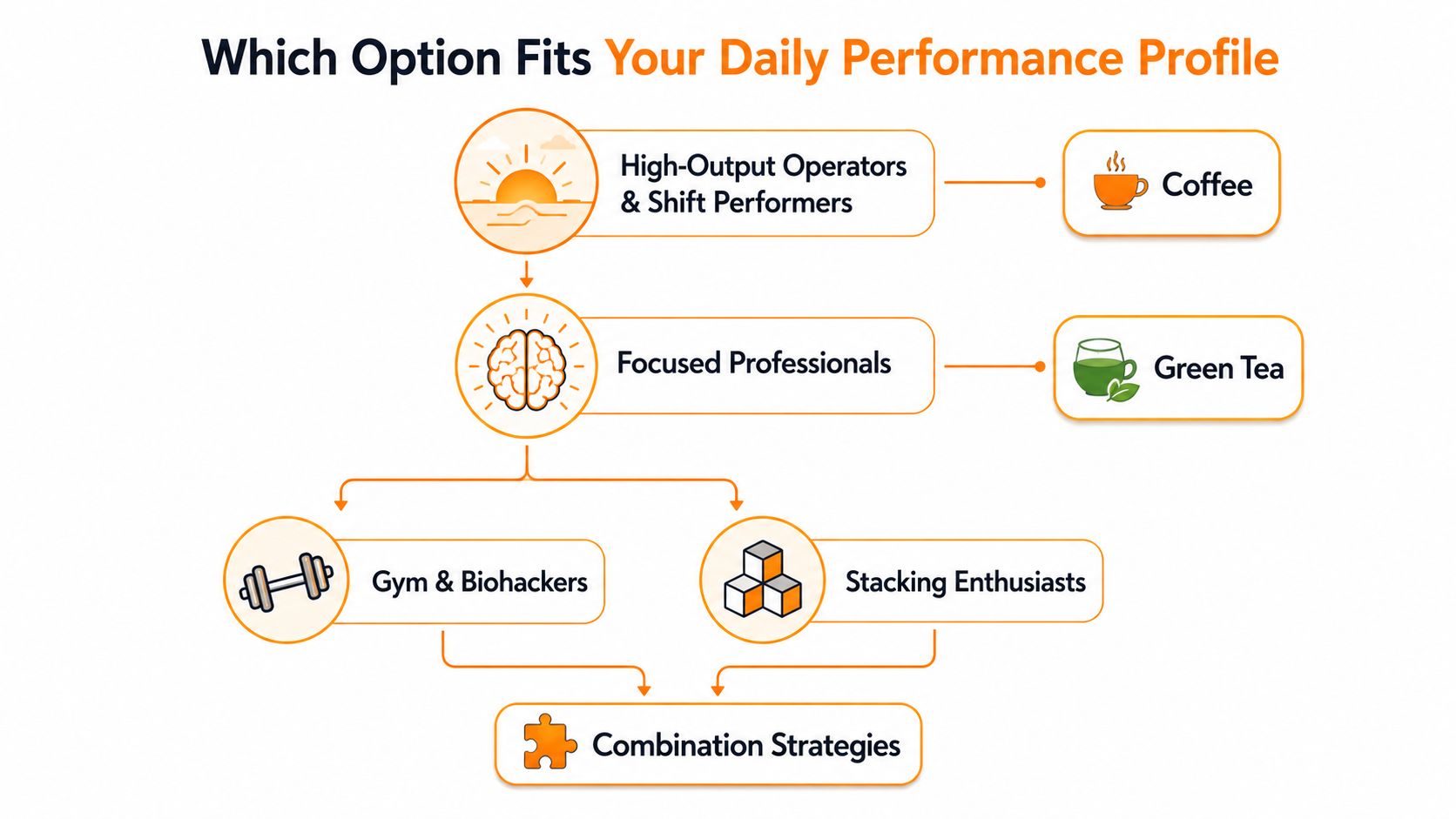
High-output operators usually need the clearest wake-up tool. If you're managing sales calls, travel, or back-to-back decisions, coffee makes sense when you need a strong opening move. It is the simplest choice before an early meeting or a demanding shift, especially when you know the first few hours will be the hardest.
Focused professionals often do better with green tea. Developers, writers, designers, and analysts usually care less about a hard jolt and more about staying smooth through a long block of concentration. Green tea fits that rhythm because it gives a gentler lift without forcing the day into a sharp peak.
Shift performers need flexibility more than ideology. A paramedic, nurse, or officer can use coffee when the priority is immediate alertness, then switch to a milder option later if the shift still has hours left. That kind of scheduling helps avoid the familiar mistake of taking too much too early, then fighting a second wave of fatigue later.
Gym and biohacker users tend to think in protocols, not beverages. They often look for a stack that respects timing, training, and recovery. In that group, coffee can be the pre-workout hammer, green tea can be the calmer daytime option, and structured pouch routines can be the cleanest way to control the dose.
Nicotine-free pouch switchers want the oral ritual without the nicotine loop. For them, the format matters as much as the stimulant. A pouch-based system can feel more intentional than another cup of coffee, especially when portability and discreteness are part of the requirement.
If your day changes by the hour, the best stimulant is the one you can stage, not the one you can only consume.
Fast decision rules
- Choose coffee: when you need the strongest alertness and the day starts hard.
- Choose green tea: when you want milder focus and less stimulation.
- Choose a pouch protocol: when you want a portable, structured routine with more control over timing.
The pattern is consistent across user types. Coffee suits force. Green tea suits smoothness. Controlled oral formats suit people who want precision.
Practical Brewing, Dosing, and Stacking Strategies
Brewing changes the result more than people think
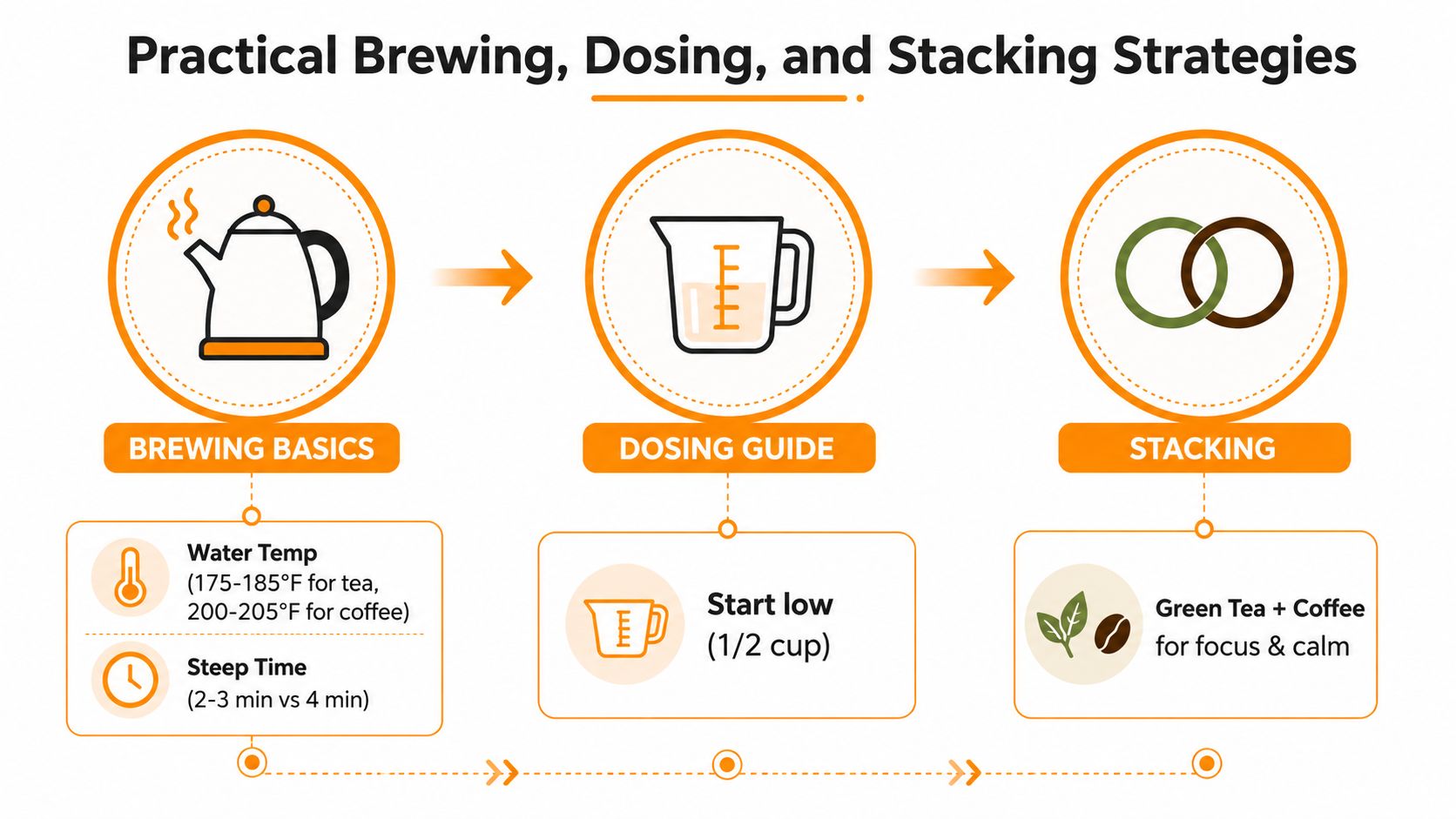
Coffee and tea are not fixed products. Brew strength, water temperature, and steep time all change how much stimulant you get. That's why two cups of the “same” drink can feel different in the same person on different mornings.
For green tea, a shorter steep generally keeps the experience lighter. For coffee, stronger brewing tends to push the effect harder. If you're trying to avoid the jittery edge, the simplest move is usually to reduce the dose before you start layering in more complexity.
Dosing is easier when you start low
A better routine usually starts with less than you think you need. A half cup can tell you whether the day calls for more, especially if you're sensitive or you already know caffeine tends to linger in your system. That's more useful than chasing a fixed “ideal” number from someone else's routine.
Practical rule: use the smallest dose that gets you to the next meaningful task.
For people who like the tea experience but want more focus, pairing caffeine with L-theanine is the classic move. The tea article from Optimal Native on the role of L-theanine and calming focus is a useful reference if you want the mechanism explained in plain language. The point is simple, L-theanine is often used to smooth stimulation rather than intensify it.
When a pouch format makes sense
Buccal nootropic pouches are the modern third option for people who care about control, portability, and no-brew convenience. They're designed for users who want a more structured stimulation protocol than “whatever coffee is available,” without turning every energy decision into another drink. That matters for commuters, desk workers, and shift-based professionals who want fewer variables in the middle of the day.
The most practical timing pattern is straightforward. Use your strongest stimulant earlier when alertness matters most. Shift to a milder option when you still need productivity but want less edge. Save the most controlled or calming format for times when consistency matters more than intensity.
Building Your Personalized Energy and Focus Protocol
If your priority is immediate alertness, coffee is usually the better answer. If your priority is calm focus with less stimulation, green tea is often the smarter daily habit. If your priority is precision, a structured pouch routine can sit between the two and give you more control over timing.
The simplest framework is this. Use coffee for early, demanding starts. Use green tea for longer work blocks or afternoons when you still need clarity. Use a controlled oral system when portability, consistency, and dosage discipline matter more than ritual.
That's the answer to whether green tea is better than coffee. Green tea is better for some routines, coffee is better for others, and the best protocol is the one that fits your work, your tolerance, and your sleep.
If you want a cleaner way to time energy, focus, and recovery across the day, explore Optimal Native and see how a structured pouch protocol can fit into a coffee-or-tea routine. It's built for people who want controlled stimulation without guessing at the dose, and it gives you a practical third option when brewed drinks aren't the right tool.