

Why Is Focus Important for Real Performance
A person is halfway through a sentence on a video call when a chat notification appears. Their eyes move to the message, the mind starts composing a reply, and the conversation continues without them. When attention returns, the thread has vanished. The meeting continues, but the quality of participation has already changed.
That small moment explains why focus matters. Focus is the deliberate direction of attention toward one task while competing signals are filtered out. It isn't a personality trait reserved for unusually disciplined people. It's a working condition that people can protect through better boundaries, clearer routines, and environments designed for fewer interruptions.
The question “why is focus important” has a practical answer. Focus helps people preserve context, notice relevant signals, make safer decisions, and complete complex work without repeatedly rebuilding their mental starting point. It also looks different across roles, so a night-shift nurse, software developer, and novelist shouldn't use identical strategies.
Table of Contents
- What Focus Actually Means in Daily Life
- How Attention Works in the Brain
- Why Focus Drives Performance at Work
- How Distraction and Fragmentation Add Up
- What Focus Looks Like Across Different Roles
- Building a Personal Focus System That Holds
- Putting It All Together for the Long Run
What Focus Actually Means in Daily Life
Focus becomes easier to understand when it's separated from the vague idea of “paying attention.” Consider a customer support specialist answering a billing question. The task may require only a few minutes of concentrated effort. The specialist reads the account history, checks the invoice, writes a precise response, and moves on. That's sprint focus, a short burst directed at a defined outcome.
A financial analyst reviewing a report needs something different. The analyst must hold assumptions, figures, exceptions, and conclusions in mind while moving through a longer chain of reasoning. That's session focus, a sustained period for work that becomes more accurate as context accumulates. A nurse monitoring patients or a machine operator watching a production line needs another form altogether. Ambient focus means maintaining readiness over time, noticing meaningful changes without reacting to every harmless signal.
These forms differ in duration and intensity, but they draw on the same limited attentional resource. Each one requires a person to decide what deserves priority and what can remain outside the mental foreground.
Focus is protection, not perfection
Focus doesn't mean that a person never notices a sound, experiences a wandering thought, or responds to an urgent request. In real work, interruptions sometimes carry important information. The skill lies in distinguishing a relevant signal from a merely available one.
A useful working definition is:
Focus means protecting the attention required by the task that matters now.
That definition changes the practical question. Instead of asking whether someone has enough willpower, the better question is whether the person's surroundings, schedule, and communication rules protect the task. A developer may be highly capable yet lose concentration when chat windows remain active, meetings split the day, and every notification arrives with the same visual urgency.
Focus can be trained, but it also has to be supported. A clear task, a visible stopping point, and fewer competing cues make concentration easier to begin and easier to sustain. The objective isn't heroic concentration all day. It's matching the right kind of attention to the work in front of the person.
How Attention Works in the Brain
A notification appears while someone is checking a spreadsheet. Their eyes move to the screen, the message is read, and the original error suddenly feels harder to find. Attention works less like a lamp under perfect control and more like a busy doorway. Goals try to guide what enters, while sudden or meaningful signals compete for passage.
Bottom-up attention is captured by change or apparent urgency, such as a loud sound, flashing notification, or person entering the room. Top-down attention follows a chosen goal, such as checking a spreadsheet for a specific error or writing a report's conclusion. Prefrontal systems help hold that goal and regulate behavior, yet novelty, emotion, habit, and incoming sensory information can pull in other directions.
The brain also pays a cost when attention switches tasks. The Cambridge research on multitasking reports that brief mental blocks during switching can consume as much as 40% of productive time. Related University of California, Irvine findings reported that office workers spent an average of 11 minutes on a task before interruption and then needed 25 minutes to return to it. These findings make attention protection practical, not abstract. Fewer unnecessary signals leave deliberate control with more room to work.
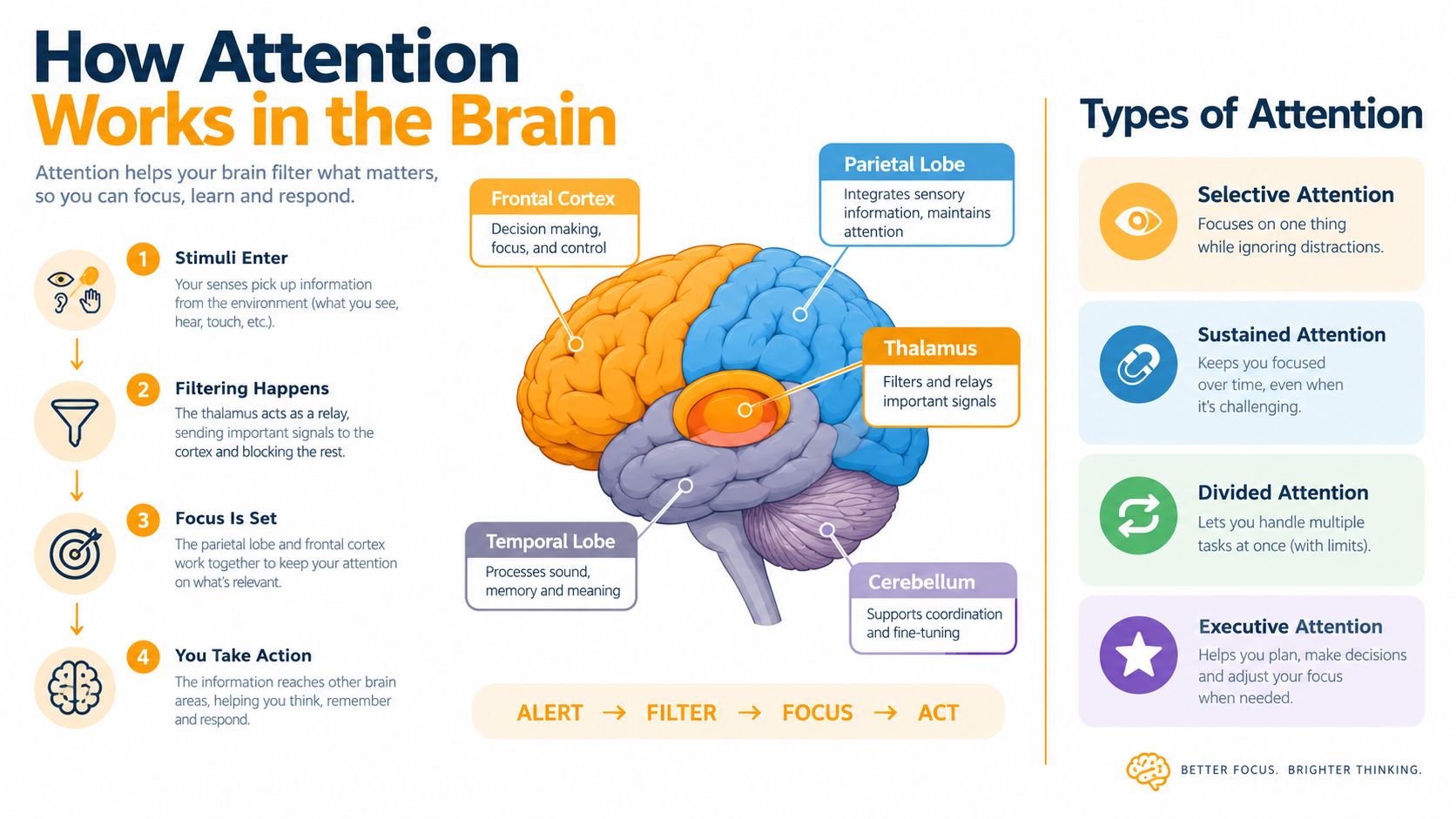
Why switching feels productive
Switching feels efficient because several tasks seem to advance. A document receives edits, a message gets answered, and a spreadsheet opens. Complex work still requires the mind to reload the goal, relevant facts, unfinished reasoning, and standard for completion whenever attention moves.
A University of California, Irvine workplace study found a median screen-focus duration of 40 seconds, with shorter focus associated with lower assessed productivity throughout the day, as described in the study of online multitasking and focus. This does not mean every task needs long, uninterrupted concentration. It shows that fragmented attention makes sustained analysis and memory work harder.
Mind-wandering adds another layer. The default mode network is more active during internally directed thought, including reflection and spontaneous mental drift. That activity can support rest, planning, and creative incubation, yet it may pull attention away while someone verifies a dosage, inspects code, or tracks a changing situation.
People seeking practical help with planning, inhibition, and working memory can review executive function support strategies. Focus depends on more than willpower. It becomes easier when the person's goal is clear and the environment stops presenting every interruption as equally important.
Why Focus Drives Performance at Work
Focus affects work through three connected outcomes: productivity, safety, and decision quality. These outcomes don't require identical tasks. A junior analyst checking formulas, a manager choosing a candidate, and a pilot deciding whether to go around all depend on keeping relevant information available long enough to act on it.
Productivity suffers when work repeatedly restarts. A focused analyst can compare figures against the same assumptions without reconstructing the entire problem after every message. A writer can preserve the logic of a paragraph. A technician can complete a sequence without forgetting which step has already been verified.
Workplace design research points in the same direction. The Gensler 2013 U.S. Workplace Survey reported that overall workplace performance fell 6% versus 2008, with the decline attributed to reduced effectiveness of focus work. The implication is operational, not cosmetic. When a workplace makes concentration difficult, other work modes can lose effectiveness too.
Focus also protects people
Safety-critical work gives the issue sharper edges. A driver who looks at a phone can miss a developing hazard. An air traffic controller handling overlapping trajectories must preserve the relevant pattern rather than let an unrelated alert break the mental model. A surgeon cannot treat an interruption during a delicate step as equivalent to a harmless pause during administrative work.
A workplace safety analysis found that accidents increase when workers are inattentive to potential hazards, while traffic-safety research links misallocated attention with crashes and attention-related errors, as documented in the analysis of attention failures and workplace accidents. In these settings, focus isn't a preference for quiet. It supports timely detection and response.
Practical rule: The more expensive an unnoticed signal becomes, the more deliberately a team should protect attention around that signal.
Decision quality depends on the same mechanism. Complex judgments require a person to compare variables, test alternatives, and resist the first plausible answer. Fragmentation encourages shortcuts because the mind has less continuity for weighing competing evidence. A manager may settle on a familiar candidate, an analyst may overlook a small inconsistency, and an operator may respond to the loudest cue instead of the most important one.
| Outcome Area | Focused Work | Fragmented Work |
|---|---|---|
| Productivity | Preserves context and supports task completion | Repeatedly rebuilds context and increases unfinished work |
| Safety | Keeps relevant cues available for detection and response | Makes missed signals and delayed reactions more likely |
| Decision quality | Allows comparison of variables and alternatives | Encourages shortcuts, premature conclusions, and weak checking |
How Distraction and Fragmentation Add Up
A message arrives while you are drafting a report. You glance at it, answer, and return to the document, yet the original line of reasoning has gone faint. Attention fragmentation describes this loss of continuity more precisely than “distraction.” A notification can interrupt the link between the task, its purpose, the evidence under review, and the next intended action.
Frequent switching makes a workday feel full without producing the expected amount of finished work. Each return requires reconstruction: What had you decided? Which detail mattered? What should happen next? The exact cost varies by person and task, but the pattern is consistent. Fragmented attention turns progress into repeated re-entry.
Modern tools place competing demands on the same limited attentional channel. Open-office conversations, always-on chat, shared documents, meeting reminders, and default notifications can keep a person responsive while leaving little uninterrupted time for reasoning. ActivTrak reported a decline in focused work and focus efficiency in its State of the Workplace report.
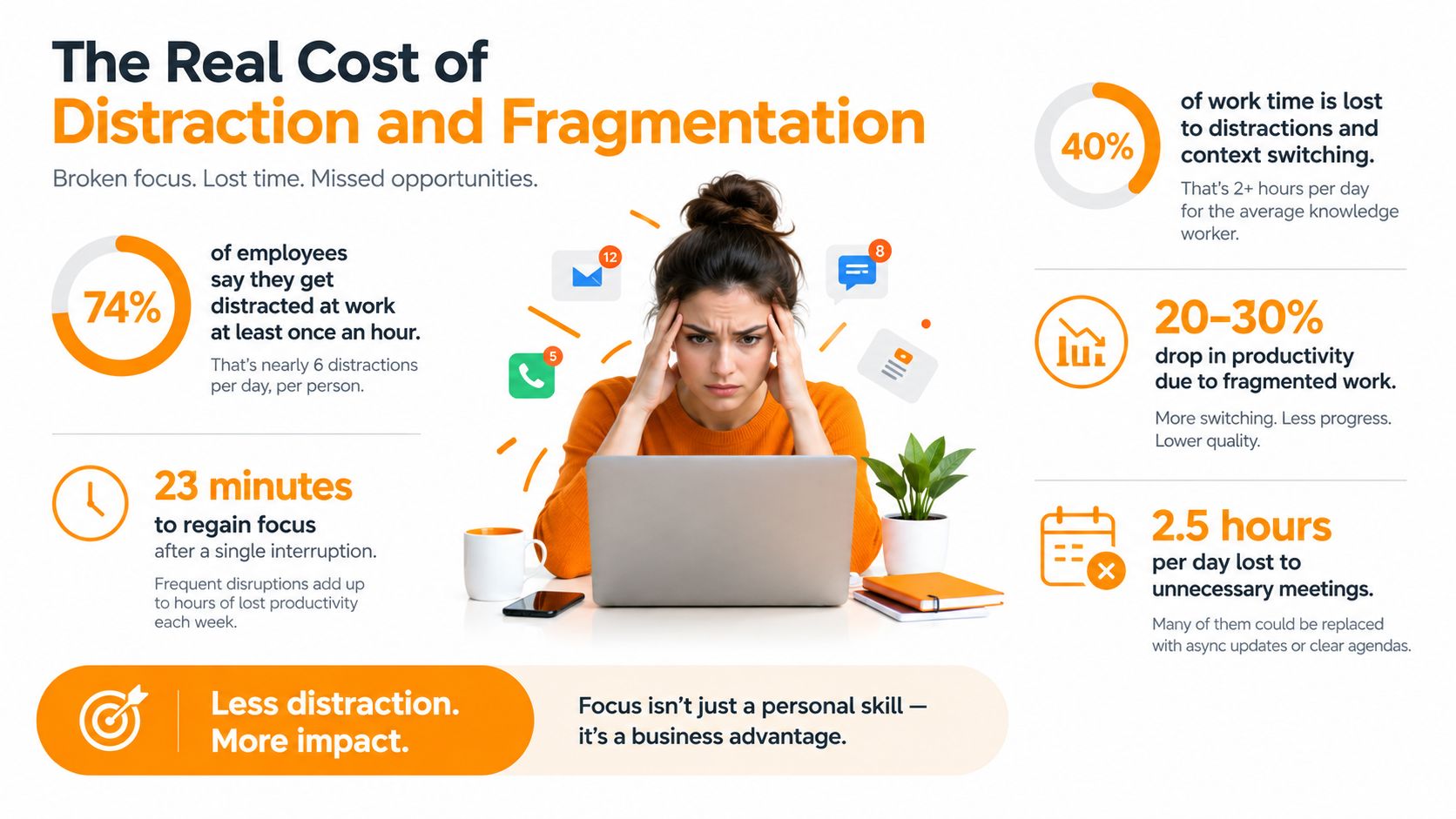
Why willpower loses the fight
Willpower struggles when the environment presents low-effort alternatives all day. Every alert creates a small judgment call, and every judgment call draws on the same control needed by the primary task. By afternoon, a disciplined professional may still value the important work but have less capacity left to protect it.
Attention works somewhat like a muscle, with an important qualification. It is not a muscle anatomically, yet sustained control becomes less reliable under constant demand without recovery. Repeated interruptions are like stopping a vehicle before it reaches cruising speed. The task keeps restarting instead of settling into a stable rhythm.
Energy matters as well. Concentration often weakens when work is scheduled against a person's natural energy pattern, so guidance on energy crashes and focus can help individuals examine that relationship.
Workplaces can reduce unnecessary switching through Practical strategies for a focused workplace with, including clearer communication expectations and fewer competing alerts. The most effective lever is system design: batch messages, separate urgent channels from ordinary ones, protect meeting-free work periods, and give colleagues a visible signal when concentration is in progress.
Attention protection turns focus from a daily act of resistance into a normal operating condition.
What Focus Looks Like Across Different Roles
A night-shift nurse doesn't need the same focus strategy as a copywriter. The nurse's attention must remain broad enough to detect a meaningful change while staying anchored to patient safety. A factory operator may watch a physical process for a long period, looking for a small deviation that requires action. For both, the scoreboard is not the number of tasks completed. It's the quality of vigilance and the absence of preventable errors.
Shift work makes this challenge harder. A meta-analysis found that shift workers performed worse than non-shift workers in processing speed, working memory, psychomotor vigilance, cognitive control, and visual attention, while a systematic review linked shift work and occupational stress with impaired cognitive functioning, as reported in the occupational medicine review of shift work and cognition. Healthcare workers with chronic sleep deficiency face particular effects on attention and working memory.
Three working realities
A knowledge worker faces a different pattern. A software developer may need uninterrupted concentration to understand a codebase, while a consultant may need to prepare a recommendation that combines notes, financial information, and client constraints. Meetings and chat can create the appearance of activity while preventing the longer reasoning required for high-quality output.
A designer, writer, or composer needs still another form of attention. Creative work often benefits from low-stimulation periods in which ideas can connect without immediate evaluation. A walk without constant media, a quiet studio, or a protected morning period can allow incubation. Interruption doesn't only delay production. It can force the creator back into explanation and judgment before the idea has developed.
| Role | Primary Focus Demand | Main Threat | Protective Practice |
|---|---|---|---|
| Shift worker | Sustained vigilance and hazard detection | Fatigue, irregular hours, missed cues | Clear handoffs, alert protocols, and recovery planning |
| Knowledge worker | Extended reasoning and context retention | Chat, meetings, and rapid switching | Protected single-task blocks and message batching |
| Creative professional | Association, experimentation, and incubation | Premature evaluation and interruption | Low-stimulation work periods and uninterrupted making time |
The practical difference matters. A nurse may need a reliable escalation protocol rather than silence. A developer may need a closed chat window and a clearly defined coding objective. A writer may need permission to delay feedback until the first draft exists.
A focus strategy works only when it matches the shape of the work.
The same principle applies to high-pressure leaders, emergency responders, and operators who alternate between rapid response and administrative tasks. Their systems should separate active monitoring, urgent communication, and deep planning instead of treating every minute as interchangeable.
Building a Personal Focus System That Holds
A focus system should survive an ordinary bad day. A demanding method that works only when sleep, workload, and mood are perfect won't protect attention for long. The most durable approach uses three layers: environment, protocol, and recovery.
Layer one is the environment
The workspace should make the desired behavior easier to see. A knowledge worker can choose a default location for complex tasks, silence nonessential notifications, and use headphones or a desk lamp as a visible focus signal. A team can define which channel is genuinely urgent and which channels can wait for a scheduled review.
The environment also includes physical access. Keeping the relevant document open, closing unrelated tabs, and placing the phone outside immediate reach removes decisions that would otherwise occur repeatedly. The purpose isn't to create a perfect room. It's to reduce the number of invitations to switch.
Layer two is a protocol
A routine gives attention a predictable entry point. One useful protocol is a 60 to 90 minute focus block with one defined task, a written outcome, and a stopping point. The guide to improving focus at work can support that kind of structured approach.
A startup ritual might involve writing the task at the top of a page, closing unrelated applications, and deciding when messages will be checked. A shutdown ritual reverses the process: record unfinished work, identify the next action, clear the workspace, and turn off work alerts. The brain has less need to keep rehearsing open loops when the next step is visible.
Shift workers may adapt the protocol around handoffs and alert periods instead of forcing a conventional office schedule. A strategic caffeine decision may fit some schedules, but sleep timing, workplace safety rules, and individual sensitivity matter more than a universal formula. A creative professional might reserve the first quiet hour for making before opening email, while a manager might batch routine approvals between higher-stakes decisions.
Layer three is recovery
Focus consumes capacity, so recovery belongs inside the system rather than at the end of an ideal week. Sleep, short walks, and genuine idle time give the mind opportunities to reduce stimulation and restore readiness. Recovery doesn't have to mean elaborate wellness programming. It can mean eating away from the screen, taking a quiet walk, or leaving a gap between demanding tasks.
Optimal Native offers a nicotine-free pouch protocol with separate products positioned for morning energy, daytime focus, and evening recovery. It can be considered alongside non-supplement approaches, not as a substitute for sleep, medical advice, or workplace safety procedures.
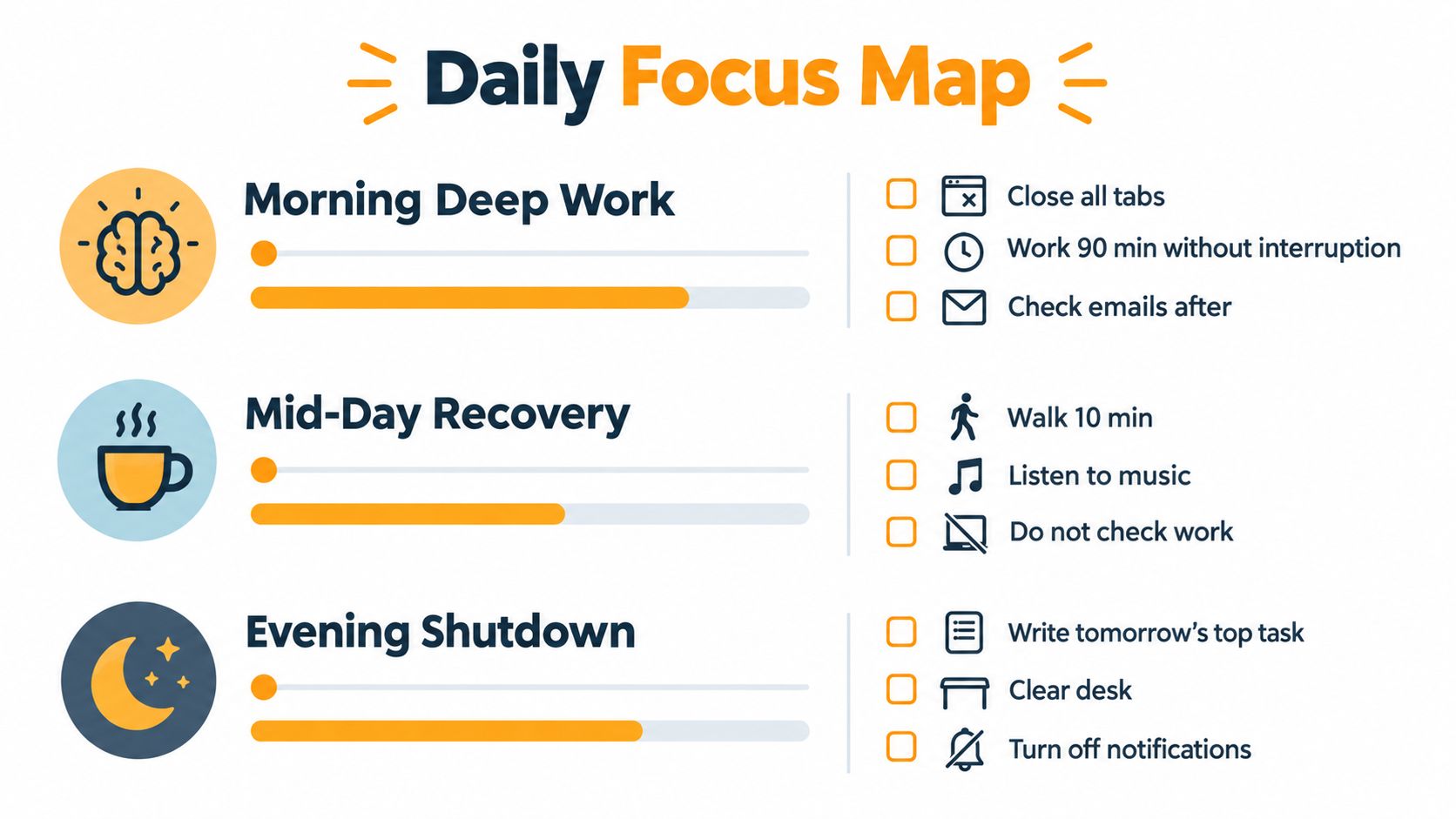
The system should be small enough to repeat. One protected block, clear notification boundaries, and a short shutdown routine can provide more value than an elaborate schedule that collapses during a busy week.
Putting It All Together for the Long Run
Focus becomes sustainable when it is treated as a protected resource rather than a personal virtue. Sleep and hydration receive places in a daily routine because people understand that performance depends on them. Attention deserves the same practical respect.
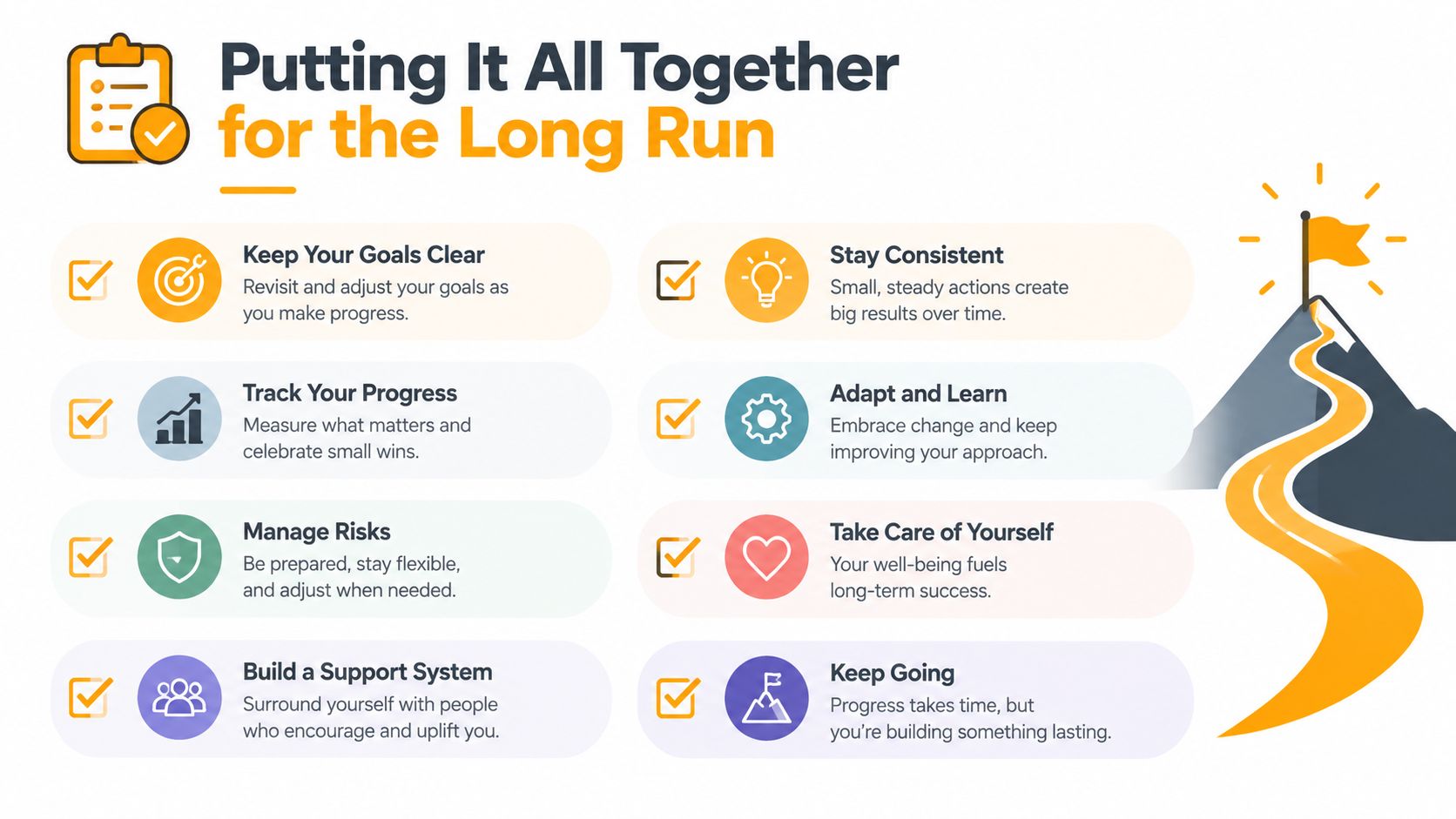
A simple daily map can work across roles:
- Protected work period: Reserve the quietest available part of the day for the task that requires the most reasoning.
- Recovery windows: Use short periods without work messages, screens, or new demands to reduce cognitive load.
- Communication batch: Review ordinary messages at defined times instead of allowing them to set the rhythm of the day.
- Shutdown signal: Write the next task, close the workspace, and end the workday with a clear boundary.
For a shift worker, the protected period may be a safety-critical monitoring window, with handoff notes and alert rules doing the boundary work. For a knowledge worker, it may be a deep analytical block. For a creative, it may be the first uninterrupted period before feedback and administration begin. The layers remain the same, but the protection changes to fit the role.
The evidence points toward a consistent conclusion. Task switching can consume productive time, short focus windows are associated with lower assessed productivity, and unsafe attention failures can contribute to accidents. Focus isn't passive concentration. It's the repeated practice of deciding what deserves attention, removing avoidable competition, and recovering before control becomes unreliable.
Small protections compound. A person who closes one unnecessary channel, schedules one uninterrupted block, and ends the day with a written next step creates a more stable starting point for tomorrow. Over weeks and months, that stability can support better work without requiring constant intensity.
Optimal Native offers nicotine-free nootropic pouches organized around morning energy, daytime focus, and evening recovery, giving people a portable option to consider within a broader attention-protection routine. Visit Optimal Native to review the protocol and choose the approach that fits the demands of the working day.