

What Is Active Recovery Explained for Better Results
TL;DR:
- Active recovery involves low-intensity movement that accelerates healing by increasing blood flow and clearing waste. It is most effective when effort remains below 65% of maximum heart rate, promoting circulation without causing additional fatigue. This practice reduces soreness, improves mood, and supports recovery without replacing proper nutrition or rest when necessary.
Most people assume that collapsing on the couch after a hard workout is the smartest path to recovery. It feels logical. You worked hard, now do nothing. But what is active recovery explained properly? It’s a smarter, science-backed alternative: low-intensity movement that keeps your body healing instead of stalling. Research shows it reduces soreness, clears metabolic waste faster, and has you ready to train again sooner. This article breaks down exactly what active recovery is, why it works, when to use it, and how to do it right without accidentally turning your recovery day into another training session.
Table of Contents
- Key takeaways
- What active recovery is: definition and physiology
- Active recovery benefits vs. passive recovery
- How to do active recovery effectively
- When to use active recovery (and when not to)
- Active recovery techniques and exercise ideas
- My take on getting active recovery right
- Support your recovery with Optimalnative
- FAQ
Key takeaways
| Point | Details |
|---|---|
| Active recovery is low-intensity movement | It keeps blood flowing after hard exercise without adding meaningful training stress to the body. |
| Intensity must stay genuinely easy | Stay below 65% of your max heart rate so recovery happens, not more fatigue. |
| DOMS and soreness reduce faster | Gentle movement clears lactate and improves circulation more effectively than passive rest alone. |
| Passive rest is sometimes the right choice | Injury, illness, or extreme fatigue call for complete rest, not active recovery. |
| Nutrition still drives glycogen recovery | Active recovery handles circulation and waste clearance; only food and time restore your energy stores. |
What active recovery is: definition and physiology
Active recovery is low-intensity physical activity performed after strenuous exercise. Instead of stopping completely, you keep the body moving at an easy effort level that promotes healing rather than creating any new training demand. Think of it as the bridge between hard effort and full restoration.
The physiology behind it is straightforward. When you exercise hard, your muscles generate metabolic by-products, most notably lactate, and accumulate micro-damage that triggers inflammation. Your cardiovascular system also needs to gradually transition from high-output mode back to rest. Stopping abruptly can leave blood pooled in the working muscles, slow down waste removal, and leave you feeling stiff and sore longer than necessary.
Gentle movement after training keeps your heart pumping at a moderate rate, which increases blood flow to muscles by up to 40%. That increased circulation delivers oxygen and nutrients to damaged tissue while simultaneously flushing out metabolic waste. Your parasympathetic nervous system, the part responsible for rest and repair, activates more readily when you ease down gradually rather than stopping cold.
Active recovery shows up in several practical contexts:
- Cooldown after training: Five to ten minutes of easy movement following your main session, like a slow walk or easy cycling spin
- Between sets: Light movement such as walking or gentle stretching during rest periods in strength training
- Standalone rest day sessions: A 20 to 30-minute easy walk, swim, or yoga session on a day when no structured training is scheduled
Common activities used as active recovery include easy walking, light cycling, gentle yoga, slow swimming, and basic mobility drills. The activity itself matters less than the intensity. What separates active recovery from a light workout is intention and effort.
Pro Tip: Active recovery should not be confused with a light training session. If the movement is creating a meaningful training stimulus, it is not recovery. It is more training.
Active recovery benefits vs. passive recovery
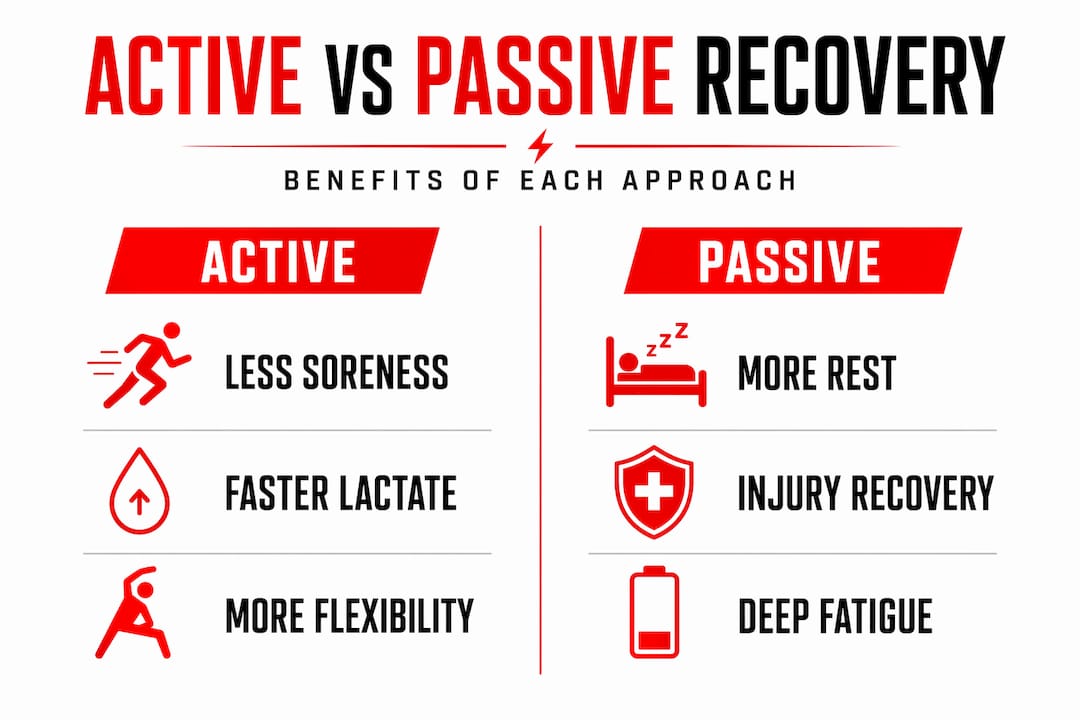
Passive recovery simply means complete rest: no deliberate movement, just sitting or sleeping. It has its place, but for routine post-training soreness and normal fatigue, active recovery outperforms it in several measurable ways.
| Recovery Type | Best For | Soreness Reduction | Lactate Clearance | Flexibility Impact |
|---|---|---|---|---|
| Active recovery | Normal training fatigue, DOMS | Strong effect | Faster, especially in first 60 minutes | Improved through gentle movement |
| Passive recovery | Injury, illness, extreme fatigue | Moderate effect | Slower | No direct benefit |
Reduced delayed-onset muscle soreness. DOMS typically peaks 24 to 72 hours after training. The inflammation and stiffness that characterize it respond well to gentle circulation-boosting movement. Active recovery does not eliminate DOMS entirely, but most athletes and exercisers report significantly less severity when they move gently the day after hard training versus staying completely sedentary.
Faster lactate clearance. Active recovery accelerates lactate clearance within roughly the first 30 to 60 minutes after intense exercise. Lactate is not the villain it was once believed to be, but its accumulation does contribute to the burning sensation and acute fatigue during high-intensity work. Moving gently keeps the metabolic machinery running at low speed, helping clear it efficiently.

Psychological reset. There is a mental component here that rarely gets discussed. Many serious exercisers report feeling mentally flat or irritable on complete rest days. Light movement, especially outdoors, stimulates endorphin release and can genuinely shift mood and mental sharpness. For athletes and performance-focused individuals, this psychological readiness matters as much as physical recovery.
There is one limitation worth addressing honestly. Active recovery does not meaningfully speed up glycogen resynthesis. Your muscle energy stores, depleted during intense training, are restored primarily by carbohydrate intake and take roughly 20 to 24 hours under optimal nutrition. No amount of easy walking changes that timeline. Active recovery is a circulation and waste-clearance tool, not an energy restoration shortcut.
“Recovery is more than rest. It involves physiological normalization, restoration of energy stores, and can be both active and passive depending on the situation.” — Ideafit.com
How to do active recovery effectively
The most common mistake people make with active recovery is going too hard. They feel antsy on a rest day, step onto the bike for what they think is a “light spin,” and push into a moderate training zone without realizing it. At that point, recovery is no longer happening.
Here is a practical framework for getting it right:
-
Control your heart rate. Stay below approximately 65% of your maximum heart rate during any active recovery session. For most adults, that sits somewhere between 90 and 120 beats per minute. If you do not use a heart rate monitor, the talk test works just as well: you should be able to hold a full, comfortable conversation without losing your breath.
-
Match duration to context. For post-training cooldowns, five to ten minutes is usually enough. For standalone rest day sessions, 15 to 30 minutes at easy effort hits the sweet spot. Going longer is rarely harmful, but it starts to blur into light training territory.
-
Pick an activity that matches your fatigue type. If you had a heavy leg day, easy swimming or upper-body mobility work keeps you moving without overloading already taxed muscle groups. If your whole body is generally fatigued, a slow walk is often the most effective option because it imposes almost no systemic stress.
-
Time it well. The most effective window for clearing lactate and managing acute fatigue is within the first 30 to 60 minutes after intense exercise. A cooldown immediately following your session capitalizes on this window. For DOMS management, the next day or the day after is when active recovery has its strongest effect on soreness reduction.
-
Check your response. If you feel noticeably better during and after your active recovery session, you got the intensity right. If you feel more tired, heavier, or more sore afterward, you pushed too hard.
Pro Tip: Practitioners recommend “dose control” for active recovery: the session should leave you feeling fresher afterward, not fatigued. If you finish feeling worse than when you started, the intensity was too high and the session crossed into training.
When to use active recovery (and when not to)
Understanding why active recovery is important also means knowing when it is not the right call. The decision comes down to what is actually going on in your body.
Active recovery works well when you are dealing with normal post-training soreness and standard workout fatigue. These are situations where your body is intact, just stressed from exercise, and gentle movement genuinely accelerates the repair process. Most people who train regularly fall into this category most of the time.
There are clear situations where passive rest is the better choice:
- Injury. If movement causes localized pain or worsens a specific condition, you are not in recovery territory anymore. Complete rest and professional guidance take priority.
- Illness. When your immune system is already working hard to fight off a bug, adding physical stress, even light activity, competes for resources your body needs elsewhere.
- Extreme fatigue or overtraining. If you are running on empty from accumulated training load, poor sleep, or life stress, passive recovery and complete rest are more appropriate than trying to move through it.
- Sleep deprivation. Sleep is the single most powerful recovery tool available. If you are significantly sleep deprived, prioritizing sleep over any form of physical activity, active or passive, is the smarter decision.
The nuanced view here is that recovery is contextual. No single approach works every time. Experienced athletes and coaches talk about “listening to your body,” which sounds vague but actually means developing the self-awareness to distinguish normal training soreness from genuine distress signals. That skill takes time, but it is worth building.
Active recovery techniques and exercise ideas
The best active recovery technique is the one you will actually do and that genuinely keeps your effort easy. Here are options worth incorporating into your routine:
- Easy walking: Probably the most accessible active recovery technique available. A 20 to 30-minute walk outdoors delivers circulatory benefits, fresh air, and often a mood lift that nothing else replicates as easily.
- Light cycling: Whether on a stationary bike or a flat outdoor route, easy cycling is a controlled environment where you can dial in your effort precisely. It is a go-to for cyclists and runners between hard training days.
- Gentle yoga or stretching: Pairing mobility work with breath control addresses both physical and mental recovery. Even 15 minutes of deliberate stretching improves range of motion and reduces the feeling of tightness after hard sessions.
- Easy swimming: Water provides gentle resistance and natural hydrostatic pressure, which can help reduce muscle swelling while keeping movement fluid and low impact.
- Foam rolling and mobility drills: Technically not cardiovascular exercise, but targeted myofascial release supports blood flow to specific tissues and is an excellent complement to any active recovery session.
Nutrition deserves a mention here because it works in parallel. Pairing your active recovery session with adequate protein and carbohydrates accelerates tissue repair. A smart snack before or after your active recovery walk, such as healthy snack alternatives with quality protein and complex carbs, supports the repair process your movement is facilitating.
Mental reset potential. Many high-performing athletes and entrepreneurs treat active recovery as structured decompression. The low-intensity movement creates a clear boundary between training stimulus and rest, which trains the nervous system to shift gears more effectively. Over time, this consistent practice supports better sleep, lower baseline stress, and more sustainable output.
My take on getting active recovery right
I have seen a consistent pattern: the people who struggle most with active recovery are either doing too much or skipping it entirely. Both extremes cost them.
What I have learned is that the mental shift matters more than the physical execution. Most motivated people are conditioned to equate effort with progress. So a “recovery day” that involves easy walking feels like wasted time. It is not. The adaptation from your hard training sessions does not happen during those sessions. It happens in the hours and days after, when your body is rebuilding. Active recovery is not a break from progress. It is part of the process.
The intensity discipline required is harder than it sounds. I have spoken with experienced athletes who still accidentally push their “easy” sessions into moderate intensity because it just feels better to move with purpose. The honest measure is simple: if you feel genuinely fresher 20 minutes after finishing, you did it right. If you feel heavier or more tired, you did it too hard.
My practical advice: treat active recovery sessions as non-negotiable, schedule them with intention, and protect them from scope creep. A 20-minute walk is not a lesser workout. It is a different kind of work entirely, and your long-term performance depends on doing it correctly.
— Optimal
Support your recovery with Optimalnative
Recovery is not just physical. Sustained performance, the kind that shows up in training, at work, and in daily life, depends on how well you manage energy across the whole day.
That is exactly where Optimalnative was built to help. The nicotine-free performance pouch system uses a curated blend of nootropics and adaptogens to support clean energy, focus, and recovery without crashes or dependency. For athletes and high-performers who take active recovery seriously, pairing smart movement with clean supplementation makes the difference between grinding through recovery and actually bouncing back. Whether you want to support relaxation after training with Optimal Native Relax or fuel morning energy with clarity, the full range is available with flexible options through the subscribe and save program. Over 300 customers report improved focus and energy. Your recovery routine deserves the same standard.
FAQ
What is active recovery in simple terms?
Active recovery is low-intensity physical activity performed after hard exercise or on rest days. It supports healing by increasing blood flow and clearing metabolic waste without creating additional training stress.
How hard should active recovery be?
Active recovery should stay below approximately 65% of your maximum heart rate, which translates to an easy conversational pace. If you finish feeling worse than when you started, the effort was too high.
Does active recovery actually reduce soreness?
Yes. Gentle movement increases circulation and clears lactate and other metabolic by-products faster than passive rest, which noticeably reduces delayed-onset muscle soreness for most people.
When should you choose passive rest over active recovery?
Choose passive rest when you are injured, sick, extremely fatigued, or significantly sleep deprived. In those situations, complete rest supports healing more effectively than any light movement would.
How long should an active recovery session last?
A post-training cooldown of five to ten minutes is enough. A standalone rest day active recovery session works best at 15 to 30 minutes, keeping intensity genuinely easy throughout.