

The Best Pre Workout Alternative for Focus
You finish a late shift, drag yourself to the gym, and reach for the familiar scoop. The energy arrives quickly, but so do the shaky hands, racing thoughts, or the worry that sleep will be wrecked later. For many people, the best pre workout alternative isn't a stronger powder. It's a better ritual built around the actual goal, whether that means steady focus, evening training, endurance, or just getting through a demanding day without another stimulant spike.
A useful alternative can be food, a lower-stimulation combination, a stimulant-free performance formula, or a portable oral pouch. The right choice depends on what needs improving, when the session occurs, and how much stimulation the individual can tolerate.
Table of Contents
- Rethinking the Pre Workout Ritual
- Why Traditional Stimulants Fall Short
- Comparing the Best Pre Workout Alternative Options
- Building a Smarter Performance Stack
- Bridging Physical Training and Cognitive Output
- Timing Strategies and Safety Considerations
- Sample Routines for Different Performance Goals
Rethinking the Pre Workout Ritual
The traditional pre-workout ritual treats arousal as proof of effectiveness. A strong flavor, a noticeable rush, and intense tingling can make a product feel powerful, but those sensations don't necessarily represent better training quality. A workout still depends on fuel, hydration, concentration, movement preparation, and the ability to recover afterward.
That distinction matters for people who train after work, operate on rotating shifts, or need to perform mentally after exercise. A large stimulant spike may create immediate alertness while making sustained output harder. The more practical question is whether the routine helps someone complete the session with good technique and still function well afterward.
The goal is repeatable output
A modern pre workout alternative should be judged by consistency, not drama. A small carbohydrate snack can be more useful than a complicated formula when the problem is under-fueling. A stimulant-free option may fit an evening session when the main priority is maintaining training quality without adding arousal. A modest caffeine combination can work for someone who wants alertness but dislikes the anxious edge.
The shift from raw stimulation to controlled performance is especially relevant for shift workers, founders, athletes, and professionals managing long work blocks. These users don't need an artificial peak that leaves the rest of the day compromised. They need a routine that can be repeated without turning every workout into a negotiation with sleep, appetite, or nervous-system fatigue.
Practical rule: If the ritual improves the first part of training but damages sleep or the next day, it isn't a successful performance protocol.
The ritual itself also has value. Mixing a drink, taking a pouch, eating a familiar snack, and starting a warm-up can create a reliable transition into work mode. That behavioral cue may be more sustainable than continually increasing stimulant intensity. A nootropic pouch, for example, can provide a compact, time-anchored action for someone moving between a hospital floor, a desk, and a training session.
The strongest alternative therefore replaces more than caffeine. It replaces the timing, preparation, and psychological transition associated with pre-workout while matching the user's actual need. That might be calm focus, physical readiness, a pump, endurance support, or an evening routine that doesn't interfere with winding down.
Why Traditional Stimulants Fall Short
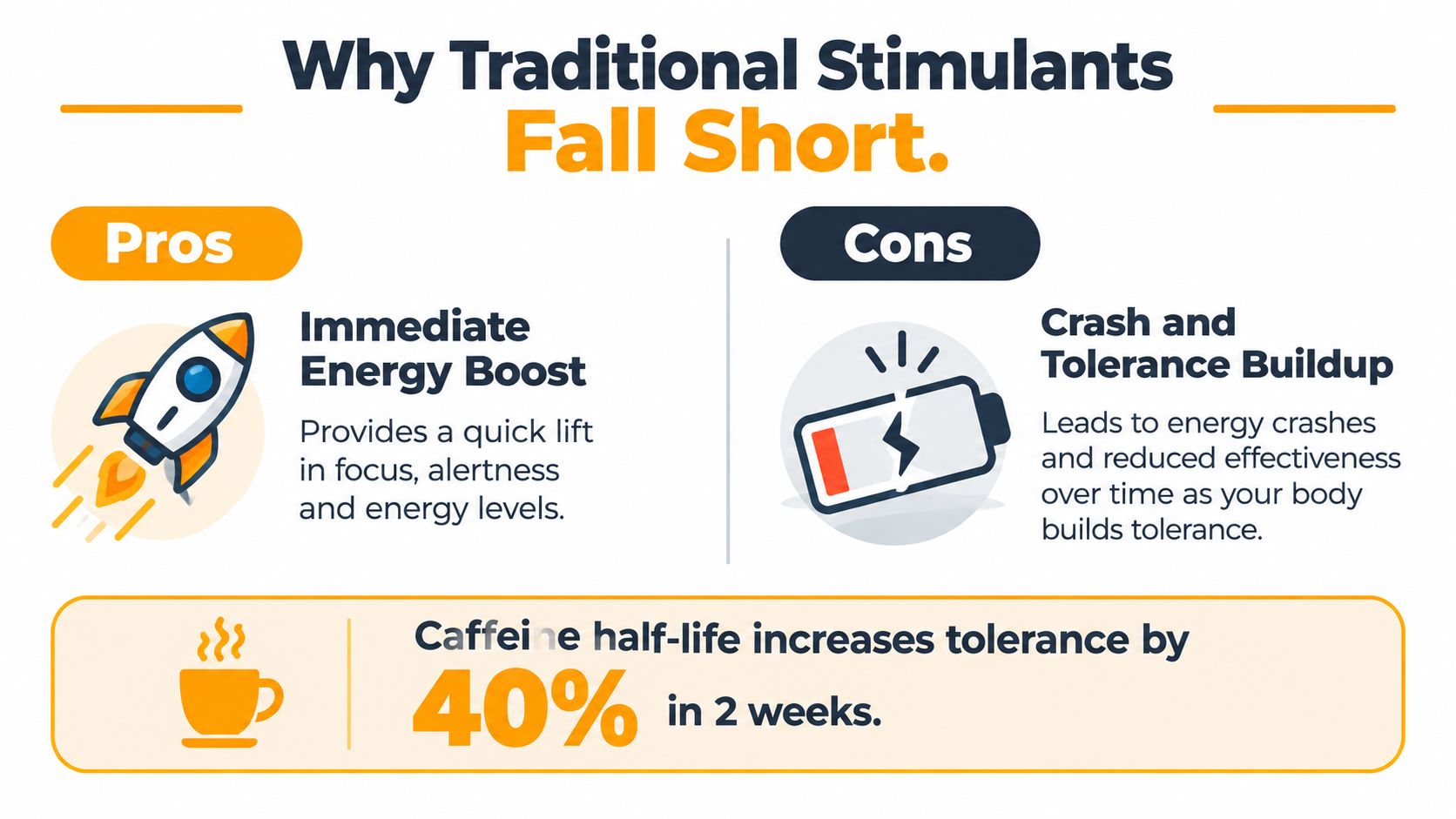
Caffeine works because it changes perceived alertness and fatigue. That acute effect is useful, but repeated exposure can change the experience. A peer-reviewed review reports that caffeine tolerance can emerge in as little as 4 days, while repeat-dose studies of theacrine showed no comparable adaptation during the reviewed protocols (peer-reviewed review of caffeine and theacrine).
That rapid adaptation creates a familiar trap. The original serving feels weaker, so the user increases the dose or chooses a more aggressive blend. The result may be more stimulation without a proportionate improvement in training, especially when the underlying problem is poor sleep, inadequate food, or accumulated fatigue.
Sensitivity varies from person to person
Some users tolerate caffeine well. Others experience jitters, anxiety, a raised heart rate, or insomnia at amounts that feel modest to someone else. Response also varies with timing, existing caffeine intake, sleep debt, medications, and individual metabolism. That makes a fixed "best" dose poor guidance for a mixed audience.
Traditional formulas can also fail for reasons that have nothing to do with caffeine. Heavy beta-alanine tingling can distract from the session, especially when a user mistakes a strong skin sensation for evidence that the formula is working. Sweeteners, acids, flavors, and large powder servings can create digestive discomfort. Proprietary blends make it harder to identify which ingredient is responsible for either a benefit or a side effect.
A practical primer on what pre workout actually does can help separate expected effects from marketing language. For readers comparing non-caffeine ingredients, a guide to non-caffeine stimulants offers a useful starting point, but any ingredient still needs to be judged by dose transparency, timing, and personal response.
The stronger scoop isn't always the better answer
Theacrine is a niche option for users seeking sustained stimulation with less evidence of tolerance buildup than caffeine. The cited review reports that theacrine up to 400 mg per day for 8 weeks appeared safe in humans with no adverse hemodynamic effects, and that a caffeine-theacrine interaction study found increased theacrine exposure without changes in heart rate or blood pressure (peer-reviewed review of caffeine and theacrine). That doesn't make it universally suitable, and it doesn't remove the need to evaluate the whole formula.
The best response to a fading stimulant effect may be a deliberate reduction in stimulation, not a more forceful product. A stimulant-free ritual, better meal timing, or a carefully controlled stack can preserve the useful part of pre-workout while removing the cycle of chasing a feeling.
Comparing the Best Pre Workout Alternative Options
A useful comparison starts with the format, not the label. Whole foods offer predictable fuel but require planning. Capsules are portable but may have a slower, less noticeable onset. Powders can combine several ingredients, yet they often create a bulky ritual and make it easy to use more than necessary. Oral pouches add a different option for people who need portability and a simple cue to begin a work or training block.
Buccal delivery is attractive because the pouch sits in the mouth rather than passing immediately through the digestive system. That can make the experience feel faster and more consistent than a heavy meal or capsule, although individual absorption and response still vary. It also lets the user separate the performance ritual from a shaker bottle, kitchen, or gym bag.
| Format | Onset Time | Best Use Case | Portability |
|---|---|---|---|
| Whole-food snack | Depends on digestion and meal size | Fueling training when carbohydrates are the main need | Moderate |
| Micro-dosed stimulant stack | Depends on the ingredients and delivery format | Controlled alertness for work or training | High |
| Stimulant-free pump formula | Usually tied to the formula and digestion | Evening sessions or users avoiding stimulants | Moderate |
| Nootropic pouch | Designed for a compact, time-anchored routine | Shift work, travel, deep work, and portable focus | Very high |
Match the option to the constraint
A banana, oats, dates, or toast can be the right alternative when the user arrives at training under-fed. The advantage isn't novelty. It's that carbohydrates address a physical requirement that stimulants can't replace. For longer sessions, a balanced meal taken earlier may be more useful than any fast-acting product.
A micro-dosed caffeine and L-theanine combination suits someone who wants alertness without the hard edge of a large stimulant serving. A stimulant-free formula makes more sense for late training, caffeine-sensitive users, or people who already consume caffeine elsewhere. Nootropic pouches suit workers who can't carry a shaker, don't want a sugary drink, or need a discreet routine during a long shift.
Nutrition decisions should also account for broader dietary needs, allergies, medications, and health conditions. Guidance from Aspen Falls Wellness dietary care provides useful context for treating supplementation as part of an individual's overall nutrition rather than as an isolated purchase.
For readers exploring alternatives to another coffee or energy drink, this guide to alternatives to caffeine for energy can help clarify whether the actual need is stimulation, food, hydration, or a change in routine.
The format won't rescue a poorly chosen protocol. A pouch used too late can still interfere with sleep if it contains stimulants. A whole-food snack can still feel heavy if the portion is too large. The winning format is the one that fits the user's schedule closely enough to be used consistently and conservatively.
Building a Smarter Performance Stack
A stack should solve one defined problem at a time. The common mistake is combining every popular ingredient, then judging the whole product by how intense it feels. A better method starts with the desired outcome, selects the smallest useful combination, and changes only one variable when evaluating results.
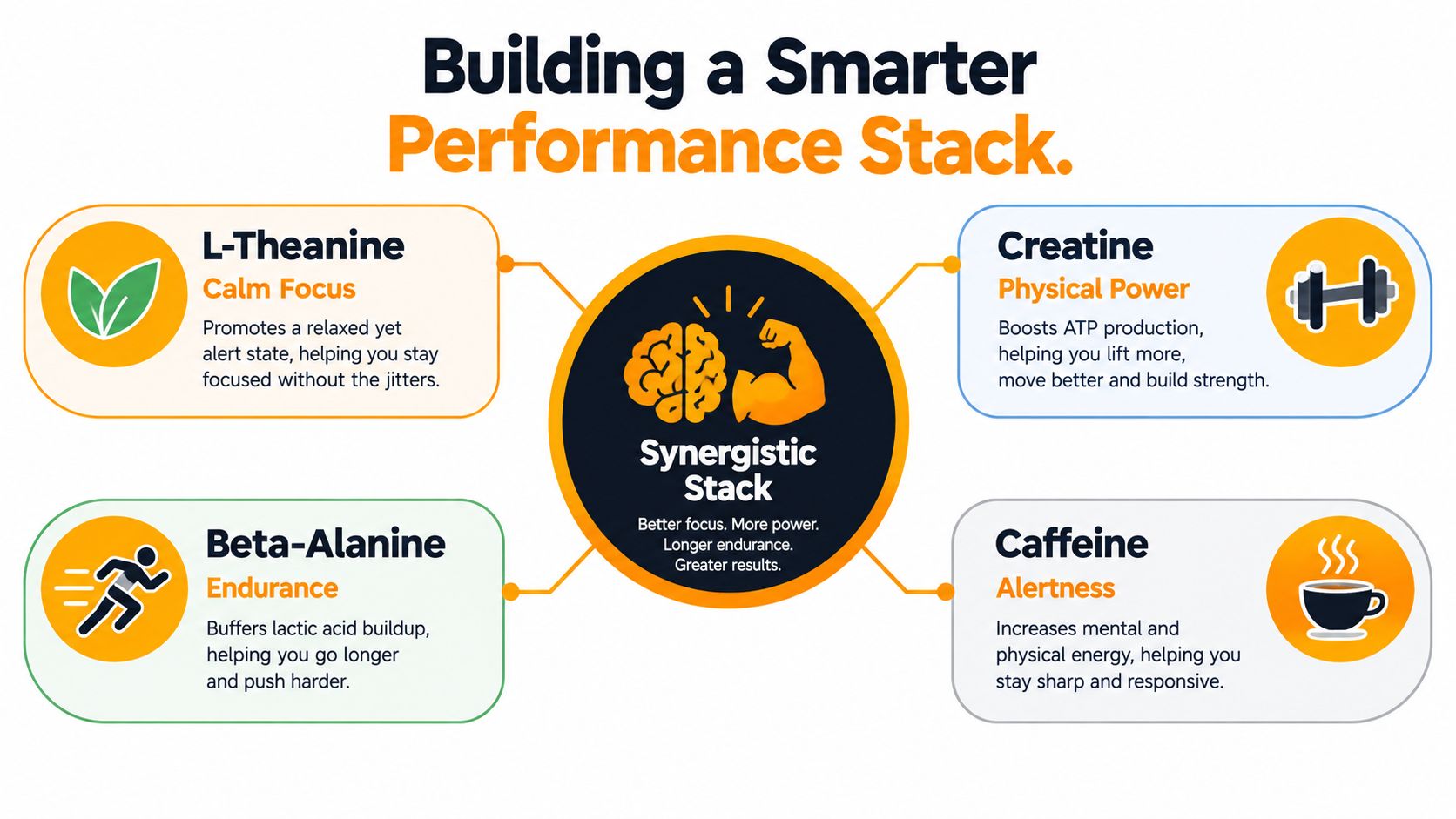
For calm alertness, the most technically credible option for caffeine-sensitive users is a caffeine and L-theanine stack. Expert reviews commonly cite about 200 to 300 mg of caffeine paired with 200 to 400 mg of L-theanine, often approximating a 1:1 to 2:1 theanine-to-caffeine ratio (Forbes Health's pre-workout review). L-theanine can attenuate jitteriness and subjective stress without eliminating alertness, which makes the pairing more suitable for focused work or training where composure matters.
Build around the outcome
For focus, use a controlled stimulant input with L-theanine rather than adding several stimulants at once. The objective is clean attention, not maximum arousal. The user should assess the combination during a normal work or training day before applying it to a high-pressure shift.
For physical training, food and hydration remain the foundation. Creatine, beta-alanine, and blood-flow ingredients belong in a broader performance plan, but their role shouldn't be confused with an acute stimulant rush. Beta-alanine tingling is a sensory effect, not a direct measure of workout quality, while a pump formula won't replace carbohydrate availability when the user hasn't eaten.
For evening recovery, remove the stimulant requirement entirely. A calming routine, light meal if needed, hydration, and a consistent wind-down cue may support better repeatability than forcing alertness into a session that occurs close to bedtime.
Read labels like a coach
A transparent label should identify every active ingredient and its amount. Avoid formulas that make comparison difficult through undisclosed blends, especially when the product combines caffeine with multiple additional stimulants. The user should also account for caffeine from coffee, tea, energy drinks, and other supplements before adding a new serving.
Performance testing can sharpen the broader plan. For people who train seriously, Telomyx VO2 max testing in Manchester is an example of a more objective way to understand aerobic capacity rather than relying only on how stimulated a session feels. For cognitive demands, supplements for mental clarity offers another lens for separating focus support from generalized energy marketing.
The stack should remain small enough to understand. If a user can't identify what changed, the protocol has become too complicated to troubleshoot.
Bridging Physical Training and Cognitive Output
The same person may need to lift before work, make decisions during a shift, and complete focused tasks late in the day. Treating those demands as separate performance problems encourages repeated dosing and inconsistent timing. A better approach uses a daily protocol that distinguishes activation, flow, and recovery.
Physical training benefits from readiness and concentration, but the workday also demands sustained attention, emotional control, and accurate decision-making. A routine that supports only the gym may leave the user overstimulated during meetings or depleted during a night shift. Conversely, a focus product that creates alertness without addressing food, hydration, or movement won't replace training preparation.
Use different phases for different demands
Morning activation can be paired with breakfast, daylight exposure, and a short movement routine. The point is to establish readiness without treating every morning as an emergency. Daytime flow should support a defined block of work, training, or shift performance, with the input scaled to the actual demand rather than used automatically.
Evening recovery requires a different signal. If training occurs late, a stimulant-free approach and a deliberate cool-down can preserve the transition toward sleep. The ritual might include mobility work, a shower, a meal, and a non-stimulating pouch or beverage, depending on the user's preferences and health context.
Nootropic pouches fit this framework because they separate the act of taking a product from a large drink or a full supplement cabinet. Their portability makes them practical for a paramedic between calls, a developer beginning a deep-work block, or a creator managing a long editing session. The delivery method is useful only when it reinforces sensible timing, not when it encourages constant use.
A performance ritual should help the user move between modes, not keep the nervous system stuck in one mode all day.
The key insight is that pre workout alternative can describe a broader timing system. The most effective routine may contain no single replacement for the original powder. It may combine food before training, a modest focus aid during a work block, and a clear evening wind-down. That approach serves physical output and cognitive endurance without assuming both require the same input.
Timing Strategies and Safety Considerations
Timing determines whether an alternative feels controlled or disruptive. A stimulant taken before a morning session may be manageable, while the same input late in the day can interfere with sleep. The user's total daily exposure, sensitivity, sleep schedule, and medications matter as much as the product's front label.
A simple rule is to place stimulating ingredients as early as the schedule allows. Users who train in the evening should test a stimulant-free formula, food-based fuel, or a non-stimulating ritual before reaching for caffeine. The aim isn't to eliminate every useful ingredient. It's to avoid treating sleep as an acceptable cost of training intensity.
Use a conservative testing process
- Start with one change: Introduce one alternative at a time so the user can identify its effects on focus, digestion, training quality, and sleep.
- Track the full day: Record caffeine from coffee, tea, energy drinks, and supplements rather than evaluating a product in isolation.
- Respect sensitivity: Jitters, anxiety, palpitations, insomnia, or unusual discomfort are reasons to stop and reassess, not signals to push through.
- Check the label: Prefer clear ingredient amounts and avoid stacking several stimulant sources without professional guidance.
- Protect hydration and food intake: A stimulant can mask fatigue caused by dehydration or inadequate energy, but it can't correct either problem.
Theacrine deserves particular caution in combination products because its exposure can change when caffeine is present. The peer-reviewed review cited earlier found that caffeine increased theacrine exposure without changing heart rate or blood pressure in one interaction study, but that finding doesn't establish universal safety for every person or formula (peer-reviewed review of caffeine and theacrine).
Know when professional input matters
People who are pregnant, breastfeeding, taking medication, managing cardiovascular symptoms, or dealing with significant anxiety should seek qualified medical advice before using stimulant products. Anyone with persistent insomnia, palpitations, chest discomfort, or severe anxiety should stop the product and obtain appropriate care.
Tolerance management also requires restraint. If a product no longer feels effective, increasing the dose may deepen the problem. A lower-stimulation day, a period without caffeine, or a shift to a non-stimulant routine can reveal whether the issue is tolerance or a more basic recovery deficit.
Sample Routines for Different Performance Goals
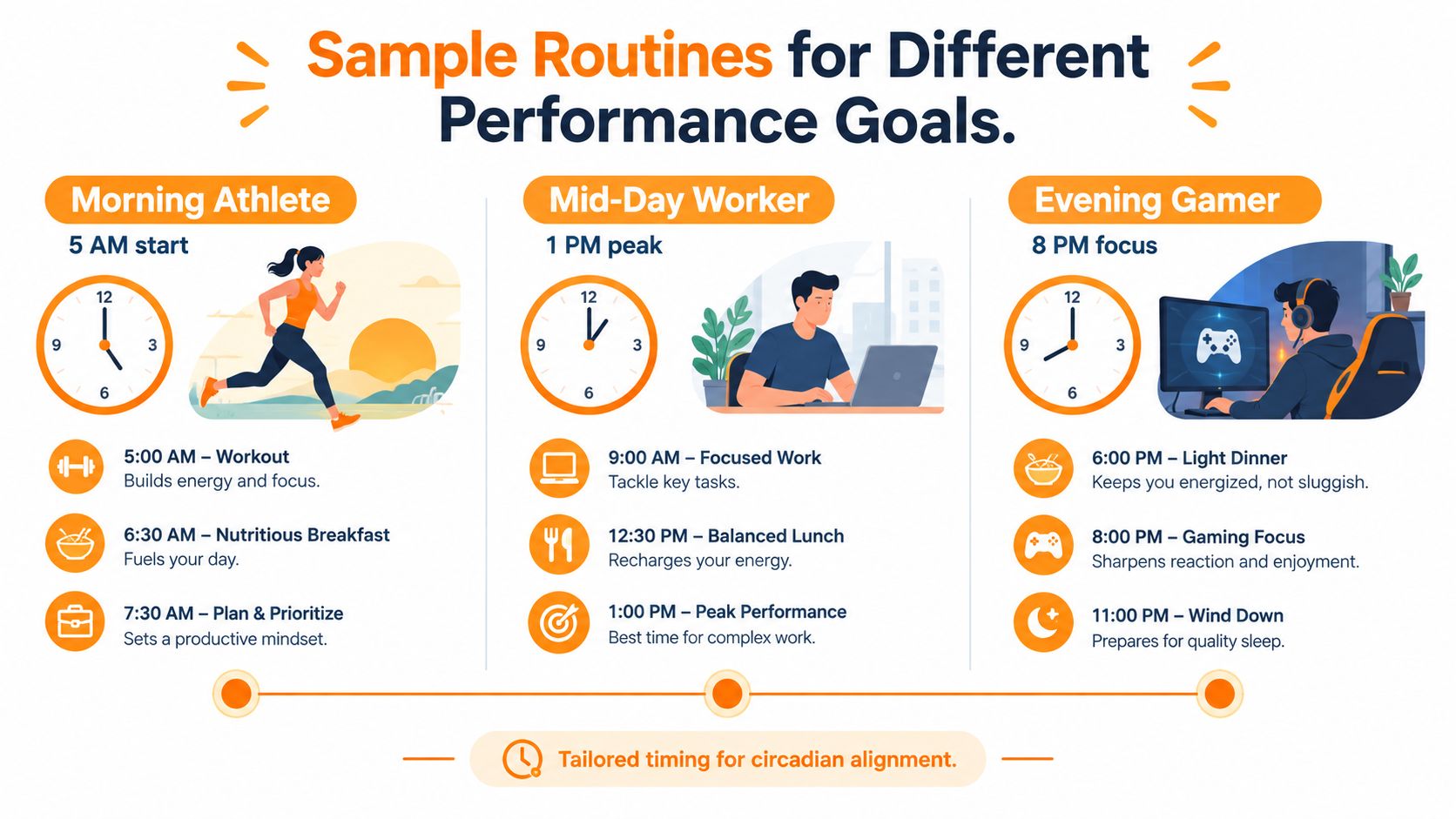
A routine works when it fits the day already on the calendar. The early-morning athlete, the mid-day shift worker, and the evening gamer don't need the same pre workout alternative because they face different timing constraints and different risks.
The early-morning athlete
A lifter training shortly after waking can start with water and an easily tolerated carbohydrate snack if food is needed. A carefully measured caffeine and L-theanine combination may suit a user who wants alertness, provided total caffeine exposure and personal sensitivity are already understood. The session should finish with a normal meal rather than another stimulant serving.
The mid-day shift worker
A nurse, emergency responder, or security professional may need portability more than a dramatic rush. A pouch-based routine can provide a consistent cue before a demanding work block, while food and water remain separate priorities. If the shift continues into the evening, the worker should avoid automatically repeating the stimulant phase and should reserve the later routine for calm focus or recovery.
The evening gamer
An evening gamer or creator often wants concentration without sacrificing sleep. A stimulant-free option, a light meal, and a defined work or gaming block can replace the traditional high-stim scoop. The routine should include a clear stopping point, lower light exposure near bedtime, and a transition that signals the session is over.
Recent coverage points to increasing interest in non-stimulant products in 2026, as the question shifts from finding a direct replacement to replacing the ritual and timing without the downsides (coverage of stimulant-free pre-workout alternatives). That shift reflects a practical reality. The best option often isn't the product that imitates the strongest sensation. It's the one that supports the user's schedule without creating a new problem.
Optimal Native offers nicotine-free nootropic pouches organized around morning activation, daytime flow, and evening recovery, making them relevant for people who want a structured pre workout alternative rather than another oversized stimulant serving. Visit Optimal Native to explore the three-stage protocol and choose a routine that fits the user's training, work, and sleep schedule.