

Melatonin for Shift Workers: Timing That Fits
UpdatedAt 7:04 on a Tuesday morning, the hospital parking lot is already bright. The shift ended four minutes ago, the drive home takes twenty-two, and the plan is to be in bed by eight with the curtains taped shut. By the time the front door closes, the body has been awake for thirteen hours, but the sun is up, and the brain has just received its clearest signal of the day that this is the moment to be alert.
That mismatch, between the sleep a roster requires and the sleep a body clock expects, is what makes daytime sleep hard to get and easy to lose. Melatonin gets pulled into the gap because it's inexpensive, sold without a prescription, and the closest thing on the shelf to a control for the internal clock. It isn't a control. It's a timing signal, and timing signals only work when they're sent at the right moment.
The honest claim is modest. Melatonin may add a small amount of sleep after a night shift, and even that evidence is rated low quality. The skill worth learning isn't finding a stronger dose. It's matching the dose to the sleep you're about to take.
Table of Contents
- Why Daytime Sleep After Nights Is Hard
- When to Take Melatonin by Next Sleep
- How Melatonin Signals the Body Clock
- What the Shift Work Trials Measured
- Three Rosters and Where the Dose Lands
- Why a Bigger Dose Is Not the Fix
- Plan the Next Sleep Before the Next Shift
Why Daytime Sleep After Nights Is Hard
The shift runs 7 p.m. to 7 a.m. Handover drags, and the nurse walks out at 7:20 into a low sun that hits the windshield the whole way home. She's tired in the way that comes from thirteen hours on her feet, but tiredness and sleepiness aren't the same currency, and her body clock is still issuing daytime instructions. The problem is a schedule fighting a clock, not a shortage of exhaustion. Anyone who has lain in a dark bedroom at 9 a.m. with heavy legs and a wide-open mind knows the difference.
If fatigue without sleepiness is unfamiliar territory, the science behind fatigue and insomnia explains why a worn-out body can still refuse to sleep.
What melatonin offers in that moment is narrow and real. It's a timing signal that may lengthen post-shift sleep by a modest amount when it lands at the right point in the cycle. It won't knock her out, and it won't do anything for the 3 a.m. stretch on the unit when she needs to stay sharp. Treating it as a knockout pill or as fuel for the shift is where most of the disappointment comes from.
The tablet doesn't create night. It tells the clock where night is supposed to be.
Two limits sit over everything that follows. First, the evidence base is rated low quality, so a personal result can be smaller than the average or absent entirely. Second, light, a dark quiet room, and a protected sleep window do more work than any milligram count. A dose taken in a bright bedroom is a signal shouted down by a louder one.
The rest of this guide runs in a deliberate order: a table keyed to the next sleep opportunity, the way the hormone talks to the clock, the trial numbers with their confidence ranges and quality ratings, three real rosters, and the point where raising the dose should stop in favor of clinical help. Use the table as the decision card and the later sections as the reason the card stays cautious.
When to Take Melatonin by Next Sleep
A nurse finishing a night shift may need daytime sleep, while the same nurse after the last shift may be trying to return to nighttime sleep. Time melatonin for the next sleep opportunity, not a fixed hour on the clock. On a rotating roster, that target can change from one day to the next.
The American Academy of Sleep Medicine guidance conditionally suggests melatonin for daytime sleep after a night shift, nighttime sleep when transitioning back from shift work, and a nap before the first night shift. The certainty behind these suggestions ranges from low to very low, so treat them as cautious guidance rather than a guarantee.
Why a fixed evening hour misses
Published studies varied in both dose and how long before habitual bedtime melatonin was taken. A habitual bedtime is a poor reference point for someone sleeping at 8 a.m. after a night shift and at night after returning to days off. The practical question is when the next sleep begins, how the roster is changing, and when you must wake.
| Situation | Take it | Sleep you are protecting | Certainty and caution |
|---|---|---|---|
| Daytime sleep after a night shift | After the shift and commute, before planned daytime sleep | Main daytime sleep | Conditional suggestion; low to very low certainty; reduce morning light |
| Transition back to days off | Before the nighttime sleep you want to reclaim | Night sleep | Conditional suggestion; reassess once the schedule changes |
| Nap before the first night shift | Before the pre-shift nap | Short nap, not the overnight shift | Conditional suggestion; melatonin is not an alertness aid for work |
| Permanent nights | Before the main daytime sleep episode, consistently | Daytime sleep | Keep timing tied to the sleep episode, not the work shift |
| Fast rotation or irregular hours | Recalculate for the next sleep, shift direction, commute, and required wake time | Whichever sleep comes next | Hardest to standardize; one fixed evening hour may not fit |
For a post-shift sleep, finish the commute first, then take melatonin before the planned sleep in a dark room. That order matters: the dose is meant to support sleep, not the drive home. The time melatonin may take to work can help you think through the interval between taking it and lying down, though the right timing depends on the sleep opportunity.
When a run of nights ends, the target becomes the nighttime sleep you want to resume. Before the first night of a block, the suggested target is the pre-shift nap. In both cases, time the dose for the sleep you are protecting, not for the hours you will be working.
For permanent nights, keep the dose tied to the main daytime sleep. With a fast rotation, recalculate using four details: the next sleep, the direction of the rotation, the commute, and the required wake time.
Working rule: plan around the next sleep, then check the shift change, commute, and wake time.
Use the table as a planning aid, not an individual prescription. If sleep or alertness problems continue, discuss them with a clinician rather than increasing the dose on your own.
How Melatonin Signals the Body Clock
Think of the body's own melatonin as a dimmer switch rather than an on switch. Levels climb through the evening, and NIOSH notes that endogenous melatonin normally peaks around 2 to 4 a.m. before declining toward morning. That rise lowers alertness and opens the gate for sleep. It doesn't force sleep the way a sedative does.
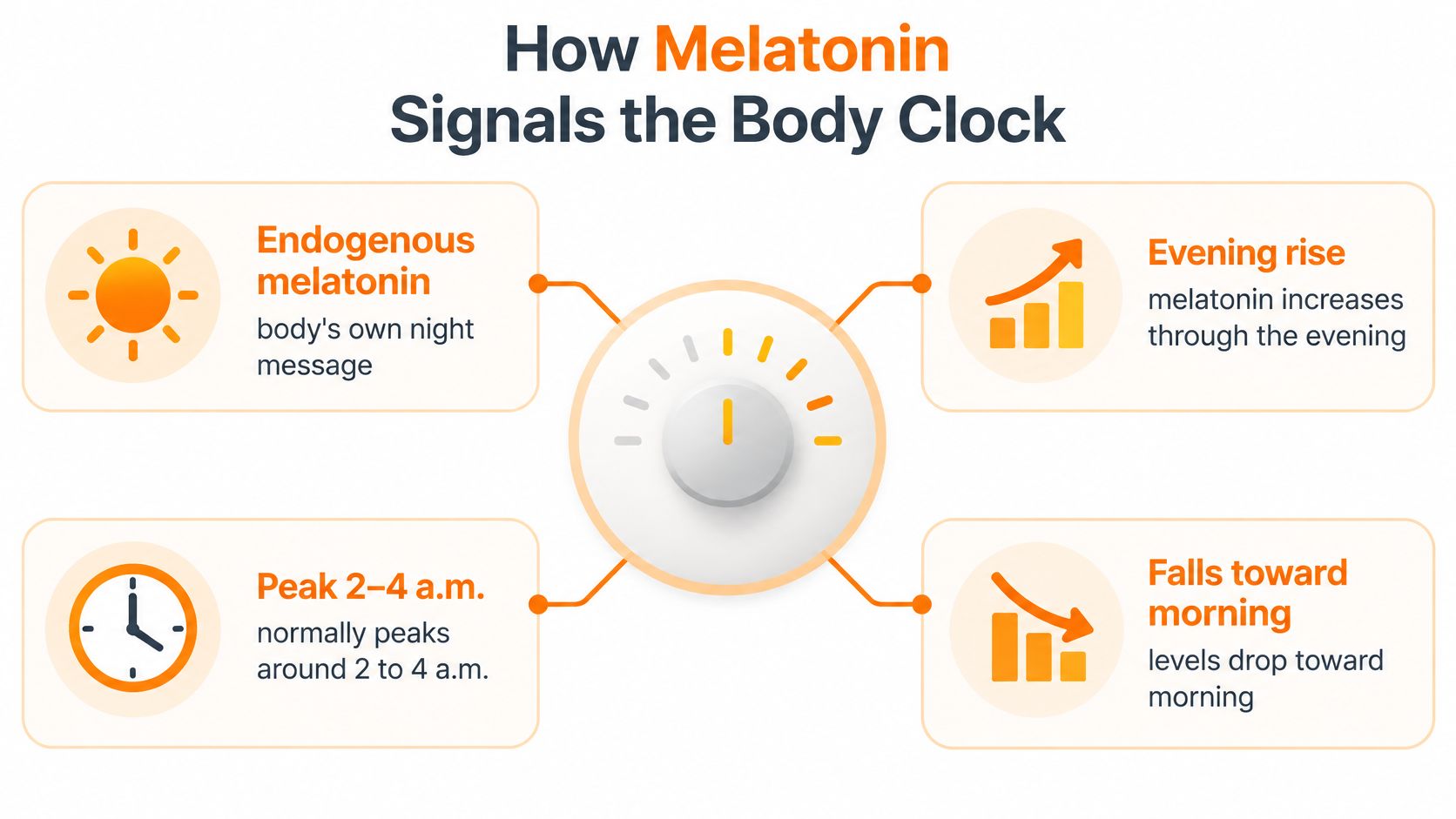
Why the same dose lands differently at 8 a.m. and 10 p.m.
A dose taken close to the intended sleep works as a go-to-bed signal, reinforcing the message the clock is already sending. The same molecule taken at the wrong circadian phase may produce little effect, or nudge the clock in the direction you didn't want. NIOSH states that plainly: mistimed melatonin can shift the body clock undesirably.
Rotating schedules defeat any single instruction, because both sleep timing and light exposure change the phase-response relationship. Yesterday's correct time is today's mistimed dose. The practical protocol is to align dosing with the worker's planned sleep episode, typically after the night shift and before daytime sleep, while cutting morning daylight and keeping the room dark and quiet.
A small dose at the right phase does more than a large one at the wrong phase.
NIOSH also cautions that research remains insufficient to recommend melatonin as a routine aid for every shift worker, and that continuing problems with sleep or alertness warrant clinical evaluation rather than escalating self-dosing. That's the line to hold onto. The measured size of the benefit is smaller and more uneven than the labeling implies, and the scheduling rule that follows from the phase mechanism is what changes outcomes.
What the Shift Work Trials Measured
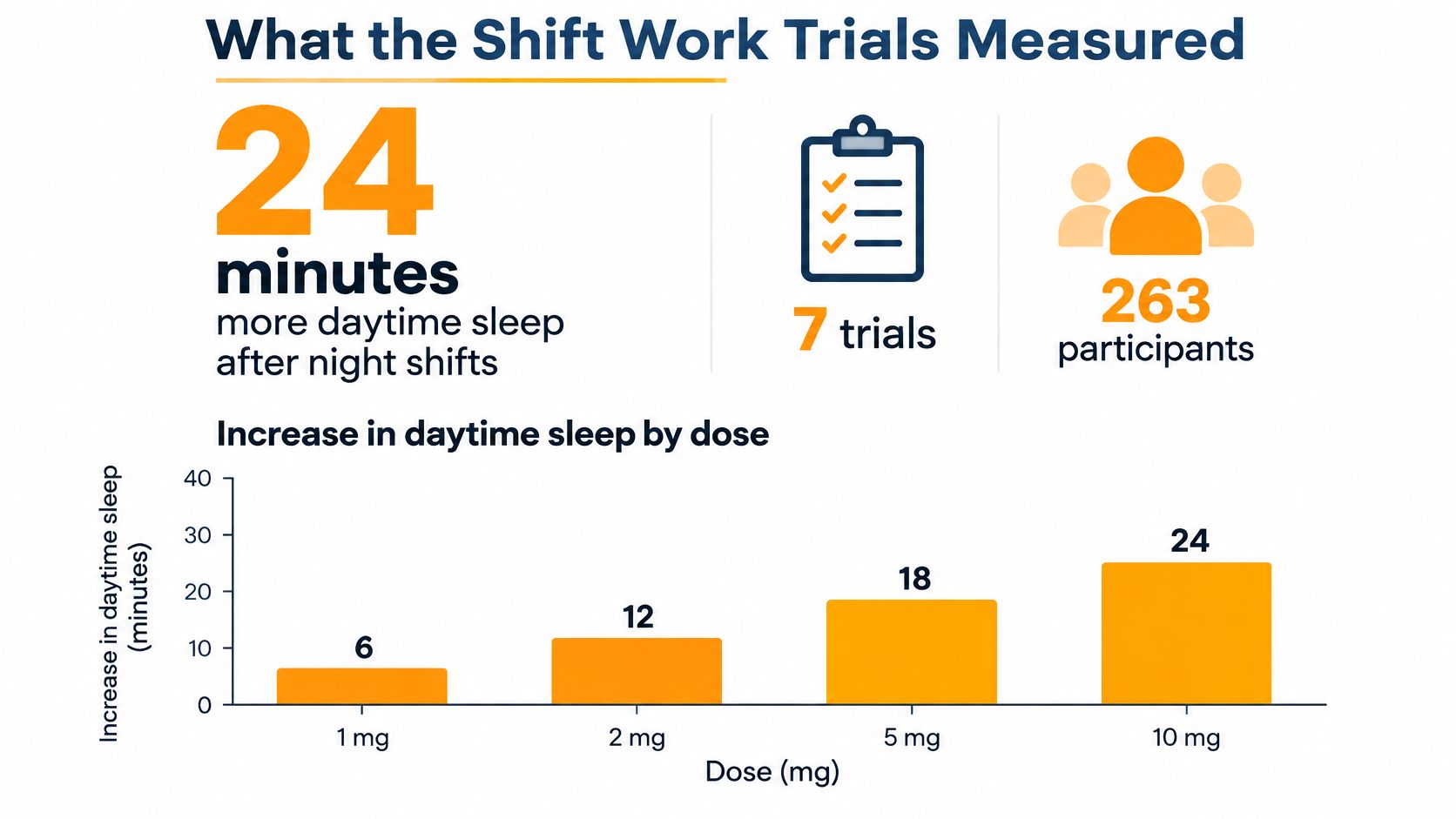
Start with the average, because it sets the scale. A Cochrane systematic review published in 2014 pooled seven trials with 263 participants and found that melatonin doses from 1 to 10 mg increased daytime sleep duration after night shifts by an average of 24 minutes compared with placebo. The 95 percent confidence interval ran from 9.8 to 38.9 minutes.
Three trials with 234 participants found about 17 extra minutes of subsequent nighttime sleep, with an interval of 3.71 to 30.22 minutes. Measured in both directions of the clock, the hormone did something.
The measure that didn't move
Then look at the number that stayed flat. Five trials with only 74 participants found time to fall asleep differed by an average of 0.37 minutes versus placebo, with a confidence interval from minus 1.55 to plus 2.29 minutes. Sleep onset was not clearly shorter in that pooled set, which is the opposite of what many people buy melatonin for.
What low quality evidence means for one worker
The review rated the whole package low quality. That rating isn't a technicality. It means the average can hide studies that found little or nothing, it doesn't prove that any particular dose or schedule works, and one worker's result can land anywhere inside the interval or outside it.
Set the smaller field picture beside it without turning it into a second verdict. Among night workers who already struggled to fall asleep, a crossover study found sleep efficiency improved and sleep onset shortened, while total sleep time and wake after sleep onset didn't change significantly.
| Measure | Result | Who was studied | How to read it |
|---|---|---|---|
| Daytime sleep after a night shift | About 24 minutes longer than placebo (95% CI 9.8 to 38.9 minutes); doses 1 to 10 mg | 7 trials, 263 participants | Low-quality evidence; a possible gain in duration, not a guarantee |
| Later nighttime sleep | About 17 minutes longer (95% CI 3.71 to 30.22 minutes) | 3 trials, 234 participants | Same review; still a small average |
| Time to fall asleep in the Cochrane set | About 0.37 minutes versus placebo (95% CI -1.55 to 2.29 minutes) | 5 trials, 74 participants | No clear shortening of sleep onset |
| Sleep efficiency in a field crossover | 82.1% at baseline to 85.5% after melatonin (plus 3.4 points) | 39 of 50 selected workers completed | Suggests a small efficiency gain in people who already had trouble initiating sleep |
| Sleep-onset latency in that field study | About 16.2 minutes to about 12 minutes (about 4.2 minutes less) | 39 completers | Onset improved here; total sleep time and wake after sleep onset did not change significantly |
Expect a possible slice of extra daytime sleep, not a transformed night. Don't generalize 39 completers, or 263 participants pooled across mixed occupations, to a specific job or a specific body. And don't read a small average as a reason to raise the dose later, since that instinct has its own set of trial results against it.
Three Rosters and Where the Dose Lands

A nurse walks toward her car as the sun comes up. The dose decision happens in that walk, not at 10 p.m. the night before.
Permanent nights, 7 p.m. to 7 a.m.
She finishes at seven, keeps sunglasses on for the drive, walks into a bedroom with the blackout lining already closed and a fan running, and takes her dose as part of that setup rather than as a separate ritual. The target is the daytime sleep she's about to start. What she is not doing is taking it to feel sharper at 3 a.m. on the unit. The failure mode for this roster is bright morning light. Twenty minutes of sun on the drive home can outweigh the signal she just swallowed.
Three nights, then a flip
A rotating paramedic works three 7 p.m. to 7 a.m. shifts, then has four days off and wants to be a daytime person again. On the block's mornings, the dose sits before daytime sleep. On the first recovery night, it moves to before the nighttime sleep he's reclaiming, because a dose at 7 a.m. would fight the flip he's asking his clock to make. The failure mode is a dose still aimed at 10 p.m. while he's on a day-sleep schedule, or one still taken after sunrise on his first night off.
First night after days off
A security officer coming off days off wants a late-afternoon nap before his first overnight. The conditional use is before that nap, with an alarm set so the nap doesn't erase the overnight wake time. The failure mode is treating melatonin as coffee for the shift. It won't manufacture alertness at 4 a.m., and taking a second dose to try is both common and unhelpful.
For the wider picture of how overnight work reshapes alertness and recovery, this short overview is worth ten minutes of a day off.
One humility check before trusting any of these scenes. The field study behind the most encouraging efficiency numbers in this area finished with 39 workers out of 50 selected from 295 screened, as reported in the 2016 randomized crossover field trial. A careful protocol tested in 39 people is a signal, not proof that a nurse, a paramedic, and a security officer respond the same way.
Roster design is the other half of the puzzle, and building a shift work schedule that supports sleep covers block length, direction of rotation, and how recovery days are spent.
If you can't point to the next sleep episode, the commute, and the required wake time, you don't yet have a timing plan.
Why a Bigger Dose Is Not the Fix
If 3 mg bought twenty extra minutes, the instinct says 6 mg buys forty. The trial record doesn't support the arithmetic. The Cochrane review's dose-response analyses found no clear dose-response relationship across the 1 to 10 mg range, and in analyses of doses of 5 mg or more, raising the dose did not significantly improve next-day sleep length. Higher doses didn't consistently produce greater benefits at all.
Wider guidance hasn't rescued the picture. Reviewers looking across published recommendations found no clear relationship between dose strength or formulation and effectiveness. A separate review of sleep-wake medications in shift work rated melatonin evidence low quality across 15 randomized trials and 718 participants and did not treat it as a proven treatment for shift-work sleep disorder.
What it will not do
- It's not an alertness drug. Staying awake and safe overnight is a different problem with different tools, and a tablet at bedtime does nothing for the 4 a.m. slump.
- It doesn't replace a protected sleep window. If the roster leaves five hours in a bright room, the dose changes almost nothing.
- It doesn't cancel late caffeine. A coffee at 2 a.m. works directly against the signal you're planning for 8 a.m., and caffeine usually wins.
Stop rules that belong with a clinician
None of this makes melatonin useless. It means the dose isn't the dial to turn when the result disappoints. These are the situations that call for a clinician instead of a second tablet.
- Sleep stays fragmented after a fair trial. Consistent timing, a dark room, and caffeine discipline for a couple of weeks with no improvement points to something else worth investigating, from shift-work sleep disorder to sleep apnea or anxiety.
- Drowsiness on the drive or on duty becomes dangerous. That's a safety event, not a supplement question, and it needs a medical conversation.
- You'd be combining it with other sedating medicines. Additive effects are a prescribing question, not a dosing question.
- You're pregnant or breastfeeding, or you have a condition the label doesn't cover. The label isn't a substitute for a clinician who knows your history.
- Only a higher dose feels like it will work. That belief is the trap itself.
The dose is not the dial. Timing and darkness are.
Keep a low, timed dose only as an optional add-on to sleep timing and a dark room, and stop self-adjusting when alertness at work or on the road is a genuine problem.
Plan the Next Sleep Before the Next Shift
Three lines, written before the next run of shifts, do more than any dosing debate.
- Name the next sleep episode and its start time. Not "tonight." A specific hour, on a specific date, after a specific shift.
- Set the required wake time and check the plan fits between the two. If the math leaves four hours, the schedule is the problem and no tablet fixes it.
- Mark whether the drive home happens in daylight. If it does, sunglasses and a blackout room are part of the plan, not optional extras.
With all three lines clear, place any melatonin shortly before that sleep, keep the room dark and cool, and judge the result by whether sleep starts a little more easily and lasts a little longer. Don't judge it by how alert the shift felt. If a line is unclear, skip the dose until the target is set, since a mistimed signal is the failure this whole approach warns against.
Late-shift caffeine belongs in the same plan. Stop it early enough that it isn't still working when you want the sleep signal to land.
Tracking helps here. A sleep and nutrition tracking comparison is a useful reference for choosing something that logs both sides of the day, so you can see whether the late caffeine or the late meal is the thing keeping you awake at 9 a.m.
Where a product fits, and where it doesn't
The wind-down hour matters as much as the dose, and how to wind down before bed covers the routine that makes any timing plan more likely to hold.
Optimal Native makes an evening pouch that follows the same rule. Evening Relax is the caffeine-free Midnight Berry formula with 2 mg of melatonin per pouch, alongside L-theanine, GABA, chamomile, lemon balm and magnesium, sold in containers of 20 and used as one pouch close to bedtime inside its 5:00 PM to 10:00 PM window. It's an optional wind-down product, not a treatment for shift-work sleep disorder, and the same evidence limits apply: a possible small help with sleep timing, never a guarantee.
Optimal Native builds a three-formula daily protocol, and its evening piece is Evening Relax, the caffeine-free Midnight Berry pouch with 2 mg of melatonin plus L-theanine, GABA, chamomile, lemon balm and magnesium, taken as one pouch close to bedtime. If you're rebuilding sleep around a roster instead of a fixed bedtime, it fits the rule this guide keeps returning to: put the signal before the sleep you're about to take. Visit Optimal Native to see how the morning, daytime, and evening formulas fit together.