

How to Focus Deeply: A Practical Guide for Real Days
By mid-morning, the usual pattern has already started. The first coffee has worn off, the body feels a little overclocked, ten tabs are open, and the brain keeps sliding off the task that matters. One Slack ping, one email preview, one glance at the phone, and the day turns into motion without output.
That cycle trains people to think they have a discipline problem. Most of the time, they don't. They have a systems problem. Learning how to focus has less to do with trying harder and more to do with building a repeatable protocol around task scope, environment, schedule, stimulation, and recovery.
Table of Contents
- The Focus Crash You Keep Losing To
- Designing Your Environment and Tasks for Deep Work
- Time-Blocking a Real Deep-Work Day
- Stacking Caffeine, L-Theanine, and Flow Pouches the Right Way
- Sleep, Nutrition, and Recovery That Protect Tomorrow's Focus
- Why Willpower Is the Wrong Problem to Solve
- Your One-Page Deep Focus Protocol and Quick Answers
The Focus Crash You Keep Losing To
The classic focus crash doesn't look dramatic. It looks normal. A person sits down with every intention of doing real work, but the task is vaguely defined, notifications are still live, and the only fuel plan is another hit of caffeine when energy drops.
That setup fails because deep focus isn't something a person summons on demand. It has to be engineered. Attention falls apart when sleep is off, when inputs are mistimed, when the room keeps inviting interruptions, and when the work itself is too fuzzy to hold the brain in one lane. For readers trying to sort out the biological and psychological side of attention drift, this breakdown of what causes poor focus is useful because it frames concentration problems as a mix of health, stress, environment, and workload, not a character flaw.
Why the crash feels personal when it isn't
A lot of people blame themselves for the moment they stop tracking. They think they got lazy. In practice, the day was often lost much earlier.
The phone stayed on the desk. The inbox stayed open. The task on the calendar said "work on proposal" instead of "draft pricing section and client objections." The second coffee got used to patch over a bad night of sleep, so the body got louder while the thinking got sloppier.
Deep focus breaks long before the person notices it broke.
That matters for founders, clinicians, analysts, developers, and shift workers because real days aren't quiet. They're fragmented, reactive, and full of false urgency. A reliable focus routine has to survive that reality.
What actually changes the outcome
The workable model has a few layers:
- Environment control: remove the cues that trigger checking behavior.
- Task design: define one visible output before the block begins.
- Time protection: schedule deep work before the calendar fills up.
- Input timing: use stimulation deliberately instead of chasing dips all day.
- Recovery: protect sleep and wind-down so tomorrow's block still exists.
Motivational fluff doesn't help here. A protocol does.
Designing Your Environment and Tasks for Deep Work
A deep-work block usually fails before the timer starts. It fails when the desk still supports distraction, when the task is too broad, and when interruption paths are left open. The fix isn't glamorous. It's mechanical.
A foundational field study of knowledge workers found that people spent an average of only about 11 minutes in a single working sphere before switching, and 57.1% of timed work segments were interrupted before completion. When workers returned later that same day, resuming took an average of 25 minutes and 26 seconds after moving through 2.26 other work spheres, according to the summary of that 2005 research at deep work statistics and interruption costs. That is why a protected block matters. Not because long sessions sound virtuous, but because re-entry is expensive.
Build a room that supports one task
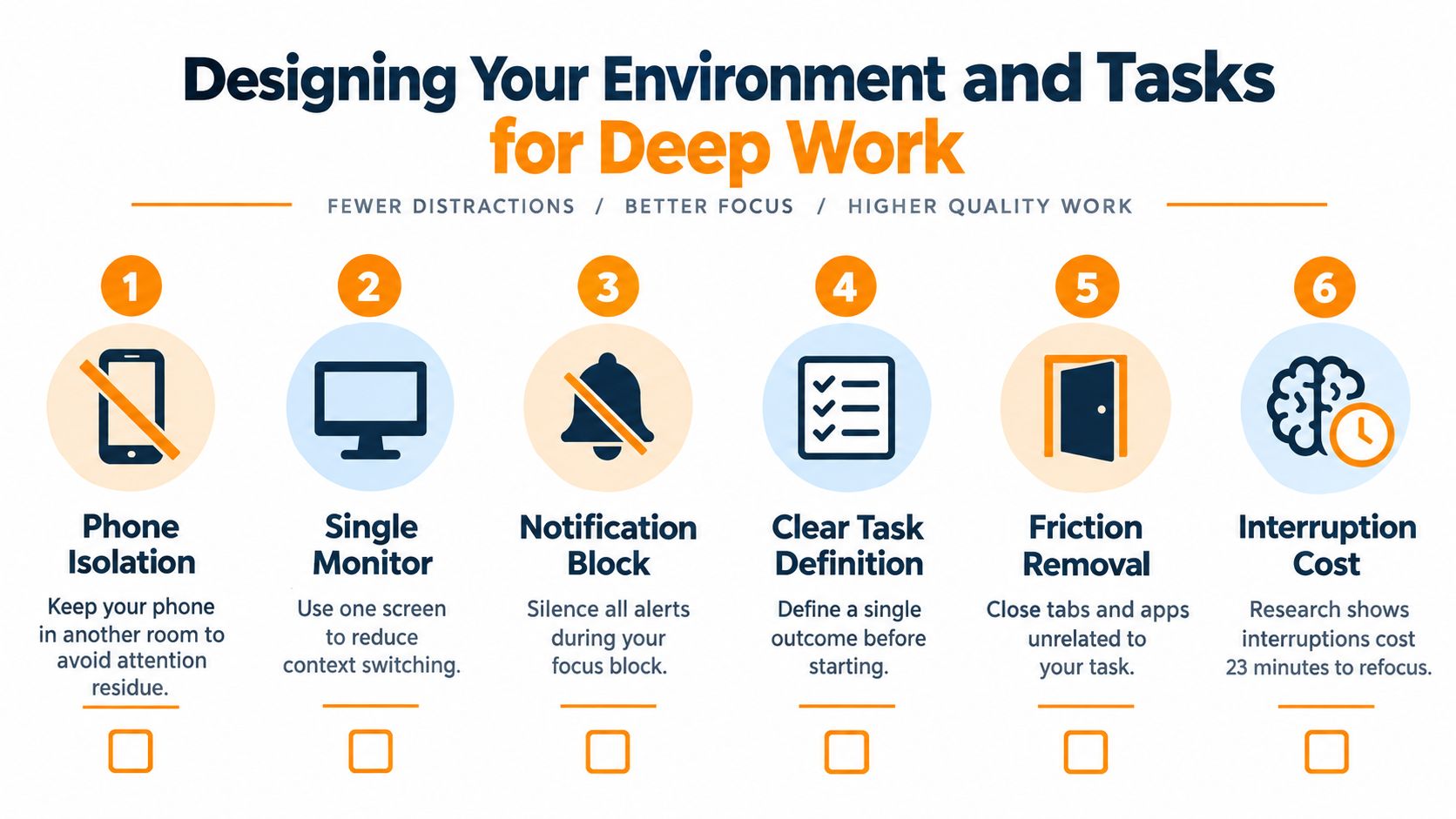
The most useful environment changes are simple and slightly annoying. That's why they work.
- Put the phone elsewhere: Face-down on the desk isn't enough. The brain still tracks it as an available reward source.
- Use one screen when possible: Multiple screens are useful for some workflows, but they also make grazing easier. For writing, planning, analysis, and strategy work, one screen often creates cleaner attention.
- Control the room: Stable lighting, tolerable temperature, and either silence or predictable ambient sound reduce the number of small corrections the brain has to make.
- Reduce visual noise: Open only the document, tool, or code window required for the block.
Screen-heavy work creates another tax people underestimate. Visual strain turns into mental fatigue fast. For people who spend full days on monitors, this guide to digital eye strain protection is a practical companion to any focus setup.
Define the task so the brain can hold it
Sophie Leroy's research on attention residue showed that switching away from an unfinished task leaves lingering thoughts that hurt performance on the next task. Her work also showed that finishing a task isn't always enough to fully disengage. A better handoff is to create a clear stopping point and write a specific ready-to-resume next step, as outlined in Leroy's attention residue research.
That idea changes task design. "Work on report" is too loose. The mind keeps scanning for what the task is.
A stronger block starts with a one-sentence definition like this:
Practical rule: one block, one artifact, one next action.
Examples work better than theory:
-
Instead of "work on deck"
Use "rewrite slides 4 through 7 so the pricing story is clear" -
Instead of "do marketing"
Use "map the landing page headline, proof, and call to action" -
Instead of "code for a while"
Use "ship the login validation function and test the edge case"
The pre-block checklist that prevents drift
Before the block starts, the setup should be boring and consistent:
- Notifications off: Slack, email, calendar popups, and phone alerts go dark.
- Document open: The exact working file is already on screen.
- Water poured: No reason to get up in the first ten minutes.
- Timer set: The block has edges.
- Output visible: A note on paper or screen states what must exist by the end.
People who want to know how to focus usually ask for better tactics inside the block. Most of the gain comes from what happens before it.
Time-Blocking a Real Deep-Work Day
A productive day doesn't alternate randomly between concentration and chaos. It has a rhythm. Deep work goes in first, shallow work gets contained, and transitions are handled on purpose instead of by impulse.
A 2026 survey reported that employees average 3.7 deep-work sessions per week while saying they need 5.1 to feel productive. The same 2026 workplace benchmark reported that only 39% of tracked work time was genuine deep focus, or about 2 to 3 hours per day, according to the Google Cloud Next deep work trends report summary. That gap tells the story. Many aren't bad at focus. Their calendar doesn't protect enough of it.
What the day looks like when focus is scheduled first
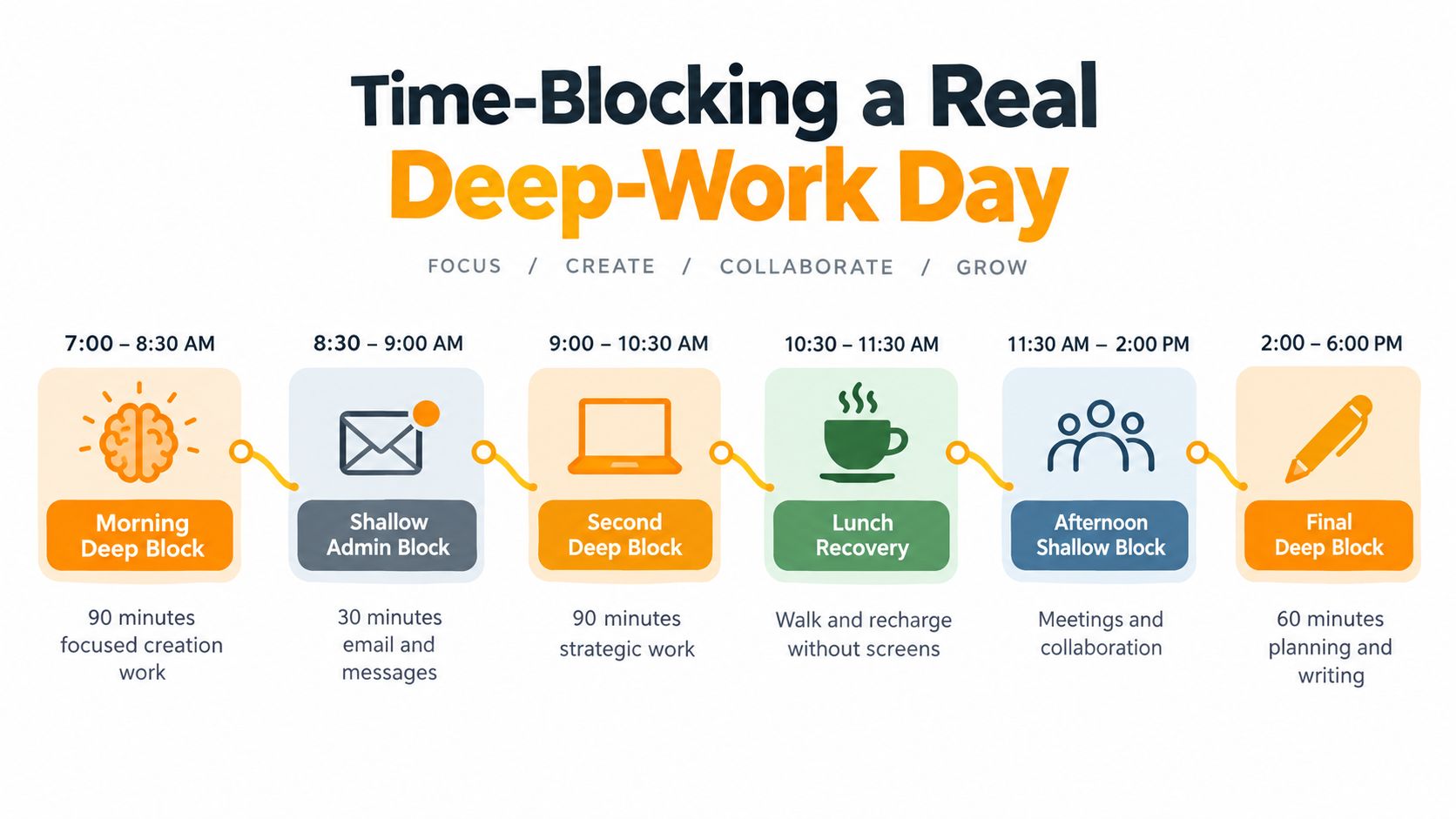
The morning block should carry the hardest thinking. That's when strategic writing, building, planning, analysis, or design work gets done. The exact hour matters less than consistency. For shift workers, a fixed start ritual tied to wake time works better than waiting to "feel ready."
A realistic pattern looks like this in practice:
- Early deep block: one defined artifact, no messages, no meetings
- Late-morning shallow block: inbox, approvals, admin, scheduling
- Midday recovery window: food, movement, no scrolling spiral
- Afternoon deep block: one narrower output than the morning block
- Late-day wind-down work: planning, review, cleanup, handoff notes
This explainer on deep work vs shallow work is useful because it helps people stop treating all desk time as equal. It isn't. Writing a strategy memo and clearing notifications don't belong in the same mental bucket.
A visual version of that rhythm helps make the pattern concrete.
Transition rituals matter more than people think
The handoff between blocks decides whether the second half of the day is usable. Without a reset, shallow work bleeds into everything.
A clean transition can be as plain as:
- close the completed file
- write the next action for the task being paused
- stand up and walk briefly
- reopen only the tool needed for the next block
The schedule should make deep work the default, not the reward for finishing everything else.
That one change fixes a lot. When people ask how to focus during a real workday, the answer is often calendar architecture before concentration technique.
Stacking Caffeine, L-Theanine, and Flow Pouches the Right Way
Most focus stacks fail because people use stimulation as damage control. Energy dips, so they add more caffeine. Attention scatters, so they add another stimulant. Then sleep gets worse, the next day starts weaker, and the loop repeats.
A better protocol separates activation, sustained focus, and wind-down. Those are different states, and they shouldn't all be solved with the same input.
Use caffeine for lift, not for all-day rescue
The most practical caffeine setup is usually a 2:1 L-theanine-to-caffeine ratio. A common example is 100 mg caffeine with 200 mg L-theanine. The point isn't to dull caffeine. It's to smooth it so the person gets alertness without as much shakiness or mental static.
This overview of L-theanine and caffeine pairing is useful because it frames the stack as a focus tool rather than a brute-force stimulant play.
Higher caffeine often feels stronger in the first stretch, but that doesn't always mean more useful work. It can narrow attention too aggressively, make task switching feel irresistible, and leave the person with a shorter productive peak followed by a rougher drop.
Match the stack to the block
Morning, flow, and evening inputs should do different jobs.
| Time Window | Stack | What It Does | Pouch Pairing |
|---|---|---|---|
| Wake-up window | Caffeine with L-theanine | Raises alertness with a calmer feel than caffeine alone | Morning pouch if a person prefers a time-anchored ritual |
| Start of deep block | Lower stimulation with a steadying component | Supports sustained attention without turning the block jittery | Flow pouch during the work session |
| Late day and pre-sleep | Non-caffeinated wind-down stack | Helps lower arousal so recovery doesn't rely on willpower | Evening pouch |
Optimal Native organizes this idea into a three-stage pouch system: Morning Energy for activation, Day Flow for daytime focus, and Evening Relax for wind-down. The point isn't that a pouch is required. The useful part is the protocol logic. Morning support, in-block support, and evening recovery should not be treated as the same problem.
Timing matters more than people want it to
Caffeine has a long tail. If a person keeps layering it into the afternoon, they borrow from the next sleep window. That's especially costly for shift workers trying to sleep during the day after a night shift. A late stimulant can feel helpful in the moment and still wreck the next recovery block.
Common errors show up fast:
- Second coffee too late: attention improves briefly, then bedtime gets pushed out mentally even if the body is tired.
- Using flow support as emergency rescue: by the time energy has cratered, the block is usually already compromised.
- Stacking stimulation on stress: the body gets louder, but the task doesn't get clearer.
The right stack should make the block steadier, not merely more intense.
People who want to learn how to focus usually get obsessed with ingredients. Timing is the bigger lever.
Sleep, Nutrition, and Recovery That Protect Tomorrow's Focus
Tomorrow's focus starts tonight. That isn't soft advice. It's operational reality. If recovery fails, the next deep block starts with degraded attention before the laptop even opens.
Shift workers feel this first because their schedule exposes the cost immediately. A 2025 systematic review concluded that sleep education alone is unlikely to solve shift workers' problems and recommended interventions that help workers self-regulate behaviors, thoughts, and emotions to manage sleep and fatigue more effectively. The same review summary notes that rotating shiftwork research found forward rotations negatively affected sleepiness, sleep efficiency, and total sleep time, while broader work reported disrupted circadian rhythm, reduced sleep quality, more daytime sleepiness and fatigue, and lower concentration and productivity in shift workers, according to this review on shift work, sleep, and fatigue.
Sleep is the base layer
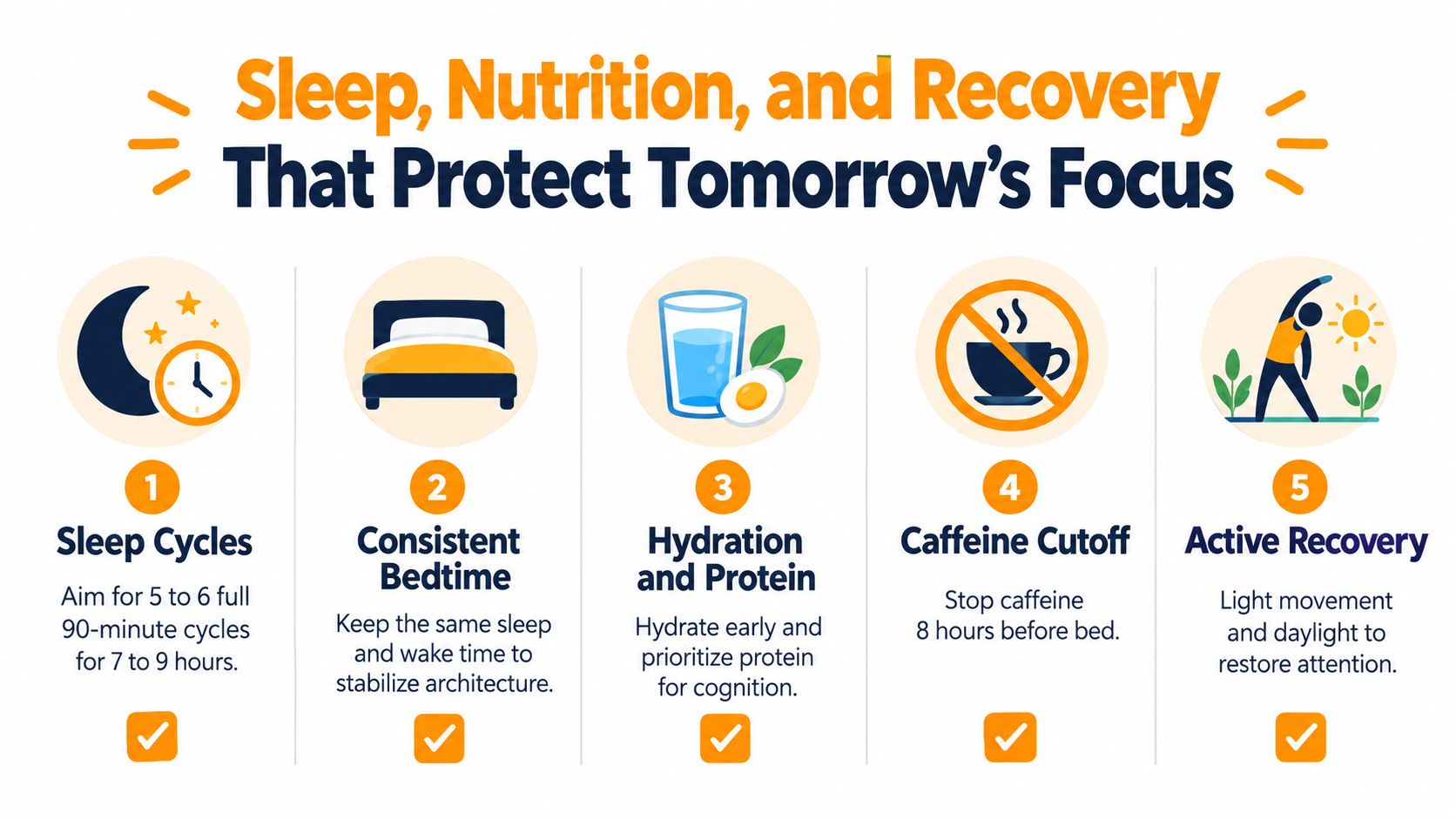
For many, the first priority is consistency. The brain does better when sleep and wake timing stop drifting all over the week. Shift workers may not get perfect consistency, but they still benefit from stable pre-sleep cues such as blackout conditions, reduced light, and a repeated wind-down sequence.
This guide on how to wind down before bed is relevant because a lot of people don't have an insomnia problem as much as they have an overactivation problem. They never downshift.
A few rules carry most of the weight:
- Protect the last hour before sleep: don't hand it to bright screens and stimulating work.
- Use the room correctly: cool, dark, and boring beats comfortable but distracting.
- Set a stimulant cutoff: if sleep is the goal, the day needs an endpoint for activation.
Food and hydration change the block more than people expect
Breakfast should support stable thinking, not a fast spike and fade. Protein plus slower-digesting carbs usually gives cleaner output than a sugar-heavy start or no food at all.
Lunch matters too. A heavy midday meal before a demanding block often creates drag. People mistake that drop for laziness when it's just bad sequencing.
Hydration is similar. It sounds minor until attention gets sticky and mistakes start increasing.
- Early hydration: start sooner instead of trying to catch up late
- Protein-forward meals: especially earlier in the day
- Lighter pre-block meals: enough fuel, not a sedative
- Steady intake: avoid the cycle of forgetting water until fatigue shows up
Movement restores attention without drama
Recovery doesn't always mean stopping. It often means changing state.
A brief walk between work blocks helps discharge stress and marks a real transition. Regular training also supports better sleep and steadier mood, which makes focus more available the next day.
For shift workers, this all gets less elegant and more practical. Blackout curtains, a hard caffeine curfew before the planned sleep block, and a repeatable routine beat idealized wellness advice every time.
Why Willpower Is the Wrong Problem to Solve
People keep treating focus like a character test. If they drift, they assume they need more discipline. That diagnosis misses the bottleneck.
The modern workday is structurally hostile to concentration. The calendar is chopped up, chat is always open, and shallow tasks arrive with the same visual urgency as important ones. Under those conditions, telling someone to use more willpower is like telling them to sprint through mud.
Fragmentation beats motivation
The better frame is this: deep focus is usually a systems problem disguised as a motivation problem.
When the day is built around availability, the person spends it reacting. By the time a quiet window appears, cognitive energy is already scattered. The task itself may still be possible, but the re-entry cost is high and the brain keeps reaching for easier loops.
That is why pre-commitment matters. If the calendar doesn't defend the block, the block doesn't exist.
If focus requires constant self-control, the protocol is broken.
The fixes are blunt on purpose
The most effective changes tend to look less like mindset work and more like operational constraints:
- Calendar the block the night before: don't leave the hardest work to whatever time survives.
- Remove Slack and email from the phone: if the pocket is an inbox, attention never fully stands down.
- Create a visible focus signal: closed door, headphones on, status changed, chair turned away from the room.
- Batch shallow work: messages, approvals, and admin belong in containers.
Some people resist this because it feels rigid. But rigidity in the system creates freedom inside the block. The person no longer has to renegotiate boundaries every few minutes.
Stop blaming the operator for a bad setup
A lot of capable people get stuck. They keep auditing their motivation instead of auditing the environment that keeps inviting drift.
A better question is simple: what, specifically, made concentration harder than it needed to be today?
Sometimes the answer is sleep debt. Sometimes it's a vague task. Sometimes it's a chat app that stayed open because the person didn't want to seem unavailable. None of those are moral failures. They're protocol failures.
That distinction matters. Once the problem is treated as design, it becomes fixable.
Your One-Page Deep Focus Protocol and Quick Answers
A usable focus system fits on one page. If it takes too much thinking to run, people won't run it when the day gets messy.
The protocol starts before the first block. The room gets reset. The phone goes away. One task gets defined as a visible output. Stimulation is timed before the work, not piled on after attention has already fractured. The block starts with one artifact in view and ends with a written next step for resumption.
The daily protocol
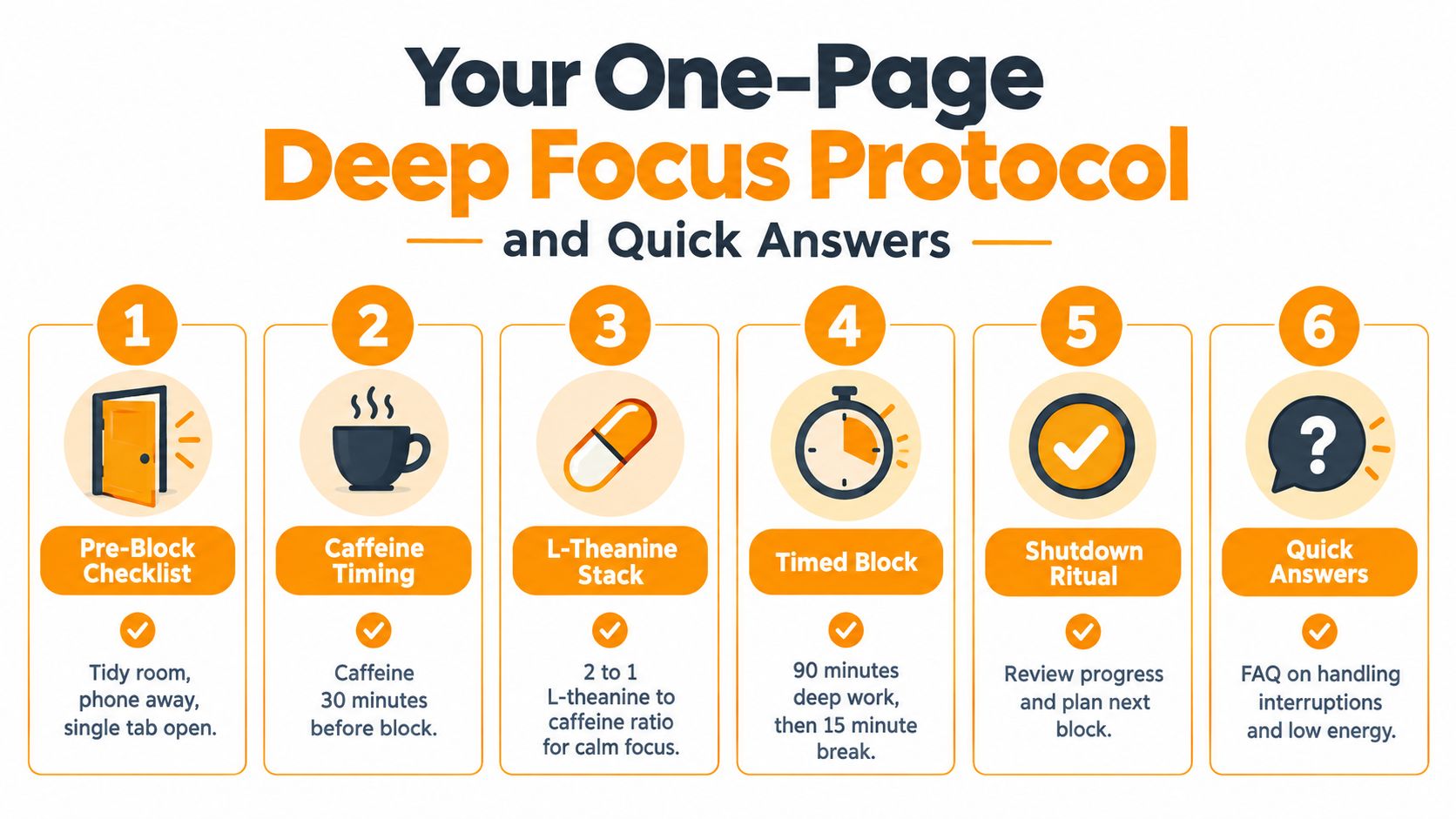
A simple version looks like this:
- Before the block: tidy the work area, isolate the phone, kill notifications, open only the relevant file, pour water.
- Input timing: take caffeine early enough to support the block, paired with L-theanine if a calmer effect is the goal.
- Block structure: work in a protected deep block with one defined artifact as the target.
- After the block: stand up, move, avoid slipping directly into random checking.
- Shallow window: answer messages, clear admin, schedule, approve, coordinate.
- Evening: switch to wind-down behavior early enough that sleep doesn't depend on discipline at the last minute.
Quick answers for the edge cases
How should rotating shift workers adapt this?
Tie the routine to wake time, not clock time. The first deep block should land after the person is fully awake and environmentally set, even if that happens in the afternoon or evening.
When should someone switch from a flow pouch to an evening wind-down pouch?
When the goal changes from output to recovery. Once more stimulation would threaten the next sleep block, the workday is over whether the inbox agrees or not.
Does L-theanine work without caffeine?
Some people use it that way when they want less overstimulation. The main practical distinction is that with caffeine it tends to function as a smoothing partner, while on its own it fits better into a calmer state.
What's the fastest legitimate way to rebuild focus after a bad week?
Don't chase it with more stimulant. Reset sleep timing as much as possible, shorten task scope, protect one clean block daily, and re-establish the shutdown ritual.
How should nicotine-pouch users step down?
Keep the ritual and remove the compulsion loop. People often do better when they replace the timing habit with a nicotine-free pouch routine instead of trying to eliminate the behavior and the cue structure at the same time.
Tape this near the monitor: protect the block, don't negotiate with drift.
Optimal Native offers nicotine-free pouches built around a three-stage daily routine for energy, daytime focus, and evening recovery. For readers building a repeatable focus protocol instead of living on random caffeine hits, that format may fit naturally into the kind of schedule described here. Explore the system at Optimal Native.