

Employee Energy Management: A Practical Workplace Guide
Fatigue isn't a soft workplace issue. In a large U.S. workforce study, 37.9% of workers reported fatigue over a two-week period, and health-related lost productive time reached 65.7% among fatigued employees, compared with 26.4% among workers without fatigue. The study estimated $136.4 billion in annual employer costs tied to health-related lost productivity, with fatigue accounting for an excess of $101.0 billion compared with workers without fatigue. The original study on fatigue and lost productivity makes the management implication plain: employee energy management belongs in operating plans, not just wellness calendars.
Managers shape energy through rosters, workload, break access, meeting design, lighting, recovery time, and the way teams use stimulants. A meditation app can't repair a schedule that repeatedly removes sleep opportunity, and a motivational poster won't prevent errors during the last hours of a demanding shift. The practical question is what leaders can change this quarter.
Table of Contents
- What Employee Energy Management Actually Means
- The Business Case for Managing Energy at Work
- The Three Dimensions of Workplace Energy
- How to Measure Energy Without Creating a Surveillance Problem
- What the Evidence Actually Says Works
- A Step-by-Step Rollout for Managers and HR Teams
- Pitfalls That Quietly Undermine Energy Programs
- Putting It All Together This Week
What Employee Energy Management Actually Means
Employee energy management is the deliberate design of work conditions that protects and replenishes the physical, cognitive, and emotional capacity people bring to their roles. It covers schedules, workload, break architecture, workplace conditions, communication norms, and recovery windows between demanding periods.
That definition matters because energy isn't just a personal quality. A worker may arrive alert and capable, then lose capacity through back-to-back meetings, unpredictable overtime, excessive context switching, poorly timed night work, or a work environment that makes recovery impossible. Managers create many of those conditions, so managers also control many of the remedies.
Energy is an operational input
Generic wellness programs usually place responsibility on employees. They offer optional content, encourage healthy habits, and then leave the underlying work design untouched. Employee energy management takes the opposite view. It treats alertness, focus, and recovery as inputs that leaders must schedule and protect, much like staffing capacity or equipment availability.
A useful operating definition has four parts:
- Protect capacity: Match workload and shift demands to realistic human limits.
- Preserve attention: Reduce unnecessary switching, interruptions, and meeting congestion.
- Create recovery: Make breaks, meals, sleep opportunity, and handoffs part of the operating model.
- Detect deterioration: Give managers simple signals that reveal fatigue before errors, conflict, absence, or turnover appear.
The distinction isn't academic. Shift-based teams face biological constraints that can't be solved through motivation. A schedule can create fatigue even when every employee follows sensible personal habits. Office teams face a different version of the problem when constant notifications and fragmented calendars make sustained thinking impossible.
Managers looking for a broader starting point can also review LeaveWizard's employee wellbeing tips, particularly where wellbeing practices need to connect with everyday management. The key is to translate advice into operating decisions.
Practical rule: If a proposed energy solution asks employees to compensate for a damaging schedule, it isn't a complete solution.
The strongest programs therefore begin with a work-design audit. Which shifts generate the most errors? When do meetings interrupt concentration? Which teams skip breaks because coverage is inadequate? Those answers identify the levers that matter more than another optional wellness resource.
The Business Case for Managing Energy at Work
Fatigue is an operating cost before it becomes a formal “energy” issue. Supervisors see the signs in preventable rework, slower customer responses, missed handoffs, short tempers, and sick leave after repeated periods without adequate recovery. Each incident can look isolated. Together, they point to scheduling, coverage, and workload decisions that are draining capacity.
The historical evidence supports treating fatigue as a productivity-control issue. A U.S. workforce study estimated $136.4 billion in annual health-related lost productivity costs, including an excess $101.0 billion associated with fatigue. Fatigued workers also reported health-related lost productive time at a substantially higher rate than workers without fatigue. The PubMed study gives managers a financial basis for reviewing how work is scheduled and covered.
Where the exposure appears
Cognitive errors emerge first in jobs requiring attention, judgment, or accurate information processing. A tired employee may finish the task while checking, prioritization, and decision-making quality deteriorate. Safety-sensitive teams carry an even higher risk because no wellness budget can compensate for preventable lapses.
Customer experience slippage follows quickly. Frontline employees finishing demanding shifts without enough recovery may sound abrupt, miss details, or take longer to resolve requests. Customers experience that inconsistency even when the staffing plan appears adequate.
Turnover is the delayed exposure. Repeated schedules with no realistic recovery window can reduce commitment long before an employee resigns. By the time attrition appears in a dashboard, the roster or coverage decision that created the strain may be difficult to identify.
| Impact Area | Headline Stat | What It Means for Managers |
|---|---|---|
| Fatigue prevalence | 37.9% over two weeks among workers in a large U.S. workforce study | Fatigue is common enough to require a system response, not case-by-case assumptions. |
| Lost productive time | 65.7% versus 26.4% for fatigued and non-fatigued employees | Presenteeism can conceal a larger capacity loss than attendance reports show. |
| Employer cost | $136.4 billion annually, with $101.0 billion in excess fatigue-related cost | Fatigue belongs in productivity, staffing, and risk discussions. |
The business case supports better work allocation, not greater pressure on tired employees. Managers should examine roster patterns, break coverage, task timing, and controlled-stimulation tools that help employees sustain attention without asking personal habits to repair a damaging schedule.
Use a work-design audit to find the recurring loss. Identify shifts with the most errors, meeting periods that interrupt concentrated work, and teams that skip breaks because coverage is inadequate. Then change the operating decision responsible. Ask, “Which roster, workload, or recovery rule keeps producing this capacity loss?” That question leads to a fix managers can implement this quarter.
The Three Dimensions of Workplace Energy
Managers need a vocabulary that distinguishes different kinds of depletion. Physical energy concerns the body's capacity to stay alert and execute tasks. Cognitive energy concerns attention, information processing, and decision-making stamina. Emotional energy concerns mood regulation, motivation, interpersonal connection, and resilience under pressure.
These dimensions interact, but they aren't interchangeable. A team may look physically rested yet remain cognitively overloaded by constant switching. Another team may have manageable workloads but lose emotional capacity because targets feel impossible and recognition is absent.
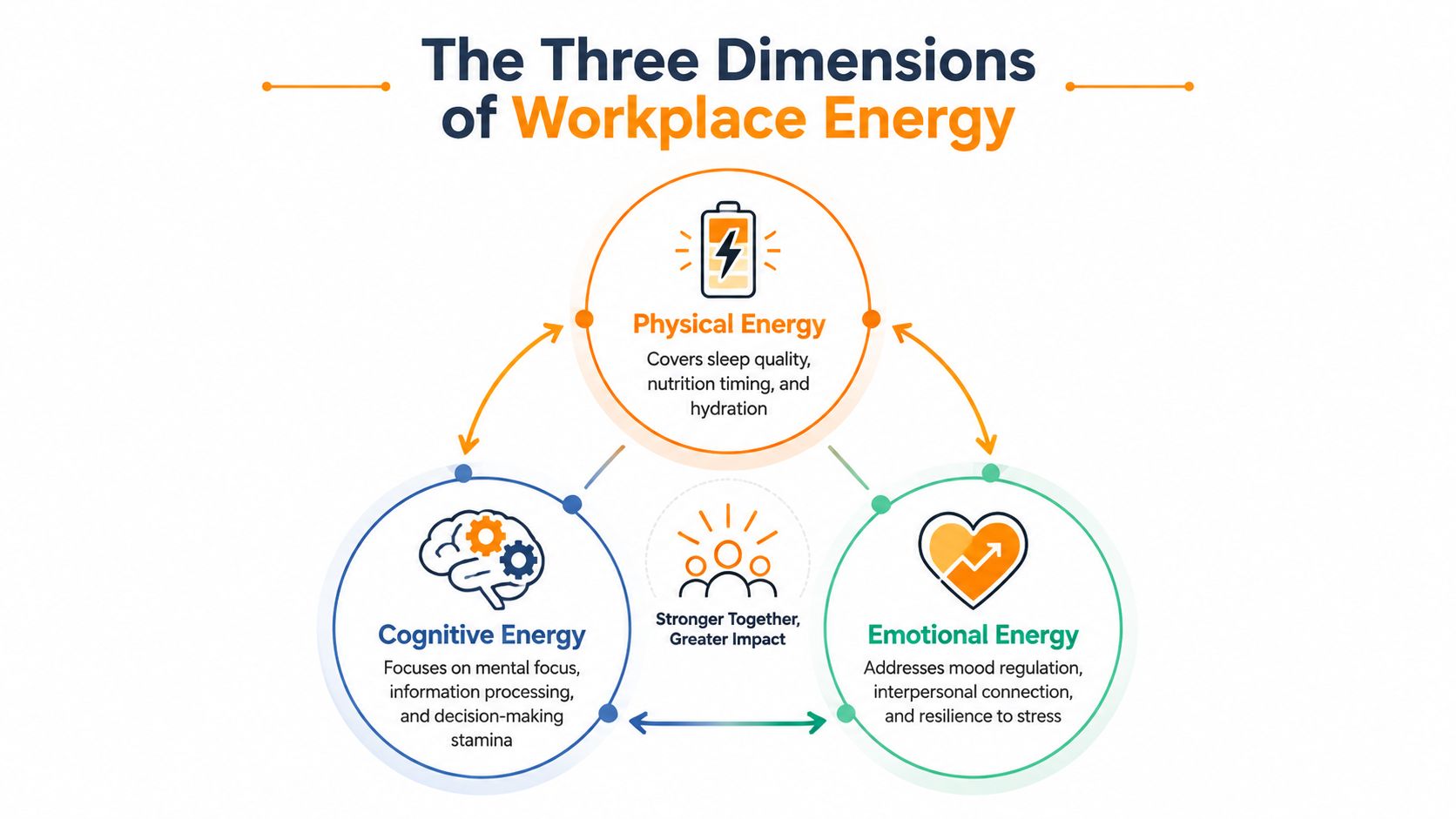
Physical energy
Physical depletion often appears through yawning, slower reactions, reduced movement, missed meals, or a sharp decline late in a shift. Shift work adds biological load because working hours can conflict with normal sleep timing. A prospective cohort study found fatigue prevalence of 18.1% in day workers, 28.6% in three-shift workers, 23.7% in five-shift workers, and 19.1% in irregular shift workers. The shift-work cohort study supports treating roster design as a fatigue lever.
Managers should inspect shift length, start times, overtime patterns, meal access, and the time available between shifts. Employees interested in personal tracking can explore sleep consistency biomarkers, but leaders shouldn't turn personal data into a performance score.
Cognitive energy
Cognitive depletion looks different. Employees reread instructions, lose task context, make avoidable checking errors, or struggle to finish deep work after a day of interruptions. Back-to-back meetings and constant notifications create this pattern even when the employee isn't physically tired.
Useful managerial interventions include protected focus blocks, fewer unnecessary handoffs, clearer priorities, and meeting agendas that make attendance purposeful. A person who says “I need a break” may need fewer simultaneous decisions.
Emotional energy
Emotional depletion appears through irritability, withdrawal, reduced initiative, defensive communication, or a reluctance to raise problems. Chronic interpersonal friction, low autonomy, and impossible targets drain this dimension faster than a single busy day.
Managers should ask whether employees have control over how work gets completed, whether recognition is specific, and whether people can report overload without being labeled uncommitted. The diagnosis should determine the remedy. Movement may help physical fatigue, but it won't repair a trust problem.
How to Measure Energy Without Creating a Surveillance Problem
Measurement should answer an operational question, not satisfy curiosity about employees' private lives. Start with signals the team already produces, add brief self-reports, and collect objective data only when the privacy case is clear and the result can change scheduling, breaks, or workload.
Managers can review meeting attentiveness, error spikes, voluntary overtime, sick days, handoff quality, and late-shift incidents. None proves fatigue alone. Together, these signals show where a manager should investigate conditions, ask employees what is driving the pattern, and test a specific change.
Build a low-friction measurement stack
Use a short pulse survey covering energy, focus, recovery, and workload fit. Shift teams can use the Samn-Perelli Fatigue Scale, while office teams may use the Swedish Occupational Fatigue Inventory. The instrument matters less than consistent timing, confidentiality, and a manager who acts on the findings.
Objective proxies can add context when privacy allows. Calendar density, team-level work-system activity, and aggregate badge data may show congestion or insufficient recovery. Individual keystroke monitoring is a poor default. It creates fear and produces ambiguous information. If a proxy cannot lead to a concrete operational change, do not collect it.
| Metric | What It Reveals | Cadence | Trigger Threshold |
|---|---|---|---|
| Short energy pulse | Perceived energy, focus, and recovery | Weekly or biweekly | A repeated decline or a clear team-level concern |
| Samn-Perelli Fatigue Scale | Fatigue intensity in shift-based work | Around demanding roster periods | A pattern of higher fatigue across a shift or handoff |
| Swedish Occupational Fatigue Inventory | Physical and cognitive fatigue in office contexts | Monthly or after major workflow changes | A sustained rise in fatigue dimensions |
| Error and rework review | Where depleted attention may affect quality | Weekly operational review | A cluster linked to a time, task, or shift |
| Overtime and absence review | Whether workload exceeds recovery capacity | Monthly | Repeated discretionary overtime or absence concentration |
| Calendar density | Whether meeting design blocks recovery and focus | Monthly | Persistent congestion around core work periods |
Set trust rules before collecting data
Anonymize results for teams smaller than the organization's privacy standard, with teams of eight as a practical minimum for reporting. Never attach scores to individual performance reviews. Employees should be able to view their own responses before leaders receive aggregated results.
Managers should identify a pattern, test a change, and check whether conditions improve. The change might involve a revised roster, a protected break, fewer meeting collisions, or a safer handoff window.
A dashboard that exposes tired employees without changing their work conditions is surveillance theater. A small survey that leads to a protected break or revised handoff is useful management.
What the Evidence Actually Says Works
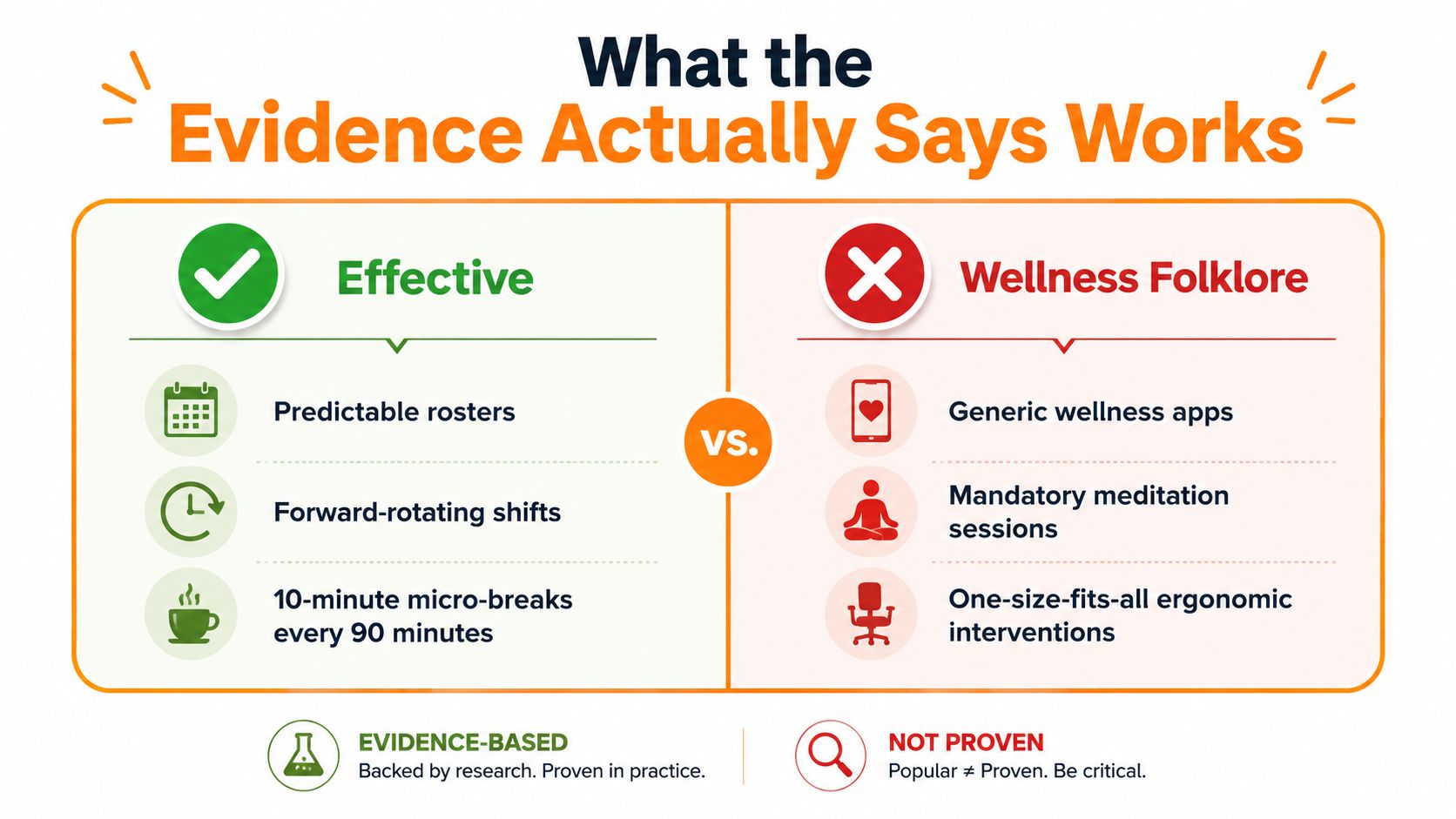
The evidence points away from wellness folklore and toward work design. A recent synthesis of shift-work fatigue interventions identified schedule adjustments, inter- and intra-workday rest, light management, early fatigue monitoring, and supervised stimulant use as practical mitigation strategies. A separate workplace-fatigue review also identified shorter work hours, better management of night work, naps and breaks, improved workplace conditions, lower work demands, and greater worker control. The CDC evidence synthesis supports a layered approach rather than a single intervention.
Start with the roster
Predictable schedules give employees a better chance to plan sleep and personal recovery. Managers should review rapid changes, overtime stacking, overnight transitions, and the time between demanding shifts. A roster that looks efficient on paper can create an unacceptable fatigue burden when it repeatedly misaligns work with sleep opportunity.
Break architecture matters just as much. A break that exists in policy but disappears whenever demand rises isn't a real control. Protected rest, genuine meal detachment, and planned handoffs give employees a chance to restore attention before quality drops.
Environmental design is another practical lever. Light exposure, temperature, noise, and workspace interruptions can either support alertness or add load. Night workers need particular care around the transition from work to sleep, while office teams need protected conditions for deep concentration.
Use stimulation carefully
Controlled stimulation can support attention, but it isn't a substitute for sleep or roster repair. A randomized study summarized by the University of Memphis review found that 97 mg of L-theanine with 40 mg of caffeine significantly improved task-switching accuracy, increased self-reported alertness, and reduced tiredness. A higher combination of 250 mg of L-theanine with 150 mg of caffeine improved rapid visual information processing accuracy, reduced mental fatigue ratings, and improved reaction-time and working-memory measures. The University of Memphis review frames the benefit as steadier attentional control, not merely stronger stimulation.
Managers should establish clear boundaries around timing, access, and individual choice. Caffeine can improve vigilance and reaction time in shift workers, but a systematic review also found reductions in sleep quality and duration, with the chronic risk-benefit ratio still uncertain. The workplace fatigue discussion from Sonder reinforces why stimulation must be paired with recovery planning.
For practical focus-work design, managers can also review how to improve focus at work. The strongest program combines roster changes, protected recovery, environmental controls, workload reduction, and carefully timed alertness support.
A Step-by-Step Rollout for Managers and HR Teams
A useful rollout doesn't require a new wellness department. It requires a manager, an HR partner, and a willingness to change one operating condition at a time.
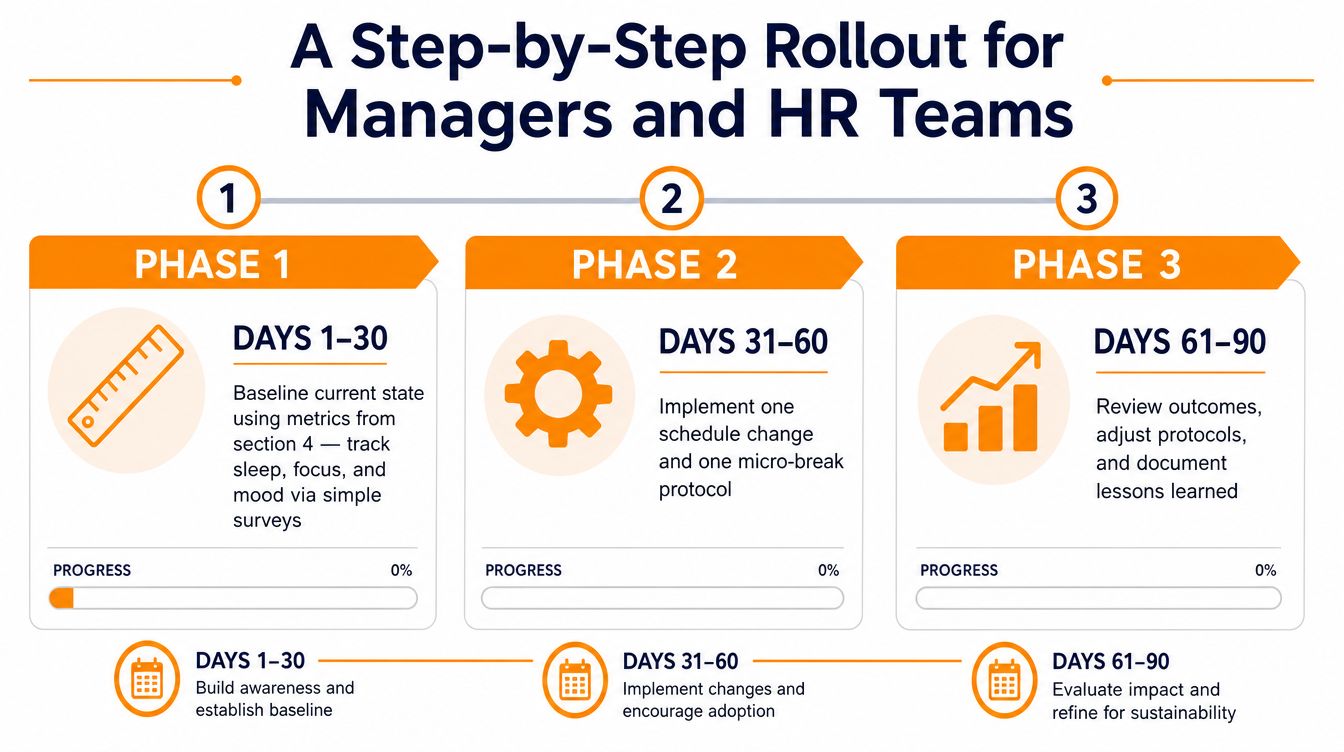
Days 1 to 30 establish the baseline
Start with a short pulse survey and the operational signals already available. Compare energy concerns with error patterns, overtime, absence, meeting congestion, and handoff problems. Each team should identify two specific energy drains, such as late roster changes and missed meal coverage.
Write a brief energy policy before buying tools. The policy should define what managers protect, how employees raise fatigue concerns, and which indicators receive review. It should also state that fatigue reporting won't be used as a disciplinary shortcut.
Days 31 to 60 run a controlled pilot
Choose one roster adjustment and one break change. A shift team might test more predictable handoffs and protected rest coverage. An office team might remove recurring meetings from a morning focus block and set a clear response expectation for nonurgent messages.
Assign an energy owner for each team. This person doesn't police individual behavior. The role is to maintain the pulse survey, log agreed experiments, and bring operational barriers to the manager.
Sample policy language can be direct:
Operating standard: Managers will protect scheduled breaks, publish shifts with reasonable notice, preserve agreed right-to-disconnect periods, and avoid placing demanding shifts back-to-back when recovery is inadequate. Employees will report fatigue risks early and participate in team-level reviews without being penalized for honest reporting.
Days 61 to 90 keep what works
Review the leading indicators. Did break completion improve? Did employees report better focus? Did errors cluster less around a particular shift? Drop changes that didn't help, refine the ones that did, and document the conditions that made the pilot workable.
Accountability must be explicit:
- Line managers: Review energy signals, enforce breaks, and remove avoidable workload.
- HR: Protect confidentiality, support policy language, and review roster fairness.
- Facilities: Adjust noise, light, temperature, and recovery spaces where practical.
- Employees: Report fatigue risks, use breaks, and identify barriers that managers can remove.
Adoption checklist:
- Baseline collected.
- Two energy drains named.
- One roster or workload change piloted.
- Break ownership assigned.
- Privacy rules published.
- Results reviewed before day 90.
Pitfalls That Quietly Undermine Energy Programs
Most energy programs fail through predictable execution errors. The organization announces support, then leaves the conditions that create fatigue untouched.
Caffeine becomes the strategy
Caffeine can support alertness, but it can also interfere with sleep. The better approach sets timing guidance, avoids treating stimulant use as mandatory, and fixes roster and recovery problems first. Managers can use guidance on preventing a caffeine crash as a conversation starter, not as a replacement for scheduling discipline.
Monitoring replaces trust
Detailed individual dashboards create anxiety and rarely explain why fatigue appears. Team-level surveys, operational indicators, and transparent privacy rules produce better decisions. A manager should be able to explain what data is collected, who sees it, and what change it will inform.
Recovery disappears between demanding shifts
A shift may end on time while the next demanding assignment arrives too soon. Review the complete recovery window, including commute demands, handoff pressure, and schedule changes. If employees can't recover between assignments, the roster is carrying hidden risk.
Rewards encourage overextension
A reward program can accidentally praise the very behavior that creates fatigue, such as excessive overtime or never taking breaks. If teams need recognition, use practical reward ideas for crews that reinforce safe coordination, reliable handoffs, learning, and sustainable performance rather than exhaustion.
Rostering also fails when managers assume every employee has the same tolerance for night work or early starts. Individual differences matter, but the operational response should remain fair and practical: offer predictable choices where possible, rotate carefully, and monitor outcomes rather than labeling people as resilient or weak.
Putting It All Together This Week
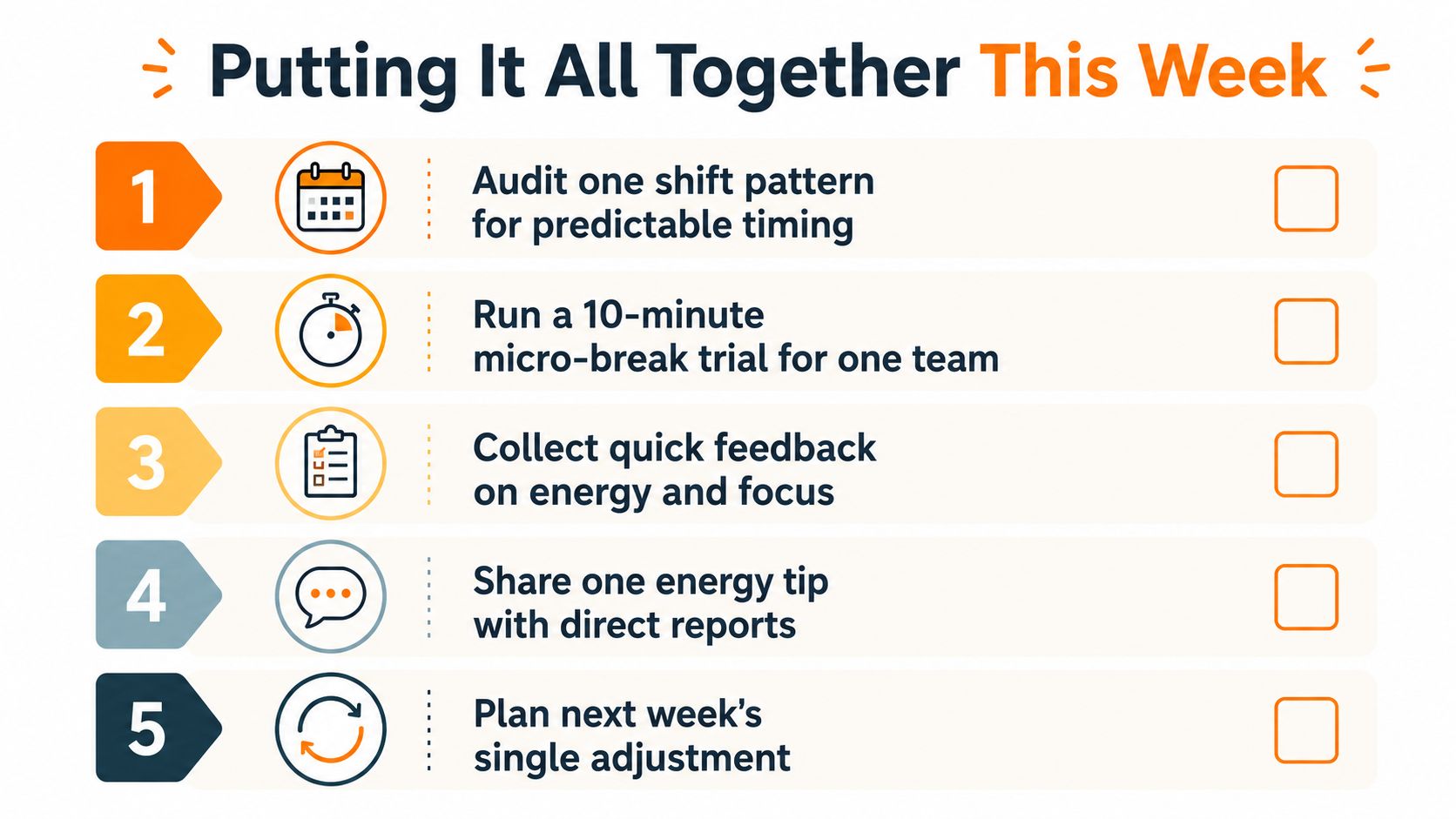
A manager can start employee energy management in five working days without waiting for a new budget.
Day one: audit one shift pattern or one overloaded calendar. Mark late changes, compressed recovery, missed breaks, and meeting congestion. Day two: run a short anonymous pulse on energy, focus, and recovery. Day three: redesign one break window so coverage makes the break real, not theoretical.
Day four: remove one stimulant-heavy ritual or replace it with a timing-aware, voluntary alertness practice that doesn't encourage late-day overuse. Day five: choose one KPI, such as break completion, late-shift errors, or team-reported focus, and assign an owner for the next review.
The mindset shift is simple: energy is an operational input to schedule against, not a personal virtue to encourage. Managers who want to improve morning readiness can also consult how to have more energy in the morning, then connect individual routines to better work design.
Over the next month, leaders should track the selected KPI, repeat the pulse, and ask whether the intervention changed the condition that created fatigue. If it didn't, the program needs a better operational lever, not a more enthusiastic poster.
Optimal Native offers nicotine-free oral pouch protocols designed for daytime energy, focused work, and evening recovery routines. Managers and high-output professionals can explore the structured approach at Optimal Native and decide whether a portable, timing-aware option fits their own energy plan.