

Caffeine Daily Limit Explained for Better Energy
For most healthy adults, the caffeine daily limit is 400 milligrams per day, roughly two to three 12-fluid-ounce cups of coffee. A single intake of up to 200 milligrams may be a useful safety reference, while pregnancy, lower body weight, medications, and individual sensitivity can make a lower amount more appropriate.
A long shift can make that number feel deceptively simple. Someone might drink coffee before work, sip tea during a meeting, take a headache medicine, and reach for a caffeinated pouch during an afternoon slump. Each choice can seem modest on its own, yet the day's total keeps rising.
The practical question isn't only whether 400 milligrams is safe for a typical healthy adult. It's how to treat caffeine as a daily budget, account for every source, distribute that budget across the day, and adjust it for the body using it. That approach helps reduce accidental overuse, uncomfortable stimulation, and sleep disruption without turning coffee into something frightening.
Table of Contents
- Introduction to Your Caffeine Daily Limit
- What the Caffeine Daily Limit Really Means
- How Weight Pregnancy and Medications Change Your Limit
- Counting Total Caffeine Across Coffee Tea and Pouches
- Timing Your Intake for Focus and Better Sleep
- Building a Steady Energy System Without Jitters or Crashes
- Your Next Steps for Smarter Daily Caffeine Use
Introduction to Your Caffeine Daily Limit
Consider a paramedic finishing an overnight shift. A coffee starts the shift, an energy drink appears during a demanding call, and a pain reliever adds caffeine before the drive home. The person may still think of the day as “two coffees,” even though the body has received caffeine from several products and at different times.
That's why a cup-based rule often fails. Serving sizes vary, labels can be easy to miss, and a newer product such as a pouch may not feel like a drink even though its caffeine still belongs in the same daily total. The U.S. Food and Drug Administration's caffeine guidance frames 400 milligrams per day as an amount not generally associated with negative effects for most healthy adults.
The figure is a benchmark, not a target. A person who feels restless, develops palpitations, or sleeps poorly at a lower intake has useful information about their personal ceiling. Someone with a smaller body, a medication interaction, or a pregnancy-related restriction needs a different budget.
Think in budgets, not cliffs
A daily budget has two parts:
- Total amount: Every source contributes to the same running total.
- Distribution: A dose taken early may affect sleep differently from the same dose taken late.
- Personal allowance: The general adult benchmark may need to be reduced for pregnancy, body size, health conditions, or medication effects.
The rest of the guide turns those ideas into everyday decisions. Readers will see how authorities define the limit, why a single-dose reference matters, how to count coffee and non-coffee sources, and how to place caffeine earlier in the day.
Practical rule: A caffeine limit works better as a spending plan. Count the full day first, then decide when each portion is worth using.
The aim isn't to force every adult toward zero caffeine. It's to make each dose deliberate, especially for shift workers, high-output professionals, and anyone who uses caffeine to bridge long periods of work. Steady alertness is more useful than repeatedly chasing a stronger effect.
What the Caffeine Daily Limit Really Means
A daily caffeine limit works like a spending plan. Each coffee, tea, energy product, or pouch uses part of the same allowance, whether you consume it at home, at work, or during a long shift. Public-health guidance places the general adult benchmark at 400 milligrams per day for most healthy adults. The FDA guidance describes that amount as roughly two to three 12-fluid-ounce cups of coffee.
The European Food Safety Authority uses a similar daily reference. Its caffeine safety topic explains that up to 400 milligrams consumed throughout the day does not raise safety concerns for healthy adults. It also identifies 200 milligrams in a single dose as a separate reference. The daily total and the size of each serving answer different questions.
The daily number isn't a toxicology cliff
The limit works more like a speed limit than a point where the body suddenly fails. Staying below a posted speed does not guarantee that every driver is safe in every situation, and going slightly above it does not mean a crash will happen immediately. The number sets a risk-management boundary for a typical situation.
Caffeine follows the same logic. 399 milligrams will not always feel comfortable, while 401 milligrams does not automatically create an emergency. The benchmark describes a level authorities consider reasonable for most healthy adults. Sleep quality, sensitivity, health status, and other personal factors can lower the amount that feels appropriate.
The single-dose reference adds another budgeting rule. Someone can remain below the daily total while taking too much in one short window. Dividing the same amount across the day is different from consuming it all at once, much like making several manageable purchases instead of spending the entire budget in one transaction.
Separate everyday limits from acute danger
Rapid intake at much higher amounts belongs to a different risk category. The Mayo Clinic's caffeine overview notes that toxic effects such as seizures can appear with rapid consumption around 1,200 milligrams, roughly three times the adult daily benchmark.
That distinction prevents two errors. Staying below 400 milligrams does not guarantee that a sensitive person will feel well. Going somewhat above the daily benchmark is not automatically the same as an acute overdose. The amount, speed, product format, health status, and symptoms all affect the situation.
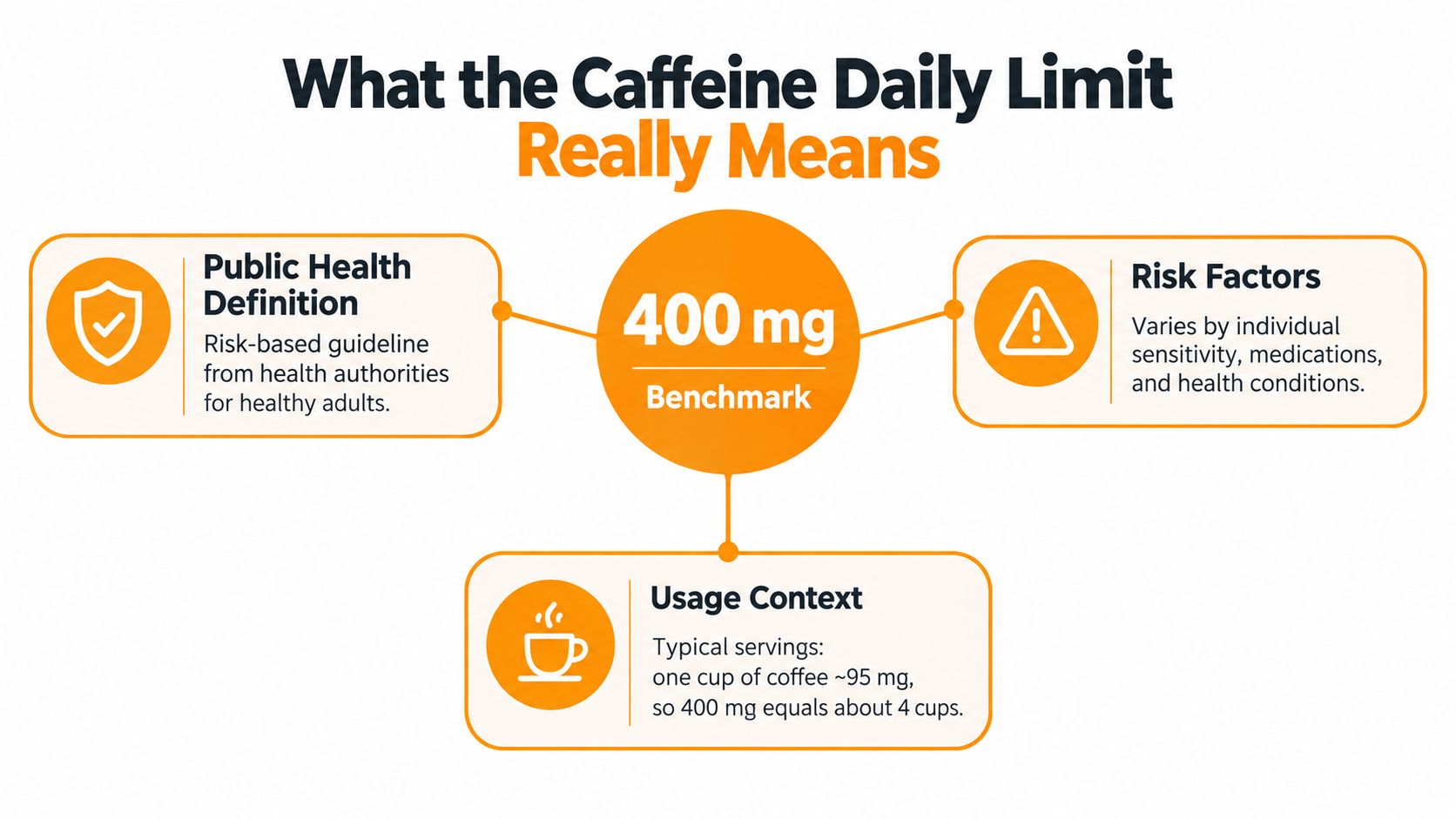
Use the daily allowance deliberately. A smaller morning serving, a counted midday serving, and no automatic refill can preserve room for later needs while avoiding an unplanned overspend.
How Weight Pregnancy and Medications Change Your Limit
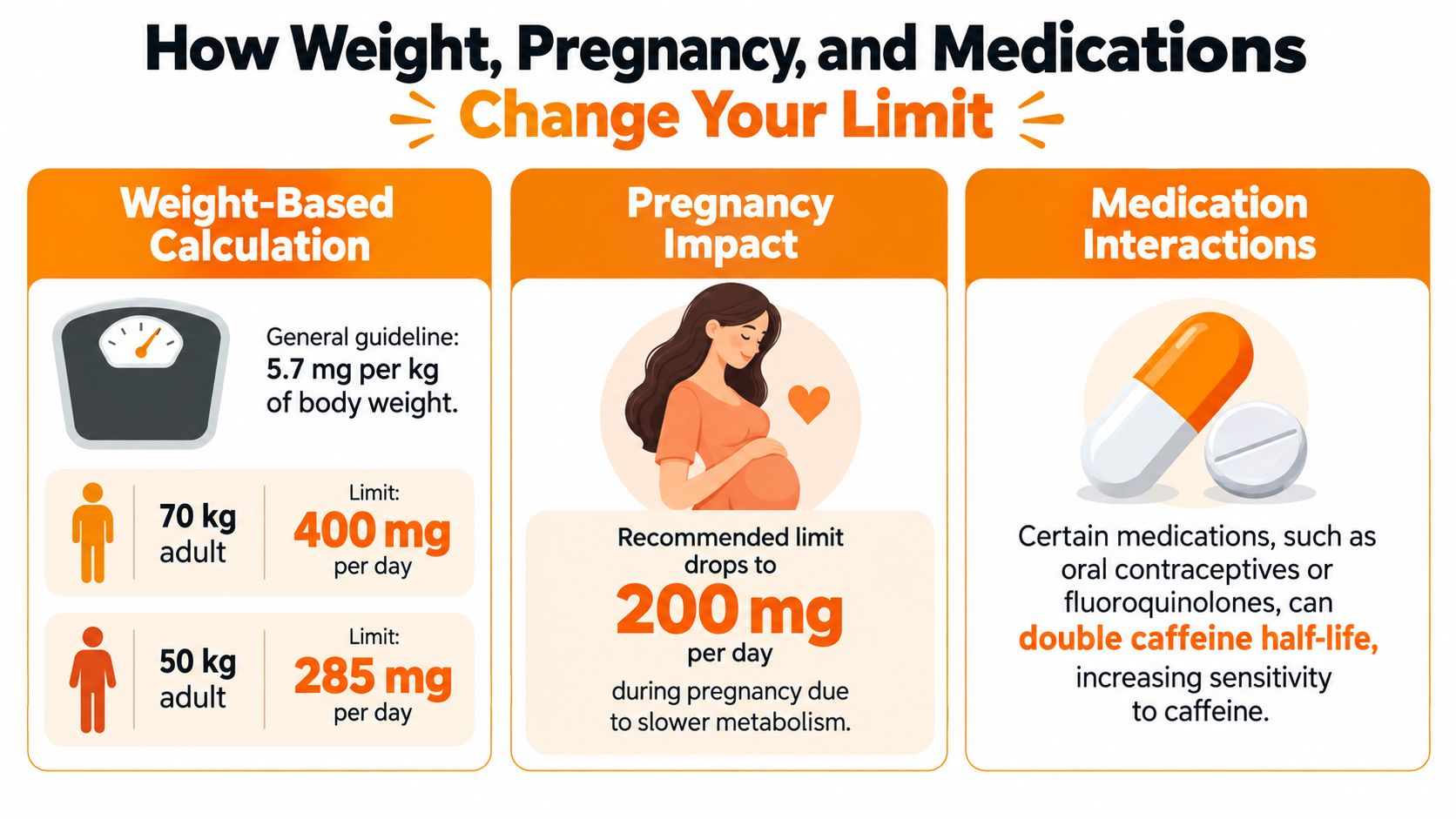
A caffeine budget is personal. The same milligram amount can feel mild to one person and disruptive to another, depending on body size, sensitivity, pregnancy, health conditions, and medications. The general adult benchmark is a population reference, not a personal prescription.
Body size changes how much feels manageable
Body weight helps explain why a fixed daily number does not affect everyone equally. A smaller person may feel a stronger effect from the same serving, particularly when caffeine is consumed quickly or combined with other stimulating products.
You do not need complex calculations to use this idea. Start with less than the general adult benchmark if your body size or past reactions suggest caution. Then watch for sleep changes, anxiety, tremor, digestive discomfort, or a racing heartbeat.
The unused portion of a general budget is not a target. If a modest serving already causes discomfort, increasing intake to approach the population-level ceiling is the wrong direction.
A general limit describes a population. Personal symptoms describe an individual.
Pregnancy uses a separate, lower reference
Pregnancy changes the budgeting rule. The European Food Safety Authority identifies 200 milligrams per day as a level that does not raise safety concerns for the fetus when caffeine is consumed throughout the day (EFSA's caffeine assessment). That amount is a separate pregnancy reference, not the adult budget with a small warning attached.
Count caffeine from coffee, tea, soft drinks, energy products, medicines, and supplements together. A drink that seems modest can use a meaningful part of the day's allowance when other sources are included.
Medications and health conditions need a check
Some medications can change how the body processes caffeine or make its effects feel stronger. Hormonal medicines and certain antibiotics are often discussed in this context, but the appropriate adjustment depends on the specific product, dose, and person.
Heart-rhythm concerns, uncontrolled blood pressure, anxiety symptoms, and ongoing sleep problems also call for individualized advice. A pharmacist can review a medication list for caffeine interactions. A clinician can assess symptoms that continue after caffeine is reduced.
Use this sequence to set a safer daily budget:
- Begin below the general adult benchmark when body size or sensitivity suggests caution.
- Apply the pregnancy-specific reference when it applies.
- Check prescription and over-the-counter medicines for added caffeine or possible interactions.
- Treat new or persistent symptoms as a reason to seek professional guidance, not as a test of how much caffeine you can tolerate.
Counting Total Caffeine Across Coffee Tea and Pouches
A morning coffee, afternoon tea, and workout product all use the same daily caffeine budget. The total also includes soda, energy drinks, pain medicines, supplements, and caffeine pouches. The American Heart Association's coffee and heart health discussion highlights why intake from several sources and newer formats needs to be counted together.
Product strength varies with serving size, recipe, brewing method, and brand. Use the ranges below for orientation, then check the package label, because the actual amount may differ.
| Source Type | Typical Caffeine Range | Counting Tip |
|---|---|---|
| Coffee | 95–165 mg per 8 oz for brewed coffee | Check serving size and preparation method |
| Tea | 30–50 mg per 8 oz | Tea type and steeping time affect the total |
| Soda | 22–46 mg per 12 oz | Count each can or bottle separately |
| Energy drinks | 80–300 mg per can | Check whether the label lists one serving or more |
| Medicines | Varies by product | Read the active ingredients panel |
| Supplements and pre-workouts | Varies by product and serving | Record the amount per scoop or serving |
| Caffeine pouches | Varies by product and pouch | Count every pouch in the day's total |
| Chocolate and other foods | Varies by product | Include small amounts when several products are used |
Build a running total
A phone note, paper card, or spreadsheet works for a shift worker. Record four items: time, product, labeled caffeine amount, and running total. If the label does not disclose caffeine, do not guess. Choose a clearly labeled alternative or leave that product out of the budget.
One espresso is not automatically equal to one standard mug. The guide to how many milligrams of caffeine are in espresso helps explain why serving volume and concentration matter. Count the amount in the actual serving, not only the drink's menu name.
Performance products require the same check. Read the ingredient panel before combining a supplement with coffee or tea. A caffeine recovery supplement online listing shows why a recovery product should not be assumed caffeine-free until its active ingredients are reviewed.
Use a stoplight decision system
- Green: The labeled total stays comfortably below the relevant personal budget, and sleep and physical responses remain stable.
- Yellow: Several products are stacked, serving sizes are unclear, or symptoms appear at a lower intake.
- Red: A concentrated product was taken quickly, or severe symptoms such as chest pain, confusion, repeated vomiting, fainting, or an irregular heartbeat appear.
Before a long shift, complete a source audit. Decide which planned servings will come from coffee, tea, a supplement, or a pouch. This turns the daily limit into a spending plan, so fatigue does not trigger unplanned purchases from the remaining budget.
Timing Your Intake for Focus and Better Sleep
A daily total doesn't tell the whole story. Caffeine taken early and caffeine taken close to bedtime can produce very different nights, even when the total amount is identical.
Caffeine's clearance takes time, and individual metabolism varies. That makes late-day intake easy to underestimate. A person may no longer feel stimulated at bedtime while caffeine remains active enough to interfere with rest.
Use a time-anchored routine
A practical schedule has three zones:
- Morning activation: Place the first serving near the beginning of the work period, especially when early alertness matters.
- Midday sustain: If another serving is needed, use a measured amount rather than repeatedly topping up an unfinished budget.
- Evening wind-down: Avoid routine caffeine late in the day, particularly when sleep already feels fragile.
The exact clock time should follow the person's sleep schedule and shift pattern. A night worker may need to treat the start of a night shift as “morning” for planning purposes, while still protecting the sleep window that follows.
Sleep check: If falling asleep becomes harder, sleep feels lighter, or early waking appears, move the final caffeine serving earlier before increasing the total.
Make the last serving a deliberate choice
A useful test is to ask whether a late dose solves a real performance need or only treats accumulated tiredness. If the answer is fatigue from insufficient sleep, another serving may hide the signal without repairing the underlying problem.
People can also compare two workdays. On the first, caffeine arrives whenever fatigue appears. On the second, the same planned sources are counted and moved earlier. Changes in sleep quality and next-day alertness provide practical feedback about timing.
The caffeine heart rate guide offers additional context for people who notice a connection between caffeine and pulse sensations. New, frequent, or unexplained palpitations still warrant medical assessment rather than self-testing with larger or smaller doses.
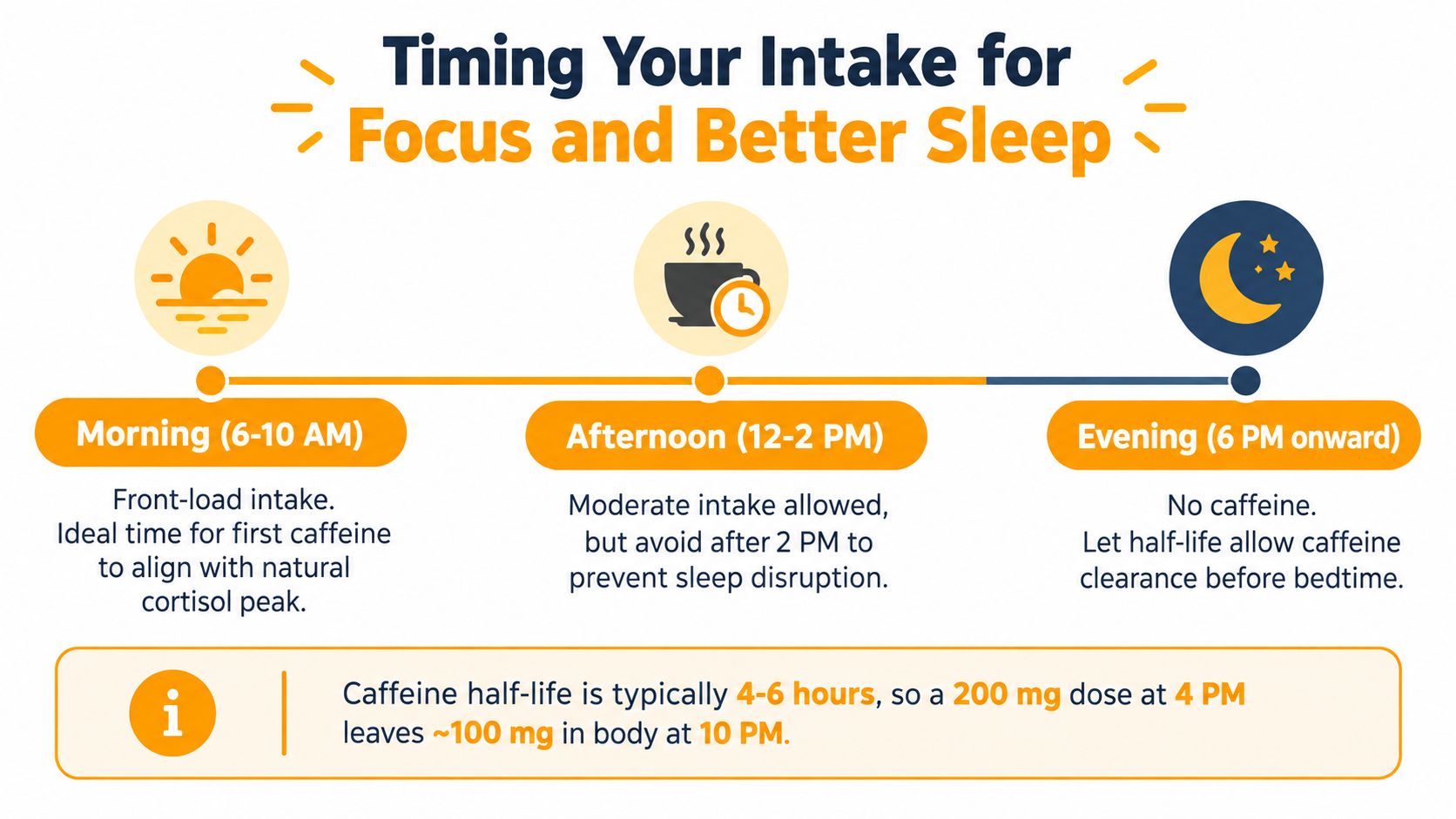
The best timing plan is the one a person can repeat. Morning-heavy intake, a measured midday option, and an earlier final serving create clearer boundaries than a stream of unrecorded sips.
Building a Steady Energy System Without Jitters or Crashes
Steady energy depends on more than a single caffeine number. Dose size, spacing, food, hydration, sleep, stress, and delivery format all influence how a person experiences stimulation.
A focused professional might use a measured coffee early in the workday, eat before a demanding block, and replace an automatic second drink with a lower-caffeine option. A firefighter or nurse working irregular hours may need a portable source, but still benefits from recording it alongside every drink and medicine.
Match the format to the task
Fast, concentrated formats can feel different from a beverage consumed slowly. A pouch may also make intake easier to overlook because there's no cup or can left on a desk. That convenience makes label awareness more important, not less.
Pairing caffeine with calming ingredients is another personal choice, not a guarantee. Readers exploring the subject can review L-theanine and caffeine to understand how the ingredients are commonly discussed together, while keeping total caffeine as the primary accounting rule.

A system also needs a recovery lane. Someone who keeps adding stimulation because sleep is poor may benefit more from earlier caffeine timing, regular meals, light exposure, movement, and a consistent wind-down routine. Additional sustainable energy tips can help broaden the plan beyond another serving.
Avoid the stacking trap
- One product at a time: Introduce a new drink, supplement, or pouch without changing several other sources simultaneously.
- Read the label first: Record caffeine before using a product, especially pre-workout formulas and energy products.
- Protect the sleep window: Don't use a late dose to compensate automatically for a poor night.
- Watch tolerance: Needing progressively more caffeine for the same effect suggests the routine deserves review.
- Keep the ritual, change the dose: Half-caf coffee, tea, or a caffeine-free alternative can preserve the habit while reducing the total.
Optimal Native offers a nicotine-free pouch system organized around morning activation, daytime focus, and evening recovery. It can be considered alongside coffee, tea, and other labeled products, but any caffeine-containing pouch still belongs in the same personal daily budget.
Your Next Steps for Smarter Daily Caffeine Use
Tomorrow's plan can start with a short audit, not a dramatic restriction. From waking until bedtime, list every caffeinated drink, food, medicine, supplement, and pouch. Record each labeled amount and time, then compare the daily total with the appropriate benchmark and with your symptoms.
Use the list as a spending plan for one daily caffeine budget:
- Start with context: For a healthy adult, 400 milligrams per day is a general upper benchmark, not a target.
- Adjust the budget: During pregnancy, use the lower reference of 200 milligrams per day. Body size, sensitivity, health conditions, and medications may call for less.
- Count everything: Drinks, medicines, supplements, and pouches all draw from the same account.
- Time the spending: Place needed caffeine earlier in the day, and review any dose that repeatedly disrupts sleep.
- Respond to symptoms: Persistent palpitations, severe anxiety, or ongoing insomnia calls for advice from a clinician or pharmacist.
If caffeine is already a large part of the routine, gradual reduction may feel easier than stopping abruptly. A caffeine tolerance reset guide offers a starting framework for reviewing dependence and habits. Professional guidance can address personal medical questions.
The aim is not to spend the entire allowance. It is to reserve enough alertness for important work while protecting recovery afterward.
Optimal Native offers nicotine-free oral pouches organized around daytime energy, focus, and evening recovery routines. Visit Optimal Native to review the available protocol and choose an approach that fits caffeine tracking and sleep protection.