

Best Supplements for Energy: Evidence, Doses and Safe Use
Updated75% of Americans reported using dietary supplements in 2024, according to the Council for Responsible Nutrition's consumer survey conducted with Ipsos, as reported by NutraIngredients. Widespread use doesn't make an energy supplement the right response to tiredness. The more useful distinction is whether someone needs temporary alertness, treatment for a deficiency, better training support, or an explanation for persistent fatigue.
The best supplements for energy address that specific problem without creating another one. For caffeine users, that means evaluating both the daily total and the clock time. For someone who remains exhausted despite adequate rest, it means investigating the cause before adding another stimulant.
Table of Contents
- Best Supplements for Energy at a Glance
- Caffeine Dose, Timing and Safety Limits
- Caffeine Paired With L-Theanine for Focus
- When Vitamins and Adaptogens Help and When They Don't
- Melatonin and an Evening Wind-Down Routine
- Choose Your Daily Energy Plan Before You Buy
Best Supplements for Energy at a Glance
Energy supplement ingredients at a glance
| Ingredient | Best-supported use | Amount used in studies | Evidence strength | Main caution |
|---|---|---|---|---|
| Caffeine | Alertness and reaction time | 100-200 mg per dose | Strong | Daily total and sleep timing |
| Caffeine plus L-theanine | Attention in the first two hours | 160 mg caffeine with 200 mg L-theanine | Moderate | Stacking with other caffeine |
| Creatine monohydrate | Strength and high-intensity training | 3-5 g daily | Strong for training | Not an alertness aid |
| Vitamin B12 | Fatigue from deficiency | No routine fatigue dose unless deficiency is confirmed | Strong for deficiency only | No athletic gain at adequate status |
| Iron | Fatigue from iron deficiency | No self-selected dose unless testing shows deficiency | Strong for deficiency only | Excess can harm organs |
| Rhodiola | Stress-related fatigue | No clear dose across products | Limited | Strength varies by product |
| Melatonin | Sleep onset | 0.5-1 mg low dose | Moderate for sleep onset | Timing can shift the body clock |
The caffeine and L-theanine pairing has been tested directly: a crossover trial summarized in a review of human studies used 160 mg caffeine with 200 mg L-theanine and found quicker responses during visual-attention testing. The table's ratings describe the ingredient's intended use, not proof that every commercial formula will reproduce a trial result.
Caffeine has the strongest evidence here for immediate alertness and reaction time. Most other ingredients address a narrower problem, such as low iron, inadequate B12, training demands, or difficulty falling asleep.
Different outcomes require different comparisons
Creatine supports training output rather than daytime alertness. Melatonin belongs in a sleep discussion, not in the same category as a stimulant. Treating both as interchangeable energy products makes comparison shopping less useful.
Human trials deserve more weight than testimonials, but many supplement studies are small. Labels also frequently differ from studied formulations in ingredient amount, preparation, or delivery route. Rhodiola is particularly difficult to compare because a product's extract strength matters alongside its stated weight, and the evidence doesn't establish a clear dose across products.
For readers whose tiredness doesn't fit a simple alertness problem, The Axelrad Clinic on restoring energy offers a broader starting point for considering fatigue rather than shopping solely by ingredient.
Selection rule: A useful shortlist starts with the problem, not the most impressive ingredient list.
Readers should shortlist only the ingredients that match their daily difficulty, then compare the label against the relevant studied amount. A long formula isn't automatically a better-matched formula.
Caffeine Dose, Timing and Safety Limits
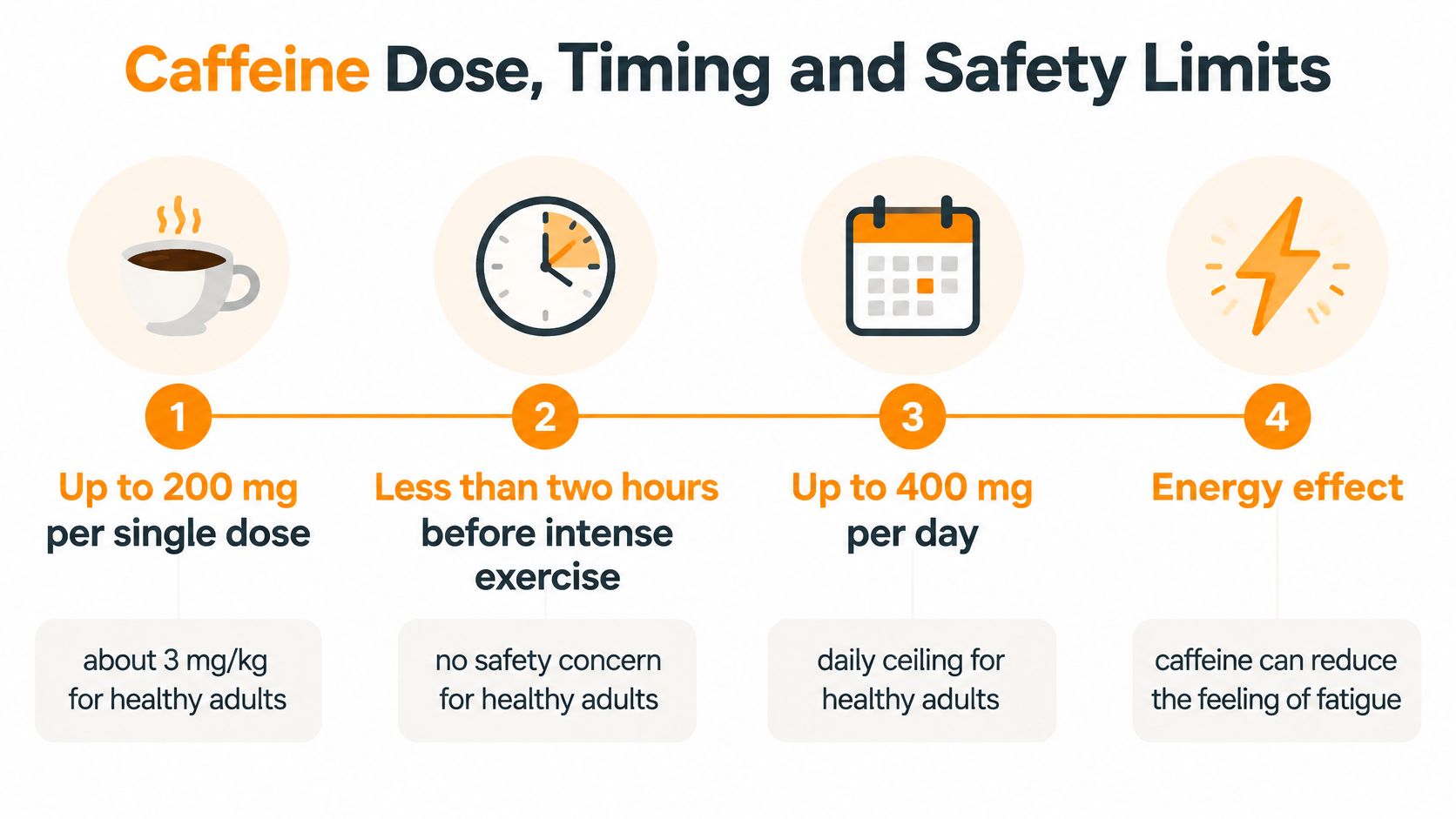
The European Food Safety Authority's 2015 caffeine assessment concluded that up to 200 mg in a single dose, approximately 3 mg/kg, raises no safety concerns for healthy adults, including less than two hours before intense exercise under normal environmental conditions; it also identified up to 400 mg daily, about 5.7 mg/kg for a typical adult, as generally not raising safety concerns across the day. These benchmarks cover all sources, including coffee, tea, soft drinks, energy drinks, and supplements.
These are safety benchmarks, not recommended targets. They don't establish that every person will feel comfortable, sleep normally, or benefit from consuming that much.
Caffeine limits and timing for healthy adults
| Limit or timing | Value | What it means |
|---|---|---|
| Single dose for healthy adults | Up to 200 mg, about 3 mg/kg | EFSA's single-dose safety benchmark |
| Total daily intake for healthy adults | Up to 400 mg from all sources | Includes drinks and supplements |
| Onset | About 30 minutes | Taking more immediately can precede the first dose's effect |
| Average half-life | About 5-6 hours | A substantial amount can remain after the noticeable lift fades |
| Coffee cutoff for sleep | At least 8.8 hours before bed | A meta-analysis estimate, not an individual guarantee |
The U.S. Army's caffeine and sleep guidance describes an onset of about 30 minutes and an average half-life of approximately 5-6 hours: a hypothetical 200 mg dose could leave roughly 100 mg after that interval and 50 mg after another. Metabolism differs with genetics, pregnancy, medications, liver function, and habitual use.
Evidence summarized alongside the FDA's caffeine consumer guidance includes a meta-analysis estimating a coffee cutoff of at least 8.8 hours before bedtime, with caffeine reducing total sleep time by about 45 minutes. That estimate shouldn't become a universal countdown, but it demonstrates why staying below a daily benchmark doesn't guarantee undisturbed sleep.
The visual summary distinguishes serving size from daily exposure.
A sample day needs a bedtime
Optimal Native provides 200 mg caffeine in Morning Energy, 75 mg in Daily Flow, and none in Evening Relax. A hypothetical day containing the morning and daytime servings totals 275 mg before any other caffeine. A second caffeinated product taken alongside the morning pouch would exceed the single-dose benchmark.
A sample schedule might place the larger serving early, the smaller serving at midday, and none after 17:00. However, that cutoff is only a scheduling example, not a sleep-safe rule. Someone sleeping early after a demanding shift may need an earlier stop, while a night worker needs a plan anchored to daytime sleep rather than conventional office hours.
A typical energy drink may contain about 160 mg, and a cola about 34 mg, but package size and formulation matter. The actual label belongs in the calculation, not a category average.
Checks before another serving
- Count every source. Include coffee, tea, soft drinks, energy drinks, pre-workout products, and pouches.
- Set a last-dose time. Base it on planned sleep, not the end of work.
- Respond to sleep changes. If falling asleep becomes harder, reduce or remove the later dose before adding a sleep supplement.
EFSA also notes that even a modest single serving can affect sleep, particularly near bedtime. A lower, earlier dose may therefore be more useful than a larger late dose if the latter undermines next-day alertness.
Readers who are pregnant or breastfeeding, are children or adolescents, have heart rhythm problems, anxiety disorders or high blood pressure, or take stimulant or sleep medication should seek clinical advice first. Palpitations, shakiness, stomach upset, and insomnia are reasons to reassess intake, not signals to push through.
When cutting back, reducing the last dose first and lowering the total gradually can make withdrawal easier to manage. The practical calculations in how many milligrams of caffeine is too much can support a label-by-label review.
Caffeine Paired With L-Theanine for Focus
Caffeine plus L-theanine is better understood as a short-term attention strategy than a general solution for exhaustion. Caffeine reduces perceived fatigue and raises arousal; L-theanine may support a calmer attentional state rather than functioning as another stimulant.
Desk work illustrates the distinction between feeling stimulated and performing an attention task accurately.
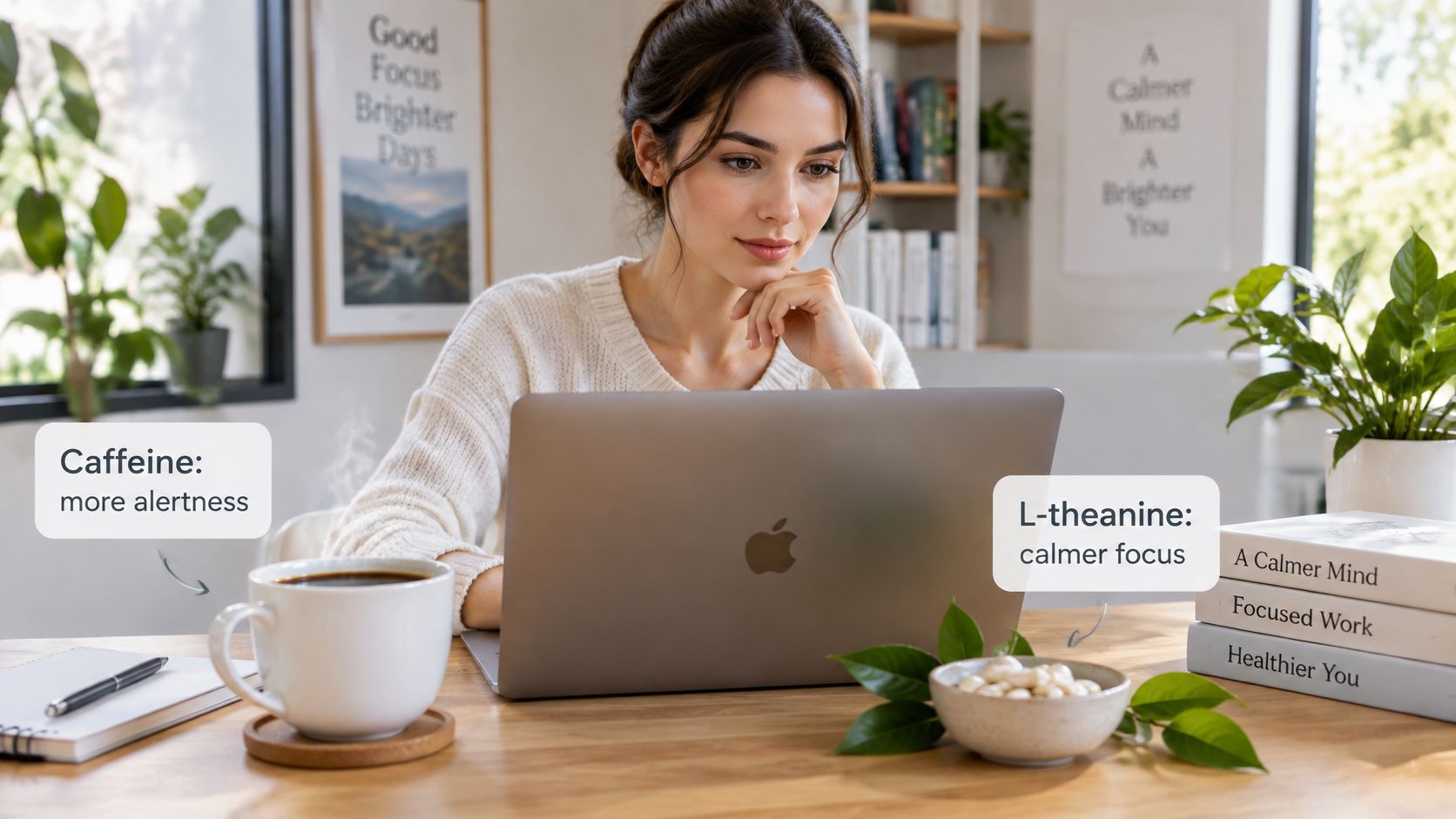
A systematic review and meta-analysis in Nutrition Reviews covering 11 randomized, placebo-controlled human studies found moderate benefits during the first two hours, especially for subjective alertness and attentional-switching accuracy; an additional crossover finding used 150 mg caffeine plus 250 mg L-theanine and reported improvements in reaction time, working memory, and task-verification accuracy. Other attention outcomes were smaller or less consistent.
A familiar ingredient pair isn't a matching formula
A later systematic review describes commonly studied combinations around 200 mg L-theanine with 160 mg caffeine, while also noting small-to-moderate effects and uncertainty around some estimates. The evidence doesn't justify promises of improved productivity, physical energy, or reliable performance for every user.
Optimal Native's Morning Energy contains 200 mg caffeine anhydrous, 50 mg L-theanine, 50 mg NAD+, 2 mg vitamin B6, and 2 mcg vitamin B12 per pouch. Its L-theanine amount is a quarter of the commonly studied amount, so evidence for that research pairing shouldn't be transferred unchanged to the pouch.
The video provides an additional viewing resource alongside the ingredient discussion.
Delivery speed doesn't establish effectiveness
A buccal pouch sits under the upper lip. The brand presents absorption through the mouth lining as potentially faster than a swallowed capsule and less dependent on whether someone has eaten, but this isn't a guaranteed result or proof of superior attention outcomes.
A product can contain studied ingredients without being a studied product.
Caffeine tolerance, sleep status, and the task being performed can all influence the experience. Before combining the pair with coffee or pre-workout, the reader still needs a complete caffeine count.
When Vitamins and Adaptogens Help and When They Don't
The cause of fatigue should come before the supplement choice. Temporary sleepiness during a predictable work period is different from ongoing weakness, reduced exercise tolerance, or tiredness that persists despite sufficient rest.
The NIH Office of Dietary Supplements' vitamin B12 fact sheet states that B12 supplementation doesn't improve athletic performance or endurance when B12 status is adequate, although deficiency can cause fatigue and neurological symptoms. Correcting a deficiency and stimulating an adequately nourished person are different interventions.
Fatigue causes, first checks and where supplements fit
| Likely cause | First check | Where a supplement fits |
|---|---|---|
| Low iron or heavy periods | Ferritin blood test | Iron only after deficiency is confirmed |
| Low B12 intake or absorption problems | Serum B12 test | B12 corrects a confirmed deficiency |
| Short or irregular sleep | Two-week sleep log | No supplement replaces sleep |
| Dehydration or skipped meals | Fluid and meal pattern | Hydration and food come first |
| Overtraining | Training load and recovery review | Creatine supports training output, not overload recovery |
| Persistent unexplained fatigue | Medical evaluation | Not automatically a stimulant or vitamin problem |
Testing narrows the decision
Heavy menstrual bleeding makes iron status worth discussing with a clinician rather than guessing from symptoms. Low B12 intake or absorption difficulties call for a different assessment. Neither problem can be reliably distinguished from sleep loss by the word tired alone.
For readers preparing to discuss laboratory results, Vital iQ Health's B12 results guide provides context for that conversation. A result still needs interpretation alongside symptoms, diet, medications, and medical history.
A sleep log can record bedtime, waking, naps, caffeine timing, and perceived restfulness. Reviewing meals, fluids, training load, and recovery can also reveal a practical problem that another capsule wouldn't address.
Metabolism support isn't an alertness claim
Morning Energy and Daily Flow include vitamins B6 and B12, which support normal energy metabolism. That physiological role doesn't establish that an adequately nourished user will feel more awake after taking them.
Creatine belongs primarily in a training discussion. Rhodiola and ashwagandha are marketed as adaptogens, but evidence for fatigue is limited, and preparations don't offer a clear, interchangeable dose. The same scrutiny applies when evaluating mushrooms for energy and focus: ingredient identity, preparation, and outcome matter more than the category name.
- Iron requires restraint. Indiscriminate supplementation can cause nausea, vomiting, and organ damage.
- Absorption needs planning. Iron should be taken apart from coffee or tea, which can reduce absorption.
- Medication changes the assessment. A clinician or pharmacist should review an iron or caffeine plan when prescription medicines are involved.
Fatigue lasting weeks deserves evaluation rather than an escalating stack. Supporting normal energy metabolism isn't the same as noticeably increasing energy, and persistent symptoms shouldn't be used as a reason to keep buying.
Melatonin and an Evening Wind-Down Routine
An evening supplement plan should support winding down, not prolong stimulation. Melatonin is relevant because it influences sleep timing, not because it supplies energy directly.
The StatPearls clinical reference on melatonin describes an elimination half-life of approximately 1-2 hours and studied doses ranging from 0.1-10 mg; timing approaches include administration up to two hours before bedtime, about one hour before the desired bedtime for delayed sleep-wake phase disorder, and low-dose guidance around 0.5-1 mg taken 2-4 hours before intended sleep. These are different clinical approaches, not instructions to combine them.
Clock timing matters more than escalation
A clinical review of melatonin and circadian timing explains that administration approximately 3-5 hours before natural sleep onset can advance the body clock, whereas administration late in the habitual sleep period or shortly after natural waking can delay it. Taking more, or taking it later, isn't automatically better.
For shift workers, the relevant bedtime may occur during daylight. That makes a generic evening schedule less useful than a plan built around the actual sleep period.
A practical routine can remain simple:
- Remove late stimulation. Move caffeine away from the intended sleep period rather than trying to counteract it afterward.
- Reduce light exposure. Dim household lighting and avoid continuing bright, demanding screen work until bedtime.
- Keep the sleep window steady. Use a repeatable bedtime when work permits.
Evening Relax combines melatonin, L-theanine, magnesium, and apigenin without caffeine. The product schedule places Morning Energy at 6:00-10:00, Daily Flow at 10:00-17:00, and Evening Relax at 17:00-22:00; those are brand usage windows, not individualized circadian prescriptions.
A caffeine-free formula can fit a wind-down routine without proving that its full ingredient combination treats insomnia.
Readers considering broader approaches can explore natural options for better sleep through Sunridge Medical. Any timing trial should use small adjustments over a two-week observation period rather than nightly dose escalation, with persistent sleep problems discussed with a clinician.
Choose Your Daily Energy Plan Before You Buy
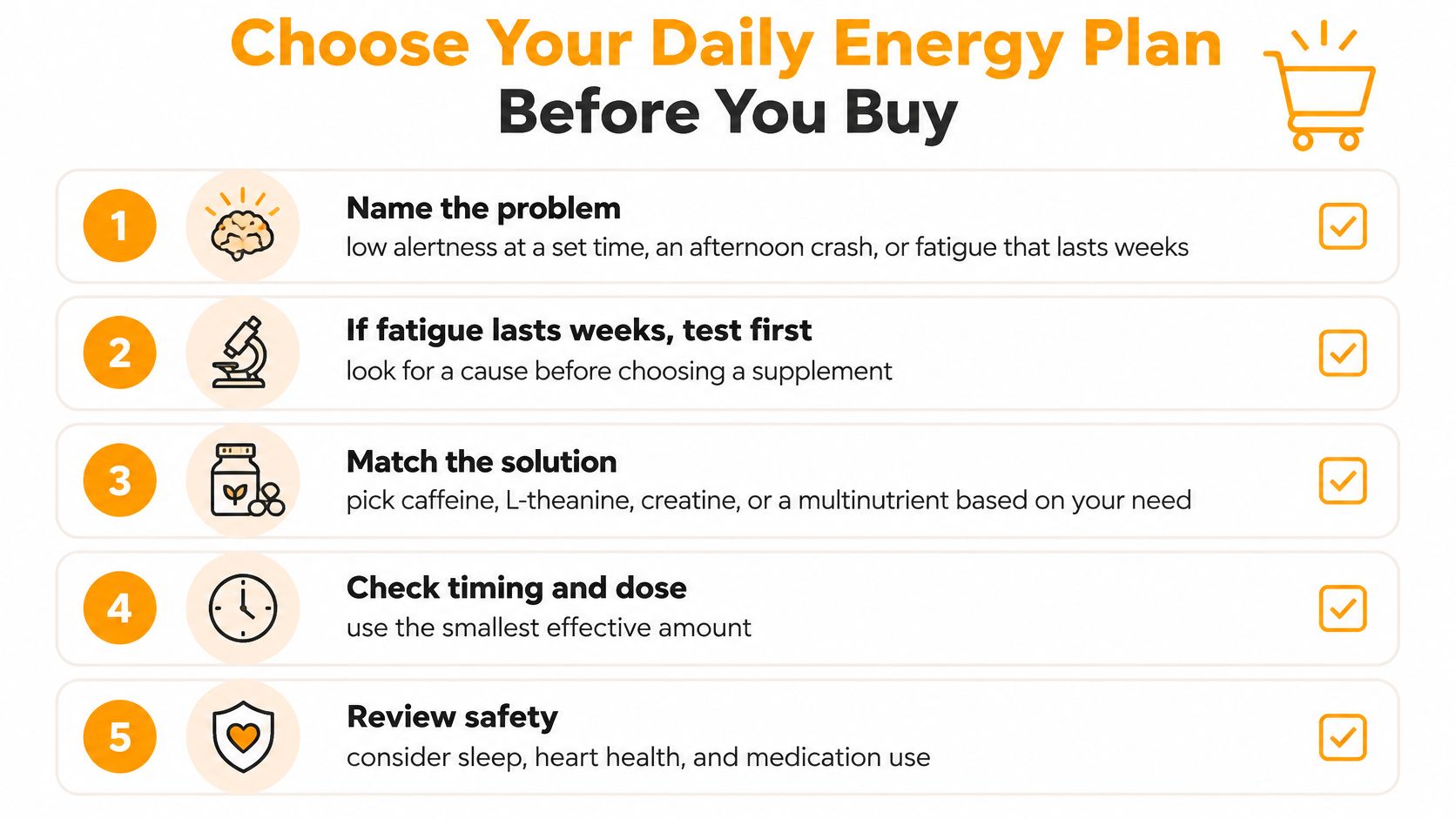
A useful purchasing checklist begins before the product comparison:
- Name the problem. Distinguish low alertness at a set time, an afternoon crash, and fatigue lasting weeks.
- Investigate persistent symptoms. Discuss iron status, B12 status, and sleep patterns with a clinician instead of automatically adding stimulants.
- Match the morning plan to the sleep schedule. For conventional daytime workers, a fixed dose before 10:00 offers a clear starting routine, not a guarantee of sleep compatibility.
- Inspect the focus formula. Compare listed caffeine and L-theanine amounts with the human-trial combinations, not just the front-label claims.
- Protect the sleep period. A caffeine-free wind-down routine is more coherent than repeatedly alternating late stimulants and sleep aids.
- Change one variable. A two-week personal log of sleep, concentration, and jitters can help identify whether the change is useful.
The checklist below summarizes the purchasing decision.
The verdict changes with the situation
For shift workers and high-output professionals, a deliberately timed alertness aid may be reasonable when paired with a protected, caffeine-free sleep period. For persistent unexplained fatigue, testing and clinical assessment are the better next purchase than a larger stack.
For people replacing a nicotine-pouch ritual, an oral format offers a familiar placement under the upper lip. It changes the delivery route, not the caffeine calculation, and it shouldn't be treated as an established smoking-cessation treatment. Caffeine itself can produce dependence, even when the format feels gentler.
A clean energy supplement comparison is most useful when it focuses on disclosed ingredients, dose, and timing rather than the word clean.
Optimal Native sells Morning Energy, Daily Flow, and Evening Relax in packs of 20 pouches each. The brand states that these are food supplements, not medicines, and they aren't intended to diagnose, treat, cure, or prevent any disease. Anyone with a medical condition or taking medication should seek clinical advice before starting.
Optimal Native offers nicotine-free oral pouches for morning energy, daytime focus, and caffeine-free evening relaxation. Readers considering this format can visit Optimal Native to compare the formulas with their caffeine count, intended sleep time, and specific reason for seeking an energy supplement.