

Athletic Performance Nutrition: A Practical 2026 Guide
At 6 a.m., an athlete can arrive at training with the perfect session written on the board and still feel flat before the warm-up ends. The deciding factors may have started with yesterday's meals, continued through overnight hydration, and extended into the recovery meal that follows the final interval. Athletic performance nutrition is a time-anchored system, not a single pre-workout checklist.
The useful question isn't “What supplement should be taken today?” It's “What does this athlete need for this session, this recovery period, and the next night of sleep?” The answer changes with body size, sport, training load, sex, phase, schedule, and performance target. The framework below turns those variables into practical decisions without pretending that one diet works for everyone.
Table of Contents
- Why Performance Nutrition Decides Your Training Day
- Energy Systems and the Three Fuels Behind Performance
- Macronutrient Targets That Match Your Training Load
- Timing Fuel Around the Training Window
- Supplements With Real Evidence and What to Skip
- Matching Nutrition to Your Sport and Goal
- Recovery and Sleep Nutrition for Next-Day Readiness
- A Sample Day, Checklist, and Quick Routine
Why Performance Nutrition Decides Your Training Day
The runner who arrives under-fueled may blame poor pacing or motivation when the issue is yesterday's carbohydrate intake. The strength athlete who skips the post-session meal may complete the workout but struggle to repair tissue and repeat quality work the following day. A paramedic finishing a night shift faces a different problem again, with irregular meals, disrupted sleep, and limited access to familiar foods.
Carbohydrate availability matters because stored carbohydrate supports glycogen storage and sustained exercise capacity. The American College of Sports Medicine guidance on nutrition for athletic performance places most training and competition needs around 3–10 g of carbohydrate per kilogram of body weight per day, with intake rising as high as 12 g/kg/day for extreme, prolonged activity. For a 70 kg endurance athlete, that can mean roughly 210–700 g daily, and as much as 840 g in exceptionally demanding phases.
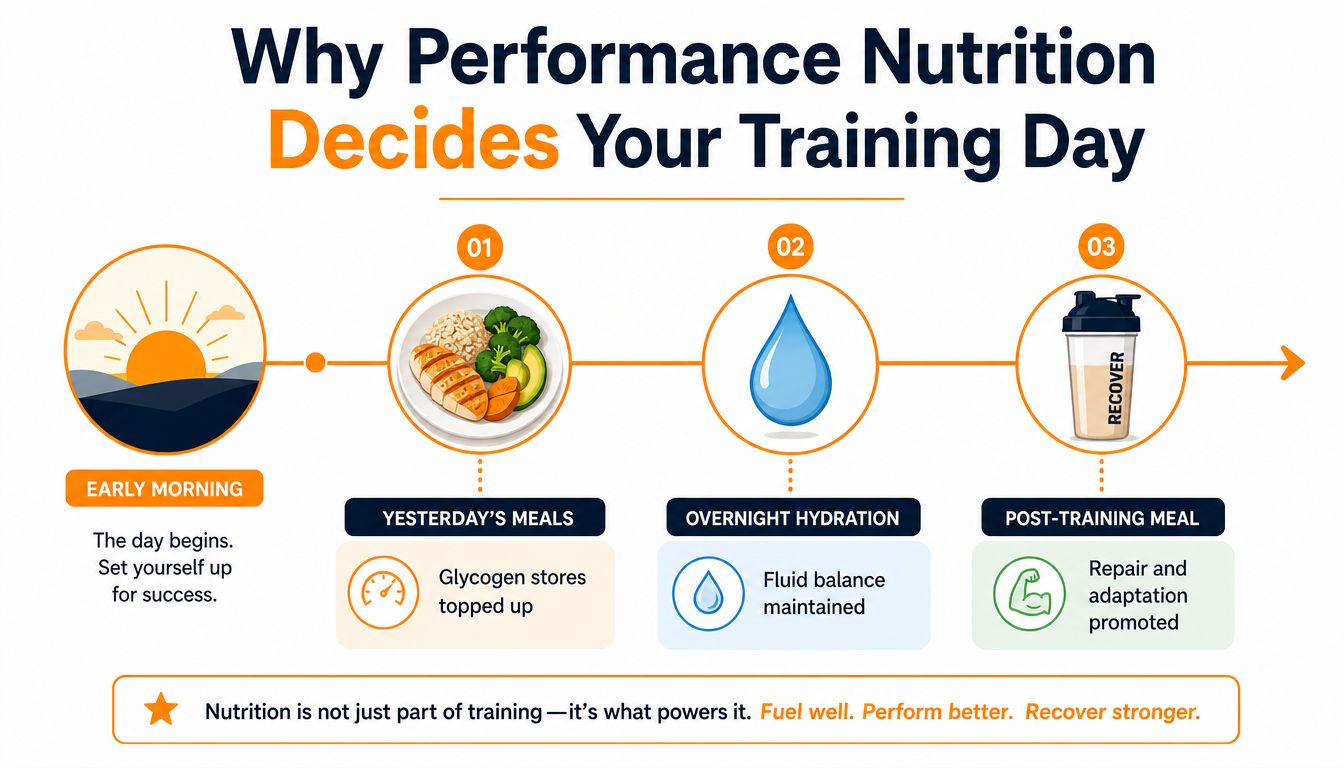
The training day is a chain
Poor energy intake can reduce session quality, concentration, mood, and the ability to adapt. A carbohydrate-rich breakfast won't repair every weakness, but it can make a demanding session feel more manageable when the athlete also replaces meaningful fluid losses and eats enough overall.
Protein supplies the raw material for muscle repair and remodeling. Fluids support circulation and temperature regulation, while electrolytes become more relevant when sweating is substantial, the session is long, or the environment is hot. None of these inputs guarantees performance. They remove avoidable barriers.
Practical rule: Arrive fueled, replace meaningful losses, eat after demanding work, and change intake when workload changes.
A simple daily review keeps the system workable:
- Before training: Build the meal or snack around the session's expected intensity and duration.
- During training: Use carbohydrate and fluids when the session is long enough or hard enough to justify them.
- After training: Pair carbohydrate with protein after demanding work, especially when another session follows soon.
- Before sleep: Protect recovery by managing late caffeine, evening food, and fluids rather than treating nighttime as an afterthought.
The best plan is the one the athlete can repeat, digest, and adjust. A technically impressive protocol that causes stomach discomfort or conflicts with work will fail in practice.
Energy Systems and the Three Fuels Behind Performance
Every movement uses adenosine triphosphate, or ATP. The body replenishes it through several overlapping energy systems, rather like a vehicle using different gears rather than switching between completely separate engines.
The phosphagen system is the sprint fuel for brief, explosive actions. The glycolytic system helps cover hard efforts by breaking down carbohydrate quickly. The oxidative system produces energy at a slower, more sustainable rate and becomes increasingly important during prolonged work. All three contribute to most activities, but intensity and duration change their relative contribution.
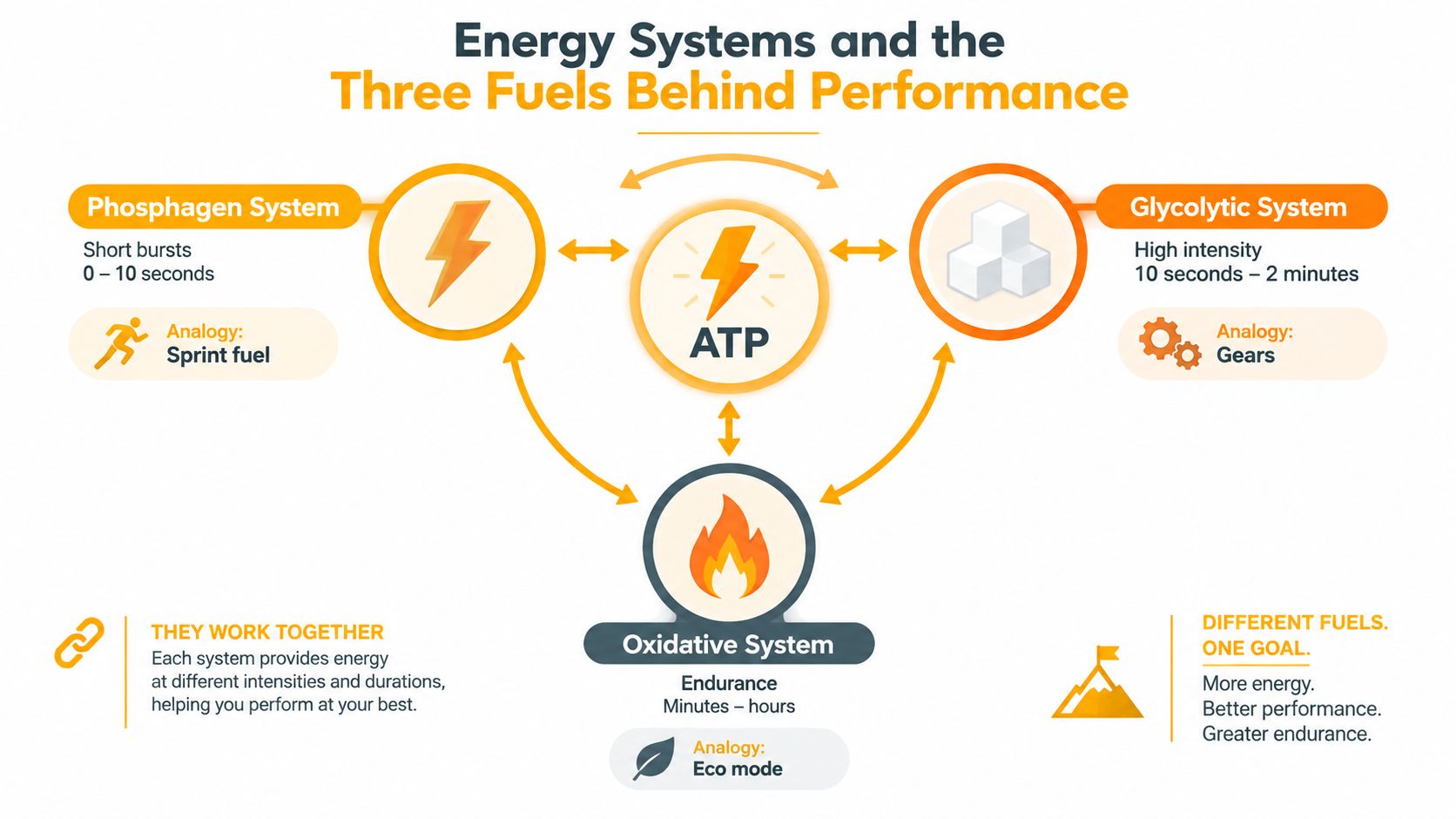
Match the macronutrient to the job
Carbohydrate is the most rapidly available macronutrient for high-intensity work. That doesn't mean every athlete needs a high-carbohydrate intake every day. It means the athlete should make carbohydrate available when the session depends on rapid energy delivery, repeated hard efforts, or prolonged exercise.
Protein has a different assignment. It provides amino acids for tissue repair, remodeling, and adaptation, but it isn't the primary fuel for most training. Dietary fat supports cell function and hormone production and contributes to lower-intensity, prolonged activity, although the body uses it more slowly than carbohydrate.
A practical plate usually contains all three:
- Carbohydrate: Oats, rice, potatoes, bread, fruit, or other familiar sources around demanding work.
- Protein: Dairy, eggs, fish, meat, soy, legumes, or a suitable protein supplement across the day.
- Fat: Olive oil, nuts, seeds, avocado, oily fish, or other tolerated sources away from moments when rapid digestion matters most.
Energy availability deserves priority before exact timing or supplements. It refers to the energy left for normal body functions after exercise expenditure. A short-term calorie deficit isn't automatically harmful, but consistently low availability can undermine recovery, immune function, reproductive or menstrual health, bone health, and mood.
The practical sequence is straightforward: eat enough total energy, match carbohydrate to workload, consume adequate protein, include useful fats, then refine timing and supplements. Athletes who reverse that order often spend money on small performance details while missing the larger nutritional constraint.
Macronutrient Targets That Match Your Training Load
Macronutrient targets should start with body mass in kilograms, then move through training demand, body-composition goals, appetite, gastrointestinal tolerance, and schedule. They aren't fixed prescriptions. A 75 kg athlete in a low-load technical phase shouldn't eat like the same athlete during high-volume endurance training.
Protein is usually the easiest place to establish consistency. A 2024 review of athlete protein recommendations summarized a current range of 1.3–1.8 g/kg/day, while broader sports-nutrition literature places needs around 1.4–2.0 g/kg/day depending on demand. For a 75 kg athlete, those ranges translate to approximately 98–135 g or 105–150 g per day.
A workable starting point is to distribute protein across the day rather than placing nearly all of it at dinner. Many athletes use roughly 0.3–0.4 g/kg per feeding, including after demanding training, then adjust according to appetite and total requirements.
Carbohydrate rises with the workload
Carbohydrate should move more dramatically than protein. A low-intensity or technical day may require less than a double-session endurance day. A high carbohydrate target also needs practice, because suddenly increasing intake can produce gastrointestinal distress.
Fat commonly occupies 20–35% of total energy, and active adults often do better with at least around 0.8–1.0 g/kg/day than with severe restriction. Fat can be reduced around training when rapid digestion is important, but removing it across the entire day creates an unnecessary nutritional problem.
| Training demand | Carbohydrate | Protein | Fat |
|---|---|---|---|
| Low-intensity or technical work | 3–5 g/kg/day | 1.3–1.8 g/kg/day | 20–35% of energy |
| Moderate training | 5–7 g/kg/day | 1.4–2.0 g/kg/day | 20–35% of energy |
| High-volume endurance work | 6–10 g/kg/day | 1.4–2.0 g/kg/day | 20–35% of energy |
| Extreme endurance phase | 8–12 g/kg/day | 1.4–2.0 g/kg/day | Adjust to energy needs |
The table offers ranges, not permission to force the highest value. Increase carbohydrate as volume or intensity rises, maintain protein during weight loss, and adjust total energy according to whether the goal is maintenance, gain, or reduction. Athletes who want a convenient way to combine protein with a familiar carbohydrate routine can browse Pep Tea matcha blends and assess whether the ingredients fit their own intake plan.
Timing Fuel Around the Training Window
Timing works best when it solves a specific problem. A large meal too close to training can sit heavily, while a tiny snack before a long interval session may leave the athlete under-fueled. The clock matters, but digestion history and session demands matter just as much.
Two to three hours before
A substantial pre-training meal can provide roughly 1–2 g/kg of carbohydrate with modest protein when the athlete has enough time to digest it. Rice with eggs, oats with yogurt, or toast with a protein-rich side can work if those foods are already familiar.
For early-morning training, a full meal may be unrealistic. A smaller top-up 60–90 minutes before can provide carbohydrate and a little protein without forcing a large volume of food. Athletes should rehearse this during training rather than testing a new product before competition.
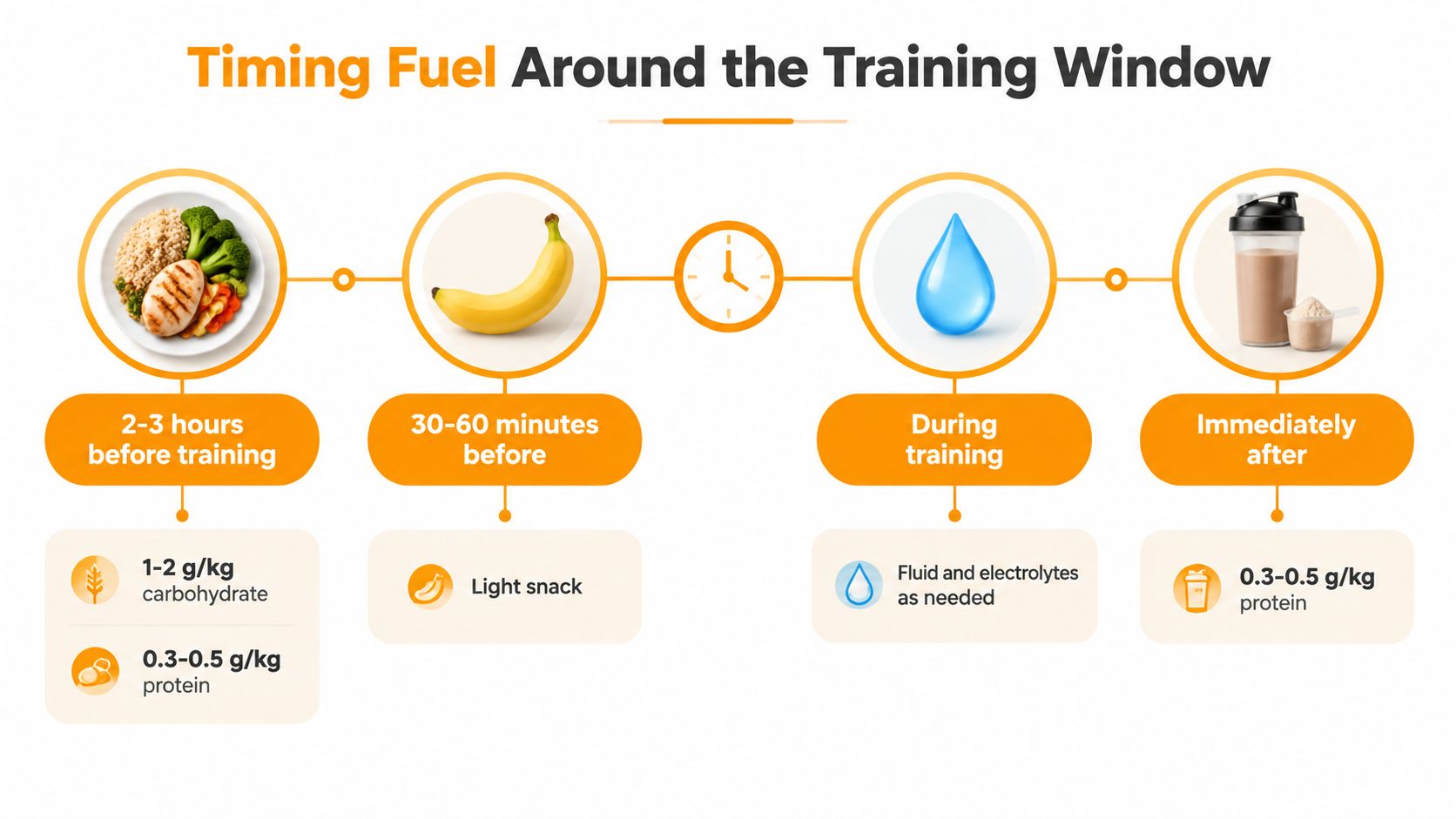
During and after the session
For steady efforts lasting beyond roughly 60 minutes, or repeated high-intensity work, ACSM guidance cited in the sports-nutrition literature supports 30–60 g of carbohydrate per hour to help maintain blood glucose and spare muscle glycogen, as described in this review of carbohydrate and creatine strategies. A drink, gel, chews, or ordinary food can serve the purpose. The best option is the one the athlete can tolerate and access.
Within the first 0–2 hours after training, a demanding session may justify approximately 1–1.2 g/kg carbohydrate alongside 0.3–0.4 g/kg protein, particularly when another session is approaching. If appetite is poor, those nutrients can be divided across the next meals rather than forced into one shake.
Caffeine requires the same discipline. Evidence supports 3–6 mg/kg before exercise, and the caffeine review in sports performance describes a practical window around 45–60 minutes pre-workout. Higher intake doesn't reliably create more benefit and can increase side effects. A morning or early-afternoon cutoff helps protect sleep, especially for athletes training late.
Hydration should be checked before, during, and after work. Pale urine generally suggests better hydration than dark urine, but urine color isn't a complete diagnostic tool. For longer or hotter sessions, fluid and sodium should be considered together, not as isolated targets. Athletes building a morning routine can also use this guide to having more energy in the morning as a scheduling prompt, then individualize the actual food and fluid choices.
Supplements With Real Evidence and What to Skip
Supplements can sharpen a sound plan, but they can't compensate for inadequate energy, poor carbohydrate availability, or chronic sleep loss. Creatine monohydrate, caffeine, and selected performance ingredients have useful roles, while many products rely on dramatic claims that exceed the evidence.
Creatine is particularly valuable for repeated-sprint capacity, strength, and recovery support. The ISSN review reports that recommended creatine dosing doesn't appear to increase dehydration, cramping, or thermoregulation risk. Short-term loading can produce roughly 0.5–1.0 L of fluid retention, without evidence of harm in heat-stressed athletes, according to the ISSN position stand on creatine.
Caffeine is more useful as a targeted tool than a constant habit. The evidence review on caffeine and exercise reports that 3–6 mg/kg can improve endurance by about 2–4% across many studies, with a mean power-output improvement of 2.9% ± 2.2% versus placebo. More isn't automatically better.
| Supplement | Evidence tier | Effective dose | Best for |
|---|---|---|---|
| Creatine monohydrate | Strong | 3–5 g/day | Strength and repeated high-intensity work |
| Caffeine | Strong | 3–6 mg/kg | Alertness, endurance, power, and technical performance |
| Nitrate-rich beetroot juice | Moderate to strong | 300–600 mg nitrate | Selected endurance and efficiency goals |
| Beta-alanine | Conditional | 3.2–6.4 g/day, split | Hard efforts where buffering may matter |
| Sodium bicarbonate | Conditional | 0.2–0.3 g/kg pre-event | High-intensity work, if tolerated |
| Montmorency tart cherry | Mixed | Individual protocol | Recovery experiments, not guaranteed results |
Beta-alanine and sodium bicarbonate can cause tingling or gastrointestinal discomfort, so athletes should trial them well before competition. Tart cherry remains a useful example of why enthusiasm should be moderated. A 2026 scoping review of Montmorency tart cherry found improved performance in only 4 of 10 studies, with mixed evidence for recovery and delayed muscle soreness.
BCAAs add little when total protein is already adequate. Most fat burners and testosterone boosters deserve caution when human athletic evidence is weak or absent. Athletes considering fasting around lifting can compare the practical trade-offs in Cartwright Fitness fasting advice, but fasting should not displace the fuel required for the session.
Before purchasing, athletes should check for third-party testing, transparent labels, contamination controls, and batch information. A product that hides exact doses isn't an evidence-based performance tool.
For readers considering cognitive supplements, the separate Alpha-GPC dosage guide can help organize questions about dose, timing, and whether the ingredient has a clear place in the athlete's plan.
Matching Nutrition to Your Sport and Goal
The same athlete may need different nutrition on a recovery day, a race-specific block, and a weight-loss phase. Sport determines the dominant stress, while the goal determines which trade-offs are acceptable.
Four useful athlete profiles
Endurance athletes need carbohydrate availability, especially when sessions are long, intense, or repeated. Long-session gut training matters because the athlete must practice eating and drinking under movement, not merely calculate a target at home. A runner preparing for a long event may find the guide on how to eat like a dedicated runner useful as a practical planning reference, then adapt it to body size and training phase.
Strength and power athletes prioritize protein consistency, sufficient carbohydrate for training quality, and total energy for adaptation. During a mass-gain phase, more energy may support progress. During a reduction phase, protein usually stays high while carbohydrate and total energy are adjusted around the hardest sessions.
Team-sport athletes need a blended model. They may combine substantial glycogen demand with repeated accelerations, contact, and technical decisions. Their nutrition should support both continuous running and explosive work, with creatine considered when repeated-sprint or strength outcomes matter.
Shift workers and tactical athletes need portable structure more than a perfect menu. Two or three dependable meals, protein-led snacks, planned caffeine windows, and food that survives transport can outperform an elaborate routine that collapses during a night shift.
| Sport archetype | Carbohydrate | Protein | Hydration focus |
|---|---|---|---|
| Endurance | 5–12 g/kg/day | Individualize within athlete ranges | Fluids and electrolytes matched to conditions |
| Strength and power | 4–6 g/kg/day | 1.6–2.2 g/kg/day | Regular intake across training |
| Team sport | 4–7 g/kg/day | Individualize to training and goal | Access during long or hot sessions |
| Shift-based or tactical | Adjust to workload | Protein at structured meals and snacks | Portable fluids and planned replenishment |
Sex, training phase, body composition goal, and health history can change the correct decision. A 2025 systematic review of dietary supplements in elite athletes found that protein most consistently improved muscular strength, creatine was particularly beneficial for sprint speed, and beta-alanine was especially useful for jump performance, while no supplement meaningfully increased lean mass across the included studies. The practical lesson is clear: match the intervention to the outcome being trained.
Recovery and Sleep Nutrition for Next-Day Readiness
Recovery doesn't end when the athlete leaves the gym. The evening routine determines whether the body receives enough carbohydrate to restore training fuel, enough protein to support repair, and enough calm to enter sleep without unnecessary stimulation.
Within 60 minutes after demanding training, a practical target can be 0.3–0.5 g/kg protein with 1–1.2 g/kg carbohydrate, especially when the athlete needs rapid recovery. If the stomach is unsettled, smaller portions across the next 2–3 meals can be easier. A rice bowl, yogurt with cereal, a smoothie, or a normal dinner can all work.
Build the evening around sleep
The late meal should contain a reliable protein source, carbohydrate suited to the next day's workload, and enough fat to make the meal satisfying. A pre-bed snack containing casein or plant protein can suit athletes who struggle to reach daily protein, while a modest carbohydrate serving may fit a hard-training schedule.
Caffeine deserves a conservative cutoff. Many athletes benefit from stopping it well before bedtime, particularly when training or work already disrupts sleep. Alcohol is a poor recovery tool because it can interfere with sleep quality and the next day's readiness, even when it appears to make falling asleep easier.
Food choices can support a wind-down routine without promising a guaranteed sleep effect:
- Magnesium-rich foods: Nuts, seeds, legumes, leafy greens, and other whole-food sources.
- Tryptophan-containing foods: Dairy, eggs, poultry, soy, and legumes.
- Fluids and electrolytes: Replace meaningful losses earlier in the evening rather than drinking a large volume immediately before bed.
- Late training adjustments: Use a lighter, digestible recovery meal and keep stimulants away from the sleep window.
Athletes managing supplements for sleep should review interactions and timing with a qualified clinician. The discussion of melatonin and magnesium for sleep can serve as a starting point, not a substitute for individualized care.
Sleep-first decision: If a late supplement or oversized meal threatens sleep, the supposedly optimal recovery protocol may produce a worse result.
The next morning provides useful feedback. Track whether the athlete woke refreshed, felt hungry, had normal concentration, and completed the planned work. A lower readiness pattern may point to insufficient energy, late caffeine, inadequate recovery food, excessive fluid disruption, or training load that needs review.
A Sample Day, Checklist, and Quick Routine
A useful sample day should be copied as a template, not treated as a prescription. For a two-session training block, breakfast can combine roughly 0.4 g/kg protein with slow-digesting carbohydrate, followed by a mid-morning snack such as fruit and yogurt. Lunch can emphasize a carbohydrate-forward plate with a substantial protein serving, while keeping fats and fiber at a level the athlete digests comfortably.
Before the second session, a banana, bread, cereal, or another familiar carbohydrate source can provide a top-up. During a long or intense workout, the athlete can use the carbohydrate and fluid strategy tested in training. Afterward, a recovery shake or meal should combine carbohydrate with protein, then dinner can include a leucine-rich protein source, vegetables, and enough carbohydrate to support the next day.
A practical grocery list
- Carbohydrate staples: Oats, rice, potatoes, pasta, bread, cereal, fruit, and sports-food options for long sessions.
- Protein anchors: Greek yogurt, milk, eggs, tofu, fish, poultry, lean meat, legumes, and a tolerated protein powder.
- Recovery additions: Chocolate milk or a smoothie base, frozen fruit, cereal, and easy-to-digest snacks.
- Support foods: Olive oil, nuts, seeds, vegetables, and portable containers for work or travel.
- Hydration supplies: Reusable bottles and an electrolyte option reserved for sessions where sweat and fluid losses justify it.
The pre-bed checklist
- Caffeine has ended early enough to protect sleep.
- Protein and carbohydrate targets are substantially covered.
- Urine isn't unusually dark, and fluid intake isn't being forced immediately before bed.
- The bedroom is cool, dark, and quiet enough for reliable sleep.
- Screens and work messages are shut down before the wind-down routine begins.
The four-step routine is simple:
- Weigh in or assess readiness: Look for unusual changes in body mass, thirst, appetite, mood, and sleep.
- Fuel the session: Match carbohydrate and meal size to duration, intensity, and digestion.
- Time the inputs: Place caffeine, fluids, intra-workout carbohydrate, and recovery food where they solve a real need.
- Review the result: Record session quality, stomach comfort, sleep, and next-day readiness, then adjust one variable.
Athletes who repeat this process build a personal performance nutrition system instead of collecting disconnected rules.
Optimal Native offers a three-stage, nicotine-free pouch protocol for morning energy, daytime focus, and evening wind-down, designed for people balancing demanding training, long shifts, and recovery. Athletes and high-output professionals can explore the timing-focused range by visiting Optimal Native and deciding whether its portable format fits an existing nutrition and sleep routine.