

Are Ultra Pouches Safe? What the Risks Really Are
Ultra pouches are not automatically safe, and the answer depends on nicotine content, total dose, age, pregnancy status and health conditions. A healthy adult caffeine benchmark sits at 400 mg per day, while pregnancy guidance is 200 mg per day, so the same pouch can fit one person's limits and use up another person's entire allowance.
The most popular advice treats nicotine-free as a safety certificate. It isn't. That label answers one question only, whether nicotine is present, while leaving stimulant load, sedative timing, oral tissue contact and household storage unexamined. Readers asking are ultra pouches safe need to split one name into several different risk profiles, then match the right profile to the person using the product.
Table of Contents
- Ultra Pouch Safety Depends on Who Uses It
- What Goes Into an Ultra Pouch and Why It Matters
- Why Nicotine-Free Does Not Mean Risk-Free
- Mouth and Gum Effects From Repeated Use
- Caffeine Limits and How Pouches Add Up Across the Day
- Melatonin, Drowsiness and Overnight Shifts
- Keeping Pouches Away From Children and Pets
- Decide Whether an Ultra Pouch Fits Your Routine
Ultra Pouch Safety Depends on Who Uses It
A pouch's safety profile depends on who uses it and what it contains. A nicotine pouch raises different questions from a caffeine or melatonin pouch, so the same verdict cannot fit every product or person.
The Verdict by Person and Product
| Who is using it | Main risk | Verdict |
|---|---|---|
| Adult smoker switching completely to a nicotine pouch | Nicotine dependence and harmful chemicals | Lower relative risk than smoking, not proven safe |
| Adult non-smoker starting a nicotine pouch | Nicotine addiction with no benefit | Not recommended to start |
| Adult using a nicotine-free caffeine pouch | Caffeine load and oral irritation | Depends on total caffeine intake and individual sensitivity |
| Adult using an evening melatonin pouch | Drowsiness and next-day impairment | Consider timing, dose and any medicines |
| Pregnant or breastfeeding user | Exposure to pouch ingredients | Not for use during pregnancy or breastfeeding |
| Anyone under 18 | Nicotine exposure and accidental ingestion | Not for use |
The U.S. Food and Drug Administration's explanation of tobacco product risks says nicotine pouches can generally be a lower-risk alternative for adults who currently smoke cigarettes. They still contain highly addictive nicotine and may deliver harmful chemicals. Adults who do not use tobacco products should not start. Lower risk than smoking is a comparison, not proof of safety.
Why Safe Is Too Broad a Word
Nicotine, caffeine and melatonin create different questions. Nicotine raises concerns about dependence; caffeine can add to a person's stimulant intake; and melatonin may affect alertness. A nicotine-free label answers only whether nicotine is present. It does not describe every risk from the pouch.
Age also matters. Brain development continues into the mid-twenties, and nicotine exposure during adolescence can affect attention, learning, mood and impulse control. Pregnancy, breastfeeding, health conditions, medicines and stimulant sensitivity can also change whether a product is a poor fit.
Find the row that matches the person and product. A verdict for an adult smoker does not apply to a teenager or someone who is pregnant.
Evidence on long-term oral effects and repeated daily use remains limited for newer products. That uncertainty does not prove harm, but it also does not support a blanket assurance. Check the specific ingredients and risks that apply to the intended user.
What Goes Into an Ultra Pouch and Why It Matters
An ingredient name alone tells a reader almost nothing. Dose, combination and purity decide whether a familiar ingredient stays routine or becomes a problem, and the amount per pouch matters more than whether the name sounds natural, clinical or harmless.
Amount Beats Familiarity
A small amount of one active can be unremarkable, while several pouches plus coffee, supplements and fortified foods can push the same ingredient into a different range. Combinations matter too, because a stimulant paired with other actives can affect sleep, heart rate or alertness differently than any single ingredient would alone.
| Ingredient | Typical role | Safety question to ask |
|---|---|---|
| Caffeine | Alertness and stimulation | How many mg per pouch, and what is the total daily amount from all sources? |
| L-theanine | Calm alertness, often paired with caffeine | Does it interact with any medicine you take? |
| Melatonin | Sleep onset in evening formulas | How much per pouch, and will it cause next-day drowsiness? |
| Nicotine | Stimulant, only in nicotine pouches | Is it present, and what are the addiction and youth risks? |
| B vitamins | Energy metabolism | Does total intake from supplements and foods stay within upper limits? |
| Magnesium | Muscle and nerve function | What is the dose per pouch, given that high doses can cause diarrhea? |
| Alpha-GPC and Cognizin (citicoline) | Cholinergic support | What human safety data exist at this pouch dose? |
| Fillers, flavorings and pH adjusters | Taste and oral delivery | Is pH and contaminant and microbial testing published? |
Caffeine needs arithmetic, because pouches sit alongside coffee, tea, energy drinks, pre-workout products and medicines. The right question isn't whether caffeine appears on the label. It's how much arrives across the whole day and how close together those doses land.
L-theanine is usually paired with caffeine to soften stimulation, and it's usually well tolerated. That doesn't remove the medicine question, particularly for readers taking products that affect alertness, blood pressure or mood. A pharmacist can check an interaction faster than a label can explain one.
Melatonin belongs to evening formulas, so timing becomes part of safety. A dose that helps one adult fall asleep can leave another groggy during a commute or early shift. Readers should treat morning impairment as part of the ingredient profile, not as an unrelated inconvenience.
Nicotine appears only in nicotine pouches, but readers need to confirm that absence on the actual can rather than assume it from branding. When nicotine is present, addiction and youth exposure become central concerns instead of background details.
Reading the Rest of the Label
- B vitamins: Compare pouch intake with multivitamins, energy drinks and fortified foods, because totals can accumulate.
- Magnesium: Check the dose and other supplements, since high amounts can cause diarrhea and stomach upset.
- Alpha-GPC and Cognizin: Ask what human safety evidence exists at the specific pouch dose, not at a different capsule dose.
- Fillers, flavorings and pH adjusters: Look for published pH, contaminant and microbial testing, because these ingredients contact oral tissue directly.
A useful one-day exercise is simple. Write down the amount per pouch, the number of pouches used, and every other source of the same ingredients. That total gives a far better safety picture than scanning for one reassuring word on the front of the can.
Why Nicotine-Free Does Not Mean Risk-Free
A nicotine-free pouch isn't automatically safe. Nicotine pouches sit between the gum and upper lip, where nicotine is absorbed into the body, and the CDC nicotine pouch guidance explains that nicotine is particularly dangerous for youth, young adults, and pregnant women.
What the Label Removes
A nicotine-free product removes nicotine dependence, nicotine-driven harm to developing brains, and nicotine effects on attention, mood and impulse control. That's a meaningful difference, especially because brain development continues until about age 25. Removing a major hazard, however, isn't the same as proving every remaining ingredient and exposure pattern is safe.
The label also doesn't turn a pouch into treatment. Public-health guidance doesn't establish a nicotine-free pouch as a smoking-cessation treatment, and claims about quitting tobacco require separate clinical evidence. Someone trying to stop smoking needs proven cessation support rather than an assumption built from a similar under-lip format.
What Still Needs Checking
The remaining questions concern the finished formula. Ingredient amounts, acidity or alkalinity, excipients, and repeated contact with oral tissue all shape the risk profile. Direct evidence on nicotine-free formulations is limited, so findings from nicotine-pouch research cannot be copied across as proof that another formula causes, or avoids, the same effects.
The same caution applies elsewhere in oral health. Readers who assess acidity and repeated exposure when choosing drinks with enamel in mind already understand the principle, because a sugar-free claim doesn't settle every question about what a product does in the mouth. Product format, contact time and formulation still matter.
Practical rule: Treat nicotine-free as the start of label reading, not the end of it.
Before regular use, readers should look for:
- Amount of each active per pouch: A total per serving isn't enough if serving size and pouch count differ.
- pH information: Acidity or alkalinity can affect comfort and tissue tolerance during repeated placement.
- Microbial and contaminant testing: The tested product, lot and date should be identifiable.
- Stability data: Ingredients should remain within specification through the stated shelf life.
- Named manufacturing controls: Vague quality language is weaker than identifiable standards and batch information.
A clear label lets a reader ask a specific question about a specific formula. That's more useful than asking whether an entire category is safe.
Mouth and Gum Effects From Repeated Use
Repeated placement puts the same ingredients against the same small area of lip and gum, so local tolerance deserves attention even when systemic doses look modest. A systematic review of oral pouch users found that prolonged placement against the lip and gingiva was associated with wrinkling or white lesions, plus dry mouth, soreness, gingival blisters and unusual jaw sensations.
Symptoms That Should Change Behavior
| Symptom | Possible cause | What to do |
|---|---|---|
| Dry mouth or soreness | Prolonged contact with oral tissue | Shorten sessions, drink water and rest the site |
| Burning or ulceration | Irritation at the placement site | Stop use and avoid that site until healed |
| Wrinkled or white patches | Local mucosal change | Stop and arrange a dental review |
| Gum blisters or bleeding | Irritation or pressure | Stop and see a dentist if it persists |
| Gum recession | Repeated placement against the gum | Stop at that site and get a dental assessment |
| Unusual jaw sensations | Repeated placement and pressure | Stop and discuss with a clinician |
Those effects appeared related to pouch frequency and duration of use. Someone using one pouch occasionally doesn't create the same exposure pattern as someone keeping pouches in place throughout a workday, every day, at the same site.
The evidence has an important limit. The review included only three studies involving 190 participants, and all were judged at high risk of bias. Long-term safety therefore remains uncertain rather than established, and nicotine-pouch findings shouldn't be treated as direct proof about every nicotine-free formula.
Five Ways to Reduce Local Exposure
- Alternate placement sites, because rotating position reduces repeated pressure and ingredient contact in one spot.
- Never sleep with a pouch in place, because overnight use extends contact far beyond a normal session.
- Keep to one pouch at a time, because stacking raises local exposure as well as total dose.
- Stop at the first warning sign, because burning, ulceration, whitening, bleeding or recession signal that tissue needs recovery.
- Book a dental review if symptoms persist, because a clinician can distinguish minor irritation from a lesion that needs treatment.
Tingling shouldn't be treated as proof a product is working. Persistent pain, whitening, an open sore or bleeding calls for removal and assessment, and local readers looking for symptom guidance can review oral sore care for local families before deciding whether an appointment can wait.
Product-specific evidence should include stability, contaminant, microbial, pH and mucosal-tolerance testing, not merely a claim that the pouch is nicotine-free. Readers comparing oral formats may also find the discussion of chewing compared with dipping useful for understanding how contact patterns differ.
Anyone with existing gum disease, receding gums, recent dental work, mouth ulcers or unexplained white patches should see a dentist before establishing a daily pouch routine. A healthy baseline matters because damaged tissue may react sooner and heal more slowly.
Caffeine Limits and How Pouches Add Up Across the Day
Caffeine safety is mostly arithmetic, but readers often count only the pouch and forget everything around it. The FDA consumer update on caffeine cites 400 mg daily as an amount generally not associated with negative effects for most healthy adults, while the maximum scheduled caffeine exposure from Optimal Native Morning Energy plus Daily Flow is 275 mg per day.
Turning Benchmarks Into a Daily Total
| Scenario | Caffeine amount | What it means |
|---|---|---|
| Healthy adult, population benchmark | 400 mg per day | Generally not associated with negative effects for most healthy adults |
| Pregnancy | 200 mg per day | Guidance is stricter; higher intake is linked in some studies to lower birth weight |
| Morning pouch plus daytime pouch | 275 mg maximum scheduled | Below 400 mg, but coffee and energy drinks still count |
| Single 200 mg pouch | 200 mg per pouch | Buccal delivery may make the peak feel stronger |
| Anxiety, insomnia, heart condition or stimulant sensitivity | Set by a clinician | Individual limit is lower and must be confirmed |
Pregnancy needs a separate calculation. An NIH-indexed clinical reference on caffeine in pregnancy identifies the American College of Obstetricians and Gynecologists guidance of 200 mg per day during pregnancy, and notes that intake above 400 mg has been associated in some studies with lower birth weight and increased miscarriage risk. One 200 mg pouch can therefore reach the pregnancy guidance before coffee, tea or chocolate enters the count.
The 400 mg figure is a population benchmark, not a personal guarantee. Readers with anxiety, insomnia, cardiovascular disease, stimulant sensitivity or relevant medicines need individual guidance, because a dose one adult barely notices can leave another jittery, sleepless or uncomfortable.
Why Peak and Timing Matter
Buccal delivery can alter the speed of exposure compared with swallowing. A 200 mg pouch may therefore produce a more noticeable peak even when the daily total looks acceptable, and actual absorption should be supported by product-specific testing rather than assumed from the route.
- Use one pouch at a time: Only one pouch is used at a time, and the stated recommended daily dose shouldn't be exceeded.
- Watch for dependence signals: Tolerance can grow with daily use, and headaches or fatigue on skipped days suggest the routine is driving intake.
- Protect sleep: Late caffeine can make an evening wind-down harder and can create a cycle of stronger morning stimulation.
Count a normal day honestly before judging the pouch. Coffee, tea, energy drinks, pre-workout products, medicines and supplements all belong in the same column.
Readers who want the arithmetic in more detail can work through how many milligrams of caffeine is too much with a written list beside them. The practical method is to record every caffeine source for one typical day, add the pouch amount, and compare the total with the limit that fits that reader's health status.
Melatonin, Drowsiness and Overnight Shifts
Approximately 11,000 U.S. emergency-department visits from 2019 to 2022 involved unsupervised melatonin ingestion among children aged five and younger, according to the NCCIH guide to melatonin. That household risk sits alongside a different adult concern, namely whether an evening product leaves someone impaired the next day.
Short-Term Comfort, Long-Term Uncertainty
NCCIH states that short-term melatonin use appears safe, but long-term safety data are lacking, particularly at doses above normal physiological production. Appropriate dosing and benefit-risk tradeoffs in children remain uncertain as well. Short-term reassurance shouldn't be stretched into a claim about indefinite nightly use.
Readers should find the melatonin amount per pouch and compare it with the dose they intend to take. If a label doesn't state the amount clearly, the evening product can't be judged against personal needs or other sleep products already in the medicine cabinet.
When Drowsiness Becomes an Occupational Risk
Melatonin can cause drowsiness, and lingering effects matter more for some jobs than others. Drivers, firefighters, paramedics, security staff, military personnel and anyone operating machinery during overnight or early-morning shifts need a full, protected sleep window before returning to safety-sensitive work. A short nap between calls isn't the setting for testing an unfamiliar sedative formula.
Interactions complicate the decision:
- Alcohol, sedatives and other sleep aids: Combining them can deepen drowsiness and impairment, so readers shouldn't stack products.
- Blood thinners: Medicine use calls for clinician review before melatonin becomes routine.
- Epilepsy medicines and related conditions: A healthcare professional should assess suitability before use.
- Pregnancy and breastfeeding: Clinician advice should come before any evening pouch use.
Readers comparing evening ingredients can review melatonin and magnesium for sleep, then bring the exact pouch label to a clinician or pharmacist if medicines are involved. Ingredient familiarity doesn't remove interaction questions.
The practical rule is conservative. Use an evening pouch only when a full sleep window is available before driving, clinical work, emergency response or machinery use, and never combine it with alcohol or another sleep aid to force a stronger effect. If next-day grogginess appears, the timing or dose doesn't fit that reader's schedule.
Keeping Pouches Away From Children and Pets
Small, flavored, portable products create a household problem that adult-focused labels often underplay. The FDA consumer update on storing nicotine pouches reports that approximately 72% of reported U.S. nicotine-pouch exposure cases from April 1, 2022 through March 31, 2025 involved children younger than 5, while ingestion accounted for about 99% of cases.
What the Exposure Numbers Show
Toxic effects in children under 5 have occurred with nicotine doses as low as 1 to 4 milligrams. Exposure cases also increased from 181 in the second quarter of 2022 to 906 in the first quarter of 2025, showing how quickly a new household product can become a common exposure source.
Nicotine-pouch ingestion was associated with higher odds of a serious medical outcome, with an odds ratio of 1.53, and higher odds of medical admission, with an odds ratio of 2.03. Those figures concern nicotine-containing pouches, not nicotine-free products, so readers shouldn't transfer the exact risk across categories.
The storage principle does transfer. Caffeine, melatonin, minerals and botanical compounds can all create dose-related problems for a small child or pet, especially when several pouches are swallowed from an open can. Melatonin products have their own accidental-ingestion history among children five and younger, which makes nightstand storage a poor habit even when the adult user feels the product is mild.
A Storage Routine That Works on Busy Days
- Keep pouches sealed in the original can, because the label identifies ingredients if exposure happens.
- Store the can high in a locked cabinet, because height alone fails once children climb or pets reach bags and counters.
- Never leave pouches on counters, nightstands or in open bags, because those are the places children encounter during normal routines.
- Keep products away from pets, because animals can chew through packaging and swallow multiple pouches quickly.
- Dispose of used pouches in a closed bin, because residue may remain after use and loose waste is easy to retrieve.
- Name everyone in the household under five, because visiting children change the risk even in homes without resident toddlers.
Shift bags need the same discipline as kitchen cabinets. A pouch can left in a gym bag, work tote or car door pocket becomes accessible the moment an adult is distracted. Returning the can to one locked location removes the need to remember several hiding places.
A candy-like format doesn't become child-safe because the adult dose is nicotine-free, sugar-free or intended for bedtime.
After suspected ingestion, adults should call Poison Control at 1-800-222-1222 and seek emergency care if symptoms appear. The original packaging should stay available so responders can identify the product and ingredients quickly.
Decide Whether an Ultra Pouch Fits Your Routine
An “ultra pouch” can mean very different things for different users. Nicotine exposure, contact with oral tissue, caffeine and sedative ingredients each create distinct considerations, so assess the specific formula and your own routine rather than relying on the label alone.
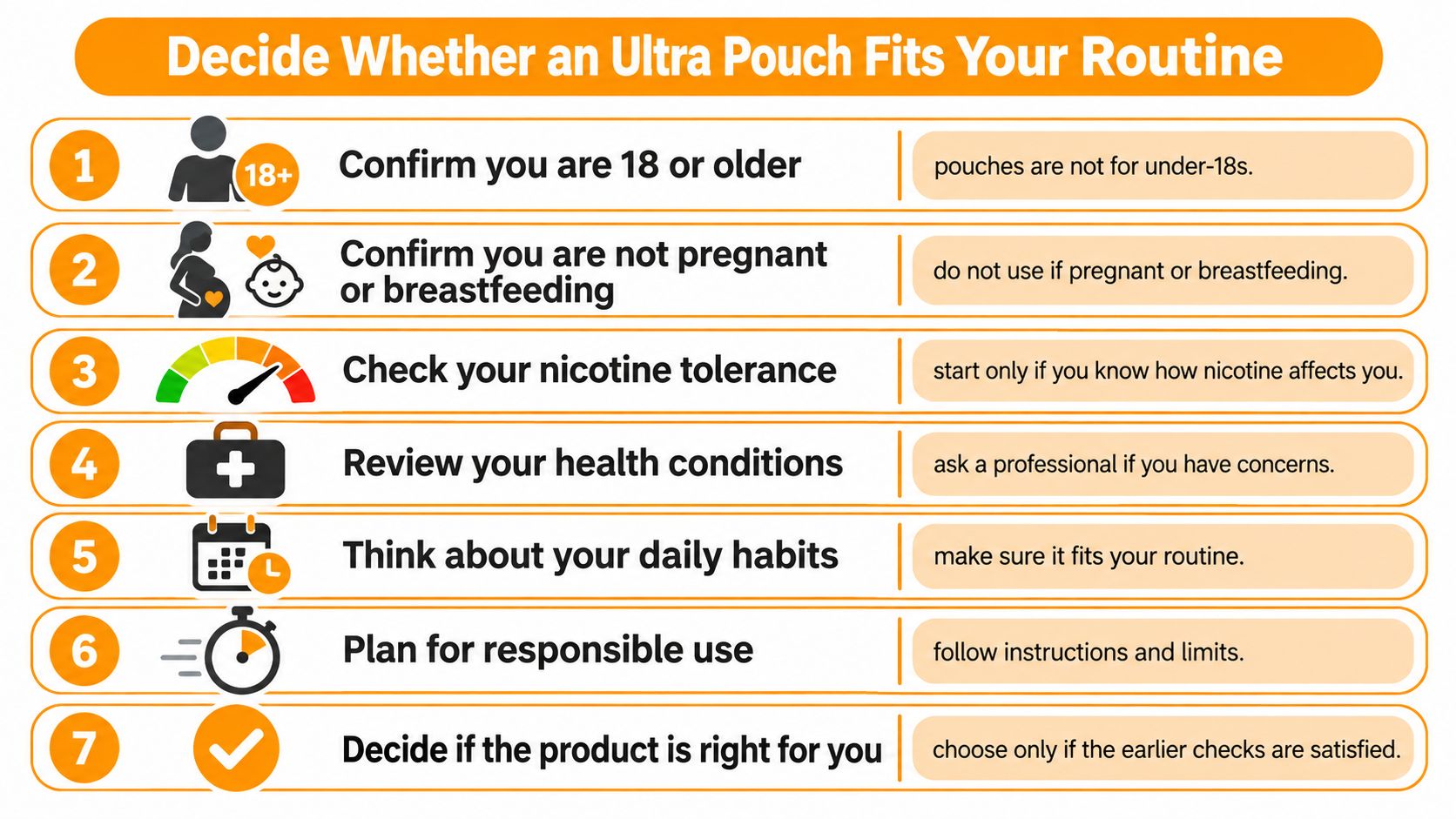
The Seven Checks
- Confirm adult status: Optimal Native pouches are for adults 18 and older, not for people under 18.
- Check pregnancy or breastfeeding: Optimal Native pouches are not for use during pregnancy or breastfeeding. Speak with a clinician about caffeine or melatonin products during these periods.
- Review medicines: If you take blood thinners, sedatives, epilepsy medicines or anxiety treatments, ask a pharmacist or clinician whether the ingredients are suitable for you.
- Add up caffeine: Include coffee, tea, energy drinks, pre-workout products, medicines and pouches in your daily total.
- Consider access at home: Keep pouches, including used ones, out of reach of children and pets.
- Check your mouth and gums: Stop using a pouch and seek assessment if you notice soreness, burning, white patches, blisters, bleeding or gum recession.
- Follow the dose: Use only one pouch at a time and do not exceed the stated recommended daily dose.
The checks address different parts of the risk. Age and pregnancy determine whether use is appropriate; medicines and caffeine affect what else is in your routine. Oral symptoms and dose habits matter even when a pouch contains no nicotine.
Applying the Checklist to a Real Routine
An adult considering a nicotine-free routine can compare Optimal Native's Morning Energy, Daily Flow and Evening Relax formulas with the same checks. Their stimulant content varies by time of day: Morning Energy contains 200 mg of caffeine, Daily Flow contains 100 mg, and Evening Relax is caffeine-free. Check the product label for ingredient amounts and consider how each formula fits your caffeine and melatonin use.
A passing checklist does not make every formula a good fit. Someone who gets jittery after coffee, works overnight shifts, takes sedatives or has gum recession may decide against use or seek professional advice first. Another adult may meet the checks and still prefer occasional use.
Treat the checklist as a routine review, not a permanent permission slip. Medicines, sleep schedules and oral symptoms can change, so reconsider your choice when they do.
For a particular person, safety depends on eligibility, total intake, oral comfort and consistent use. Use one pouch at a time, stay within the stated recommended daily dose, and stop if mouth symptoms develop. Ask a clinician or pharmacist when a medicine or health concern makes the answer uncertain.
Optimal Native's nicotine-free protocol includes Morning Energy, Daily Flow and Evening Relax, with different caffeine levels across the formulas. Adults considering the products can review the ingredients, timing and usage guidance on Optimal Native before deciding whether the routine suits them.