

Adaptogens for Stable All-Day Energy: 2026 Guide
TL;DR:
- Adaptogens are plant-based compounds that promote stable all-day energy by regulating the body’s stress response and supporting cellular energy. Unlike caffeine, they work gradually over weeks to modulate the HPA axis and mitochondrial function, providing steady energy without crashes. Proper product quality, consistent use, and lifestyle habits are essential for maximizing their benefits.
Adaptogens are plant-based compounds that promote stable all-day energy by helping the body regulate its stress response and optimize cellular energy metabolism. Unlike caffeine, which spikes cortisol and delivers a short burst followed by a crash, adaptogens like ashwagandha, Rhodiola rosea, and Panax ginseng work at the level of the HPA axis to keep your energy output steady across the full day. A 2025 Springer review confirms that these herbs modulate immune function and stress pathways rather than acting as direct stimulants. That distinction matters enormously for professionals, students, and health-conscious consumers who need focus and stamina that lasts, not a two-hour window followed by fatigue.

1. How adaptogens produce stable all-day energy
Adaptogens work by promoting homeostasis, the body’s ability to maintain internal balance under physical or mental stress. When stress rises, cortisol and adrenaline spike, burning through energy reserves quickly. Adaptogens interrupt that cycle by modulating the HPA axis, which governs your cortisol output, so your energy metabolism stays more consistent throughout the day. The result is not a stimulant buzz but a steadier baseline that holds up under pressure.
This mechanism separates adaptogens from every other category of natural energy booster. Caffeine blocks adenosine receptors temporarily. Adaptogens, by contrast, support mitochondrial function and antioxidant defenses at the cellular level. That is why clinical benefits for fatigue appear after weeks of consistent use rather than within an hour of your first dose. Patience is the price of genuine, sustained energy.
2. Ashwagandha: the chronic stress and sleep specialist
Ashwagandha (Withania somnifera) is the most clinically studied adaptogen for stress-driven fatigue. Its active compounds, called withanolides, suppress excess cortisol and support GABA receptor activity, which explains why it improves both energy and sleep simultaneously. A 2026 MDPI review found that 240 to 600 mg daily over 8 to 12 weeks reduced stress by 28 to 44% and improved sleep quality by 41 to 72%. Better sleep is one of the most direct routes to stable daytime energy, making ashwagandha uniquely effective for people whose fatigue is rooted in chronic stress or poor recovery.
Ashwagandha is best suited for long-term use rather than acute mental performance. If your energy crashes are tied to burnout, anxiety, or disrupted sleep, this is the adaptogen to prioritize. Look for extracts standardized to at least 5% withanolides to get the dosing consistency the research supports.
Pro Tip: Take ashwagandha in the evening rather than the morning. Its cortisol-lowering and sleep-improving effects work best when aligned with your body’s natural wind-down window, which then translates into better energy the following day.
3. Rhodiola rosea: the acute mental fatigue fighter
Rhodiola rosea is the adaptogen with the strongest short-term evidence for cognitive performance under stress. Its key bioactives, rosavins and salidroside, protect neurons from oxidative damage and support serotonin and dopamine balance. A 2026 trial with medical students showed that 50 mg twice daily for 20 days improved sleep, mood, and psychomotor performance during a high-stress exam period. That is a meaningful result for anyone who needs mental sharpness to hold up across a demanding workday.
Rhodiola is also well-supported for physical performance. A double-blind study in football players found that four weeks of Rhodiola rosea supplementation improved fatigue tolerance and decision-making under pressure. For professionals and athletes who face both cognitive and physical demands, Rhodiola is one of the most versatile long-lasting energy herbs available.
4. Panax ginseng: the endurance and vitality adaptogen
Panax ginseng is one of the oldest and most researched energy support herbs in traditional and modern medicine. Its active compounds, ginsenosides, support ATP production in mitochondria and modulate immune function, giving it a dual role in physical endurance and mental clarity. Clinical studies consistently show improvements in fatigue, reaction time, and working memory with standardized extracts at 200 to 400 mg daily. For busy professionals who need both physical stamina and cognitive output, Panax ginseng covers both bases more directly than most herbal energy supplements.
One practical note: Panax ginseng is stimulating enough that some users experience mild insomnia if they take it late in the day. Morning dosing is the standard recommendation, and cycling it every 8 to 12 weeks prevents tolerance buildup.
5. Eleuthero and schisandra: the underrated endurance pair
Eleuthero (Eleutherococcus senticosus), sometimes called Siberian ginseng, improves oxygen utilization and reduces perceived exertion during sustained physical effort. It is particularly well-regarded for enhancing endurance naturally in athletes and manual workers. Schisandra chinensis, meanwhile, supports liver detoxification and adrenal function, two systems that directly affect how long your energy holds up under repeated stress. Together, these two herbs address the physical side of fatigue that ashwagandha and Rhodiola do not fully cover.
Neither eleuthero nor schisandra has the same volume of clinical trials as ashwagandha or Rhodiola, but their traditional use and emerging research make them strong supporting players in a broader adaptogen regimen. Schisandra is especially interesting for people who experience afternoon energy dips tied to metabolic stress rather than sleep deficits.
6. How to choose quality adaptogen products
Standardized extract dosing is the single most important factor in whether an adaptogen product actually works. A label that says “500 mg ashwagandha root powder” tells you almost nothing about efficacy. What matters is the concentration of active compounds: withanolides for ashwagandha, rosavins and salidroside for Rhodiola, ginsenosides for Panax ginseng. Reputable products list these percentages clearly, and tracking outcomes over 8 to 12 weeks against a consistent dose is the only reliable way to assess whether a product is performing.
Third-party testing is equally non-negotiable. Adaptogen supplements are not regulated as drugs, which means clinical supervision is advised for anyone taking them alongside prescription medications. Look for NSF Certified for Sport or USP verification on labels, and consult a clinician if you take any medication that processes through the liver.
Pro Tip: Start with one adaptogen at a time for the first 8 weeks. This lets you isolate its effects on your energy and stress levels before adding a second herb. Stacking multiple adaptogens immediately makes it impossible to know what is working.
7. Comparing top adaptogens for energy and fatigue
The table below summarizes the key differences between the five adaptogens covered in this article, organized by primary benefit, typical dose, and best use case.
| Adaptogen | Primary benefit | Typical dose | Best for |
|---|---|---|---|
| Ashwagandha | Chronic stress, sleep, cortisol | 240–600 mg/day | Burnout, anxiety-driven fatigue |
| Rhodiola rosea | Acute mental fatigue, mood | 100–200 mg/day | Exam periods, high-pressure workdays |
| Panax ginseng | Physical endurance, cognition | 200–400 mg/day | Athletes, demanding cognitive work |
| Eleuthero | Oxygen efficiency, stamina | 300–600 mg/day | Physical endurance, sustained effort |
| Schisandra | Adrenal and liver support | 500–2000 mg/day | Metabolic stress, afternoon crashes |
Rhodiola and Panax ginseng are the strongest choices for mental fatigue and same-week performance gains. Ashwagandha delivers the most evidence for long-term stress reduction and sleep improvement. Eleuthero and schisandra are best added once you have a stable foundation with one of the primary three.
8. Lifestyle habits that amplify adaptogen benefits
Adaptogens work best when your daily habits are not actively working against them. Three specific practices have the strongest evidence for optimizing energy steadiness alongside herbal supplementation:
- Morning sunlight exposure. Getting direct sunlight within 30 minutes of waking anchors your circadian rhythm, which governs cortisol timing and energy peaks throughout the day. This single habit makes every adaptogen you take more effective by giving your body a clear biological clock signal.
- A 12-hour eating window. Compressing your meals into a 12-hour window and stopping food intake 3 hours before bed reduces the metabolic load on your liver and adrenal glands overnight. This directly supports the recovery processes that adaptogens like schisandra and ashwagandha are trying to enhance.
- Eliminating sugar-spiked drinks. Sugary drinks and high-caffeine beverages create the exact cortisol and blood sugar volatility that adaptogens are working to smooth out. Replacing them with water, herbal teas, or clean energy sources removes the biggest obstacle to steady all-day energy.
These three habits do not require supplements. They are the foundation that makes sustained energy ingredients perform at their ceiling rather than their floor. For a deeper look at morning energy optimization, the strategies pair directly with any adaptogen regimen you build.
Key takeaways
Adaptogens deliver stable all-day energy by regulating the stress response and supporting cellular energy metabolism, not by stimulating the nervous system directly.
| Point | Details |
|---|---|
| Mechanism matters | Adaptogens modulate the HPA axis and mitochondrial function, not adenosine receptors like caffeine. |
| Standardization is required | Always choose products listing active compound percentages, not just total herb weight. |
| Timing affects outcomes | Ashwagandha works best in the evening; Rhodiola and Panax ginseng perform better in the morning. |
| Results take weeks | Clinical benefits for fatigue and stress appear after 8 to 12 weeks of consistent use. |
| Lifestyle multiplies results | Circadian alignment, meal timing, and removing sugar drinks amplify every adaptogen’s effect. |
What we’ve learned from building with adaptogens daily
The biggest mistake people make with adaptogens is treating them like a faster, cleaner version of caffeine. They are not. When someone comes to Optimal Native frustrated that their ashwagandha “isn’t working” after ten days, the first question we ask is: what does your sleep look like? What are you eating at 9 p.m.? The herb is rarely the problem. The lifestyle context almost always is.
The second issue we see constantly is product quality. The adaptogen market is full of whole-herb powders sold at attractive prices that deliver almost none of the active compounds the clinical research used. A 600 mg capsule of unstandardized ashwagandha root powder is not the same product as a 300 mg extract standardized to 5% withanolides. The numbers look similar on a label. The biological effect is not.
We are also direct about one thing the marketing rarely says: adaptogen benefits require patience. If you are on prescription medications, especially antidepressants, thyroid medications, or immunosuppressants, you need a clinician involved before you start. The CYP450 interaction risk is real, and 70 to 80% of common drugs metabolize through the same liver pathways that several adaptogens affect. That is not a reason to avoid them. It is a reason to use them correctly.
What we believe in is the combination: quality standardized extracts, consistent daily use over at least eight weeks, and the lifestyle habits that give those herbs a stable environment to work in. That combination produces the kind of energy that professionals and athletes actually need. Not a spike. A floor that holds.
— Optimal Native
Try Optimal Native for clean, sustained energy
Optimal Native’s performance pouch system is built around the same adaptogens and nootropics covered in this article, formulated for the specific demands of professionals and athletes who cannot afford an afternoon crash.
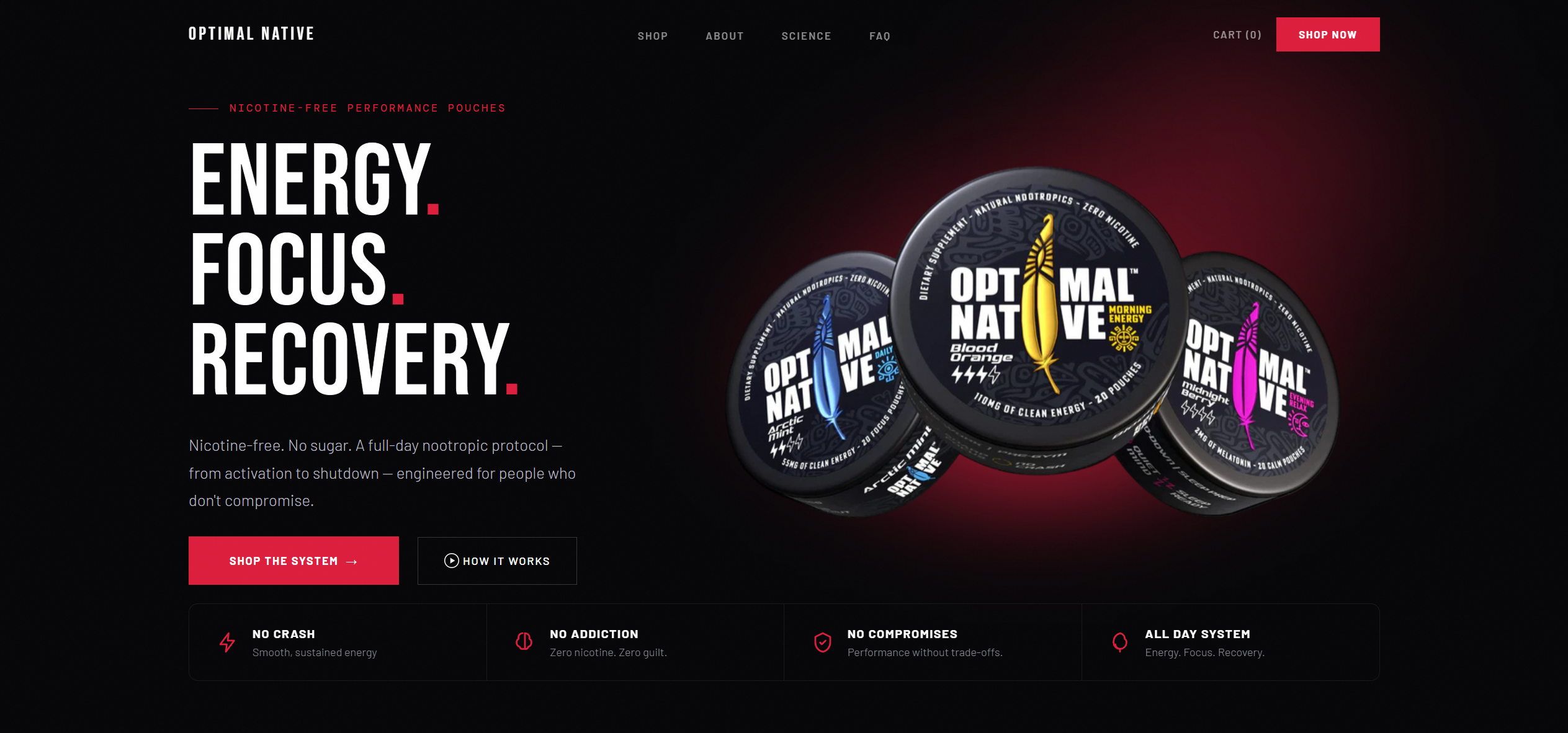
Every product in the Optimal Native lineup uses standardized extracts with verified active compound concentrations, not bulk herb powders. The subscribe and save option makes consistent 8 to 12 week use, the minimum needed for real results, both affordable and automatic. If you want to cover multiple energy and recovery pathways at once, the Optimal Native bundle combines the core adaptogen and nootropic stack into one convenient package. Over 300 verified customers report improved focus and energy with no jitters or crashes. That is the standard we hold every formula to.
FAQ
What are adaptogens and how do they support energy?
Adaptogens are plant compounds that help the body maintain balance under stress by modulating the HPA axis and supporting cellular energy metabolism. Unlike stimulants, they build steady energy over weeks rather than delivering an immediate spike.
How long before adaptogens improve energy levels?
Most clinical studies show meaningful improvements in fatigue and stress after 8 to 12 weeks of consistent daily use. Rhodiola rosea is the exception, with some cognitive benefits appearing within 20 days at 100 mg per day.
Which adaptogen is best for mental fatigue?
Rhodiola rosea has the strongest short-term clinical evidence for mental fatigue, with studies showing improved mood, sleep, and psychomotor performance in high-stress populations like medical students and competitive athletes.
Are adaptogens safe to take with medications?
Adaptogens can interact with medications through CYP450 liver enzyme pathways, which process 70 to 80% of common drugs. Anyone on prescription medications should consult a clinician before starting a daily adaptogen regimen.
Can adaptogens replace caffeine for all-day energy?
Adaptogens do not replace caffeine’s immediate stimulant effect, but they reduce the stress-driven energy volatility that makes caffeine dependency so common. Used consistently alongside good sleep and meal timing, they support a more stable energy baseline that reduces the need for caffeine throughout the day.