

The Role of L-Theanine in a Nicotine-Free Routine
TL;DR:
- L-theanine, an amino acid found in green tea, is studied for calm, focused alertness. It is not a quit-smoking or nicotine cessation aid and has not been shown to ease nicotine withdrawal or cravings in people. If you have decided to cut nicotine, talk to your doctor or a cessation service; if you simply like the pouch format, L-theanine is one ingredient in nicotine-free pouches such as Optimal Native.
Nicotine is addictive, and stopping it is genuinely hard, which is why proven support from a doctor, pharmacist or quitline matters. This article looks at a different question: what L-theanine, a naturally occurring amino acid found in green tea, actually is, what research says about it, and how it fits into a nicotine-free daily routine. To be clear up front: L-theanine is not a cessation aid, and Optimal Native is not a cessation product.
Table of Contents
- Key takeaways
- What nicotine withdrawal actually does to your brain
- What L-theanine research does and doesn’t show
- L-theanine vs. proven cessation treatments
- How L-theanine fits a nicotine-free routine
- Clearing up common misconceptions
- My take on willpower vs. neurochemistry
- Optimal Native: a nicotine-free pouch for your daily routine
- FAQ
Key takeaways
| Point | Details |
|---|---|
| Withdrawal peaks fast | Nicotine withdrawal symptoms typically peak at 2-3 days and begin resolving over 2-4 weeks. |
| L-theanine is studied for calm focus | Human research looks at relaxation and attention in general, not at quitting nicotine. |
| Animal data is not proof | A mouse study looked at nicotine reward and withdrawal signs; that has not been shown in people. |
| Quitting needs proven support | If you have decided to cut nicotine, a doctor, pharmacist or quitline can recommend evidence-based options. |
| Not a cessation product | L-theanine is generally well-tolerated as a food ingredient, but neither it nor Optimal Native is a quit aid. |
What nicotine withdrawal actually does to your brain
Most people go into quitting expecting a rough few days. What they get is a multi-week neurological reset that affects mood, memory, sleep, and the ability to feel pleasure. Understanding this is what changes the strategy.
Nicotine withdrawal symptoms typically include:
- Intense cravings that spike unpredictably, especially in response to triggers like stress, coffee, or routine
- Anxiety and irritability driven by a sudden loss of nicotine’s calming effect on the brain
- Difficulty concentrating, sometimes severe enough to affect work performance in the first week
- Sleep disruption, including vivid dreams and early waking
- Depressed mood, tied to disrupted dopamine signaling
Symptoms peak around days 2 and 3, then gradually ease over two to four weeks. But here’s what most guides leave out: recovery is not linear. Many people hit a secondary rough patch around week two, when the novelty of quitting wears off and the dopamine deficit still hasn’t resolved.
Nicotine doesn’t just hook into one receptor. It disrupts dopamine, GABA, serotonin, and glutamate systems simultaneously. That’s why withdrawal feels like it affects everything at once, and why it is worth getting proper medical support rather than trying to manage it alone.
Research also shows that e-cigarette withdrawal causes measurable hormonal changes, including shifts in adrenaline and beta-endorphin levels, reinforcing the point that this is a physiological process, not just a mental battle. Knowing that should remove some of the shame and redirect your energy toward strategy.
What L-theanine research does and doesn’t show
L-theanine (5-N-ethyl-L-glutamine) is the technical name for the compound. You may see it called “L-theanine” in supplements and “theanine” in research. Both refer to the same molecule. It’s found primarily in Camellia sinensis, the plant used to make green, black, and white tea. The concentration is highest in matcha and shade-grown green teas.
L-theanine is best known for calm, focused alertness. It promotes relaxation without drowsiness and has been studied for mental focus, which is why it is often paired with caffeine. Those studies looked at everyday focus and relaxation; they did not test L-theanine as a way to quit nicotine or to ease withdrawal.
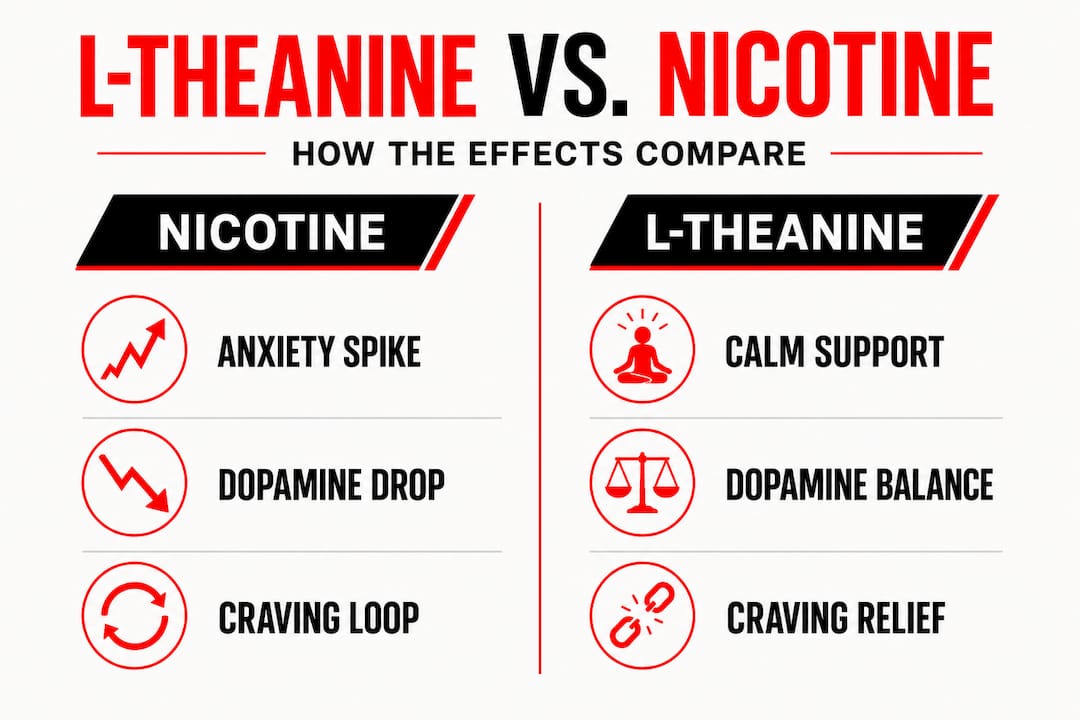
You may see claims online that L-theanine helps people quit. They usually trace back to an animal study in which L-theanine reduced nicotine reward and withdrawal signs in mice. Mouse results are an early research signal, not evidence that it works in people. L-theanine has not been shown to help humans quit nicotine, reduce cravings or ease withdrawal.
L-theanine does not bind to nicotine receptors and carries no known addiction potential, which is one reason it is widely used as a food and drink ingredient. That is a safety point, not evidence that it treats nicotine withdrawal.
Pro Tip: Pair a calm-focus break with a moment of intentional breathing or a short walk. Simple, consistent cues like these make any daily routine easier to stick to.
L-theanine vs. proven cessation treatments
If you have decided to cut nicotine, it helps to know which options are actually proven. Here’s how L-theanine compares with treatments a doctor or pharmacist may discuss with you:
| Aid | Mechanism | Addiction risk | Cognitive benefit | Proven quit aid? |
|---|---|---|---|---|
| Nicotine patch/gum | Replaces nicotine gradually | Low to moderate | None | Yes |
| Varenicline (Rx) | Blocks nicotine receptors | None | Minimal | Yes (Rx) |
| Bupropion (Rx) | Dopamine/norepinephrine reuptake inhibition | None | Mood support | Yes (Rx) |
| L-theanine | Amino acid from tea; studied for calm focus | None | Yes, focus and calm | No |
| Melatonin | Regulates sleep cycle | None | Sleep only | No |
The key difference: nicotine replacement therapy, varenicline and bupropion are proven cessation treatments; L-theanine and melatonin are not. If you’re quitting, start with the proven options and ask your doctor or pharmacist before adding any supplement.
What L-theanine does have going for it as an everyday ingredient:
- Non-addictive with no documented physical dependence, even at high doses
- Commonly paired with caffeine to make energy feel smoother
- No rebound anxiety, unlike some calming herbs such as valerian
- Backed by human research on relaxation and attention
- Available without a prescription and generally affordable
None of that makes it a substitute for medical advice. For anyone trying to quit nicotine, proven treatments and professional support come first.
How L-theanine fits a nicotine-free routine
If you simply enjoy the pouch format, or want calm focus without nicotine as part of your day, here’s a practical way to think about L-theanine.
-
Know what’s in your pouch. Check the label for the amount of L-theanine and caffeine per serving, and count caffeine from coffee, tea and energy drinks too.
-
Use 100-200mg per dose. Most human studies and clinical use land in this range. Research on its calming effects suggests this dose supports focus reliably without sedation. Follow the serving directions on the product you use rather than adding extra.
-
Avoid mega-dosing. There is no evidence that taking 400mg does twice the job. L-theanine has a ceiling effect on relaxation. Stick to the effective range.
-
Add dietary sources. Matcha tea contains roughly 20-45mg per gram of powder, making it the highest food source available. A single matcha latte provides a meaningful dose on top of any supplement. Green tea’s natural L-theanine also comes paired with low caffeine, which sharpens the focus effect.
-
Notice how you feel. Write down focus quality and sleep on a simple 1-10 scale for a week. It helps you see which time of day suits a caffeinated or a caffeine-free option.
-
Get proper support if you’re quitting. If you’ve decided to cut nicotine, talk to your doctor, a pharmacist or a quitline such as 1-800-QUIT-NOW in the US. L-theanine and Optimal Native are not cessation products.
Pro Tip: Timing matters. A caffeinated pouch suits the morning or early afternoon; in the evening, choose a caffeine-free option so it doesn’t get in the way of sleep.
Clearing up common misconceptions
Several questions come up repeatedly about L-theanine and nicotine. Let’s address them directly.
-
Is L-theanine addictive? No. It has no known abuse potential, does not create dependence, and there are no withdrawal effects from stopping its use. This is supported by decades of use in Japan, where it has been consumed as a food ingredient for centuries.
-
Can I use it alongside a patch or gum? Ask your doctor or pharmacist before combining any supplement with a cessation treatment. L-theanine is not a cessation aid and isn’t meant to fill gaps in one.
-
Does L-theanine ease withdrawal? There is no good human evidence that it does. Research on L-theanine looks at relaxation and attention in general, not at nicotine withdrawal.
-
Is the animal research relevant to humans? Animal studies are a starting point, not a guarantee. The mouse findings on nicotine have not been confirmed in people, so they shouldn’t be read as evidence that L-theanine helps anyone quit.
My take on willpower vs. neurochemistry
I’ve spent years watching people fail at quitting not because they weren’t motivated, but because they were fighting a neurochemical battle with only motivational tools. The idea that quitting is “all mental” is one of the most damaging myths in this space.
What I’ve seen again and again is that withdrawal is multi-dimensional. It hits behavior, biochemistry, hormones, and cognitive function at the same time. You cannot willpower your way past a dopamine deficit any more than you can willpower your way past a broken leg.
L-theanine gets my respect because it’s simple and well studied as an everyday ingredient. But it isn’t a quit aid, and I’d be wary of anyone who sells it as one. If you’re quitting, the evidence points to proven treatments and real support.
The people I see succeed consistently are the ones who treat quitting as a protocol, not a test of character. They use proven cessation treatments where appropriate, get support from a professional or quitline, and build systems for their hard days.
— Optimal Native
Optimal Native: a nicotine-free pouch for your daily routine
Optimal Native makes nicotine-free pouches for adults 18+ who like the pouch format. They are a food supplement, not a cessation product. Each formulation includes L-theanine alongside a blend of adaptogens and nootropics, built for different times of day: Morning Energy (200 mg caffeine), Daily Flow (75 mg caffeine) and Evening Relax (caffeine-free).
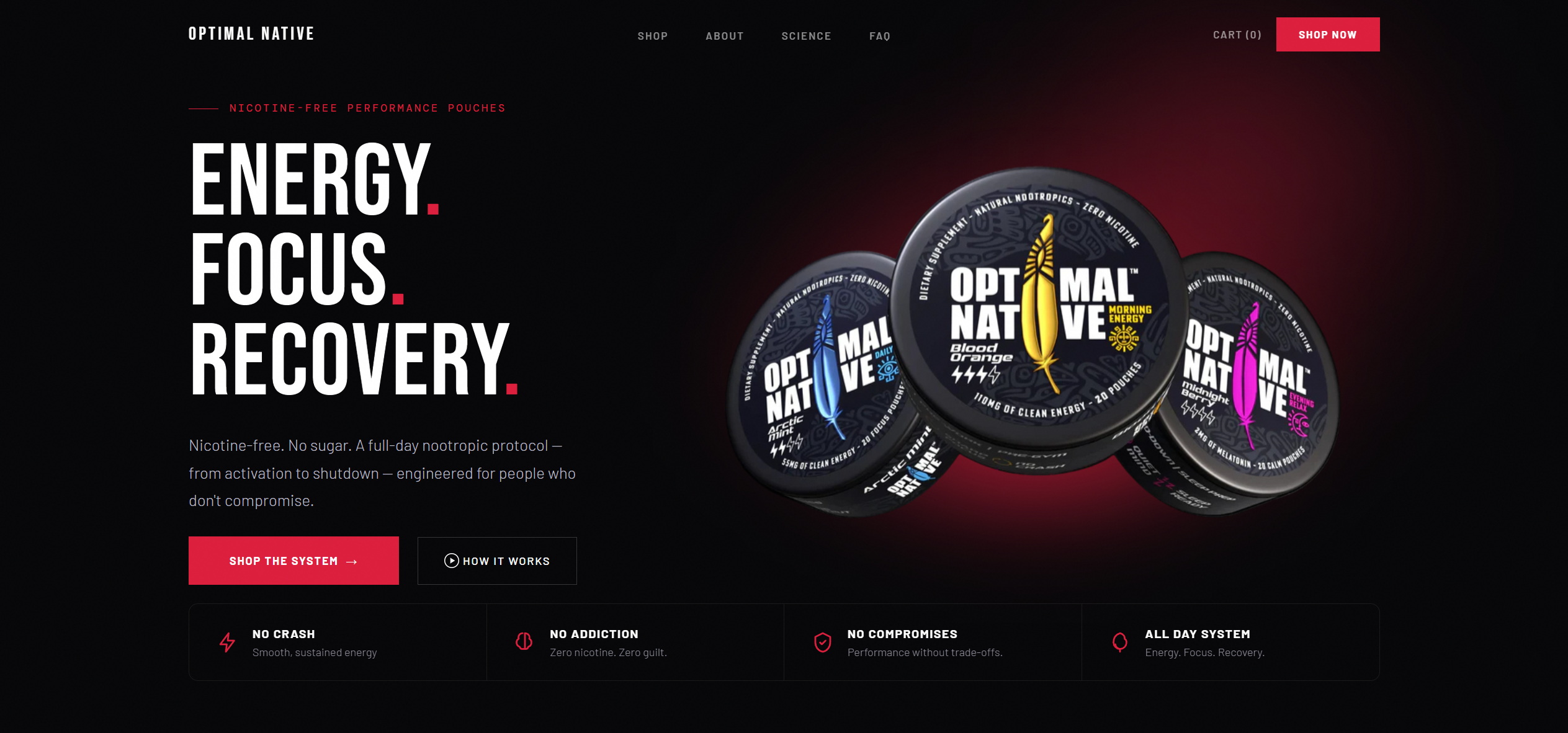
Over 300 users rate Optimal Native 4.9 out of 5 stars. If you want a nicotine-free pouch as part of your day, check out the Subscribe and Save option for ongoing access at a lower cost. You can also explore the Optimal Native bundle to try the full morning-to-evening range.
FAQ
Does L-theanine help you quit nicotine?
No, not on current evidence. L-theanine is an amino acid studied for calm focus; it has not been shown to help people quit nicotine, reduce cravings or ease withdrawal. If you’ve decided to cut nicotine, talk to your doctor or a cessation service.
How quickly does L-theanine work?
In research on calm focus, effects are usually reported within 30-60 minutes of a dose. That research is about everyday relaxation and attention, not nicotine withdrawal.
Can L-theanine reduce nicotine cravings directly?
There is no human evidence that it does. An animal study found reduced nicotine reward in mice, but that hasn’t been shown in people, so L-theanine shouldn’t be used as a craving or relapse-prevention aid.
Is it safe to take L-theanine with a nicotine patch or gum?
L-theanine is generally well-tolerated as a food ingredient, but ask your doctor or pharmacist before combining any supplement with a cessation treatment. It is not a replacement for, or an add-on to, nicotine replacement therapy.
How much L-theanine is typical?
Most human studies on calm focus use roughly 100-200mg per dose. There is no recommended L-theanine dose for nicotine cessation, because it is not a cessation treatment.