

Clean Energy Supplement: What It Means and How to Judge One
What makes a product "clean" if no regulator defines the word? That's the gap most labels skip. A clean energy supplement can sound cleaner, faster and safer than coffee or an energy drink, yet the name alone proves none of those things.
A better question is simpler. How many milligrams are in each serving, how long should the effect reasonably last, and what does the dose add to the caffeine already in a normal day?
Table of Contents
- What Clean Energy Means in a Supplement
- Ingredient Profiles Behind the Label
- How Much Caffeine Is Too Much to Stack
- Melatonin, Timing and Who Should Skip Them
- Pouches, Capsules or Drinks Compared
- Who Benefits Most From a Clean Energy Routine
- Judge a Label and Run a One-Week Test
What Clean Energy Means in a Supplement
A clean energy supplement is a non-prescription product aimed at steady alertness without the sugar, calories and sharp crash linked to a typical energy drink. It isn't a separate regulated category. "Clean" is a marketing word, not a federal standard, so readers have to test the claim against the label.
Think of fuel delivery. A standard energy drink empties a full tank at once. A well-built supplement releases fuel in measured stages across a morning, with a smaller dose, a set time window and no automatic second spike.
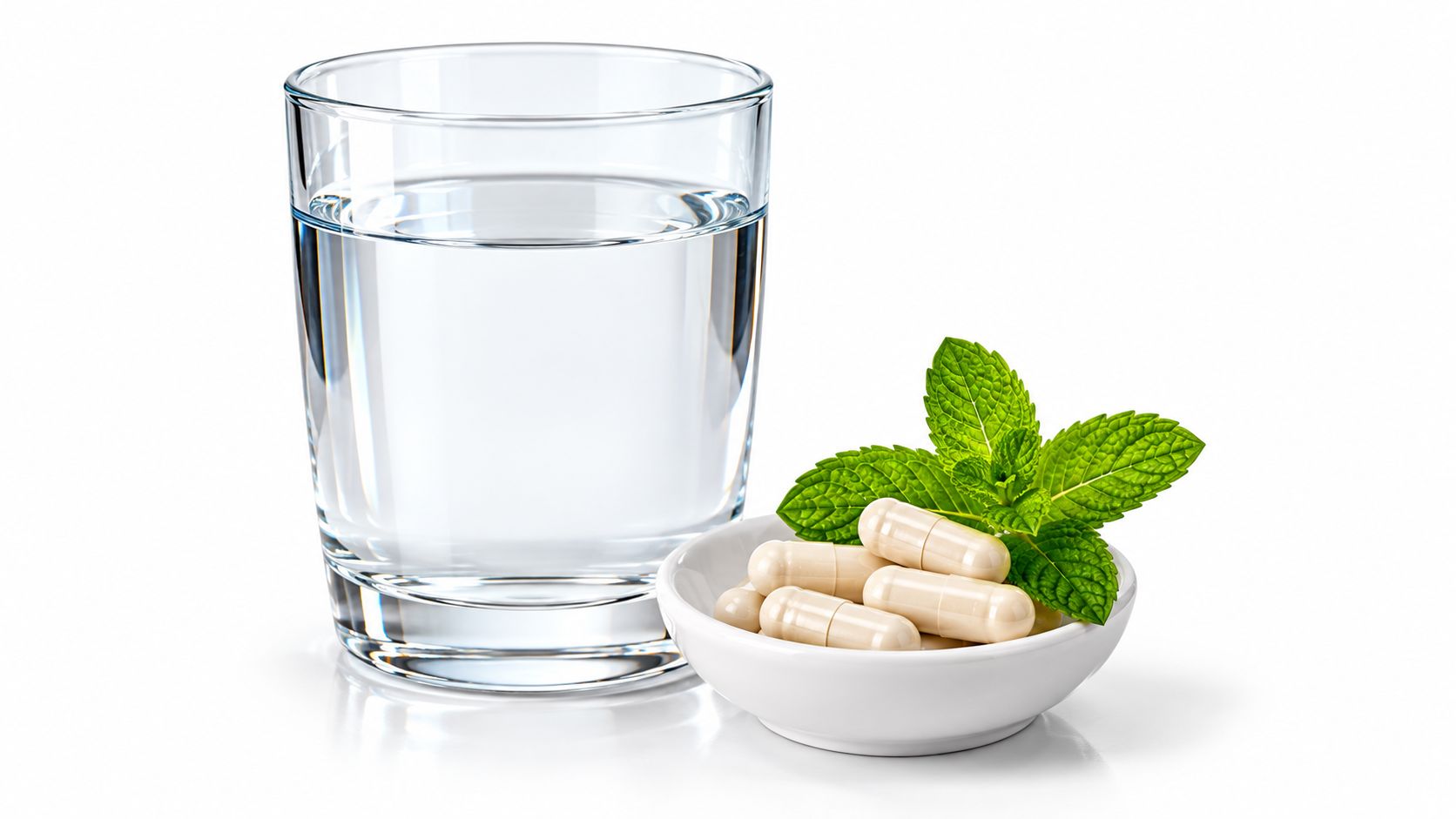
Most formulas use three layers. The first is a stimulant base, usually caffeine. The second is a focus or calm partner, usually L-theanine. The third adds support nutrients such as B vitamins. Guides to clean ingredients in energy supplements can help readers separate those layers from flavoring and filler language.
Demand explains the crowded shelf. In 2023, 48% of surveyed consumers said they were looking for supplements to support energy levels, according to a consumer survey commissioned by NOW and conducted by Suzy.com.
Three tests cut through the wording:
- Disclosed milligrams: The caffeine amount per serving is printed, not buried in a blend.
- Realistic time window: The label doesn't promise all-day focus from a short-acting dose.
- Total daily count: Coffee, tea, medication and other supplements count too.
In practice, clean usually means transparent dosing, not faster or stronger effects.
Ingredient Profiles Behind the Label
| Ingredient | Role in the formula | Typical amount per serving | Evidence strength |
|---|---|---|---|
| Caffeine | Main alertness driver | 75 to 200 mg | Strong for short-term alertness |
| L-theanine | Paired with caffeine for attention | 100 to 200 mg | Moderate, mainly alongside caffeine in the first two hours |
| Theacrine | Marketed as a longer-lasting mild stimulant | No standard dose, check printed mg | Limited human data |
| B vitamins (B6, B12, niacin) | Support normal energy metabolism | Listed as % of daily value | Helps with deficiency, no proven boost in well-fed adults |
| Alpha-GPC and Cognizin (citicoline) | Choline sources for focus | No standard dose, check printed mg | Small trials, mixed results |
| Melatonin | Sleep timing in evening blends | 0.5 to 2 mg low dose | Strong for timing-related sleep problems |
| Magnesium | Relaxation support | Check elemental mg printed | Modest, mostly for low intake |
| Apigenin | Plant flavonoid in calm blends | No standard dose, check printed mg | Limited human data |
The Pairing Readers Overrate and Underrate
Caffeine does most of the alertness work. L-theanine isn't a stimulant on its own. Its value sits in the pairing. A systematic review and meta-analysis of 11 randomized, placebo-controlled human studies found moderate effects favoring combined caffeine and L-theanine during the first two hours after dosing, particularly for alertness and attentional-switching accuracy.
That time limit matters. The review measured acute laboratory tasks, not real-world productivity, driving safety or emergency response. A product shouldn't turn a one to two hour window into a promise of constant focus for a full shift. Effects also shift with sleep status, caffeine tolerance, dose ratio and individual absorption.
B vitamins cause a different confusion. They support normal energy metabolism, and correcting a deficiency can matter. That doesn't mean extra B12 creates extra energy in a well-nourished adult. Percent of daily value tells readers the nutrient dose, not the size of any felt effect.
Where Evidence Gets Thin
Theacrine and apigenin have limited human data, so confident dose claims deserve skepticism. Alpha-GPC and Cognizin rest on smaller trials with mixed results. Magnesium needs a closer read too, because the elemental amount is what counts, not the heavier compound weight on the front of a blend. Readers comparing non-stimulant options can also review adaptogens for stable all-day energy as a separate category, not as a substitute for checking milligrams.
Melatonin belongs in evening formulas as a timing signal, not as daytime energy support. Its role is different from every other row, which is why timing gets separate treatment below.
How Much Caffeine Is Too Much to Stack
The U.S. Food and Drug Administration guidance on caffeine states that up to 400 milligrams of caffeine per day is an amount not generally associated with negative effects for most healthy adults, roughly two to three 12-fluid-ounce cups of coffee. It isn't a personal target. Sensitivity, absorption and elimination rates vary substantially between individuals.
| Source | Serving | Approximate caffeine |
|---|---|---|
| Brewed coffee | 8 fl oz | about 95 mg |
| Brewed coffee | 12 fl oz | about 140 mg |
| Espresso | 1 shot | about 63 mg |
| Black tea | 8 fl oz | about 47 mg |
| Green tea | 8 fl oz | about 28 mg |
| Cola | 12 fl oz | about 34 mg |
| Energy drink | 16 fl oz | 100 to 200 mg |
Tea strength changes the count, so caffeine comparisons from TOO MATCHA help readers avoid treating every cup of green tea as identical.
Run the Arithmetic on a Normal Day
Start with a worked example. A 200 mg morning serving plus a 75 mg daytime serving equals 275 mg before any other source. Add one 12 fl oz coffee at about 140 mg and the total reaches about 415 mg. That single coffee pushes the day over the FDA reference level.
The procedure is plain. List every caffeine source in a typical day, including coffee, tea, cola, energy drinks, pre-workout, medication and other supplements. Add the milligrams. Compare the total with 400 mg, then judge the supplement inside that total, not in isolation. A fuller walkthrough is available in this guide to how many milligrams of caffeine is too much.
Practical rule: If a label gives no caffeine milligrams per serving, the daily total can't be calculated.
Caveats sit next to the number. Pregnancy, certain medical conditions, medication interactions and individual sensitivity can lower the appropriate intake. Readers should read labels for milligrams per serving, not only for the word "energy."
Melatonin, Timing and Who Should Skip Them
Melatonin isn't a simple nighttime switch. Evidence is strongest for timing-related sleep problems, not for general insomnia. Treating it like a sedative leads to the wrong dose, the wrong hour and disappointment when sleep doesn't change much.
An NIH evidence summary on melatonin for sleep disorders found melatonin reduced sleep-onset latency in normal sleepers by a weighted mean of 3.9 minutes, and by 38.8 minutes in people with delayed sleep phase syndrome. The gap between those figures is the lesson. Population and condition change the result.
The National Center for Complementary and Integrative Health melatonin guidance reports a 2018 randomized controlled trial of 307 people with delayed sleep-wake phase disorder where melatonin taken one hour before the desired bedtime, together with a fixed bedtime, led participants to fall asleep an average of 34 minutes earlier. The same source notes clinical guidelines found insufficient evidence to recommend melatonin for chronic insomnia.
Timing Risks That Labels Gloss Over
Low doses of roughly 0.5 to 2 mg may be sufficient, while higher doses can increase daytime drowsiness, dizziness and gastrointestinal effects, as summarized in a recent review of melatonin dosing. Mayo Clinic guidance cited there advises avoiding driving or machinery for five hours after use.
Caffeine creates the mirror problem. The National Heart, Lung, and Blood Institute healthy sleep guidance states caffeine can make it harder to fall asleep if its effects haven't worn off by bedtime, and recommends using caffeine only in the morning rather than during the afternoon.
For rotating schedules, a fixed evening clock window may not match biological night. Testing a melatonin routine on a non-critical day is safer than testing it before a commute, a night shift or early duty.
Who Should Talk to a Clinician First
- Pregnancy or breastfeeding: Medical advice should come before stimulant or melatonin use.
- Under 18: Adult dosing references don't transfer automatically.
- Medication use: Blood thinners, sedatives and diabetes medication raise interaction questions.
- Health conditions: Heart rhythm problems, high blood pressure, anxiety disorders and known sleep disorders need individual review.
Pouches, Capsules or Drinks Compared
The format is the door the dose walks through. The milligrams decide how strong the effect is. That distinction corrects the most common misconception about a clean energy supplement in pouch form.
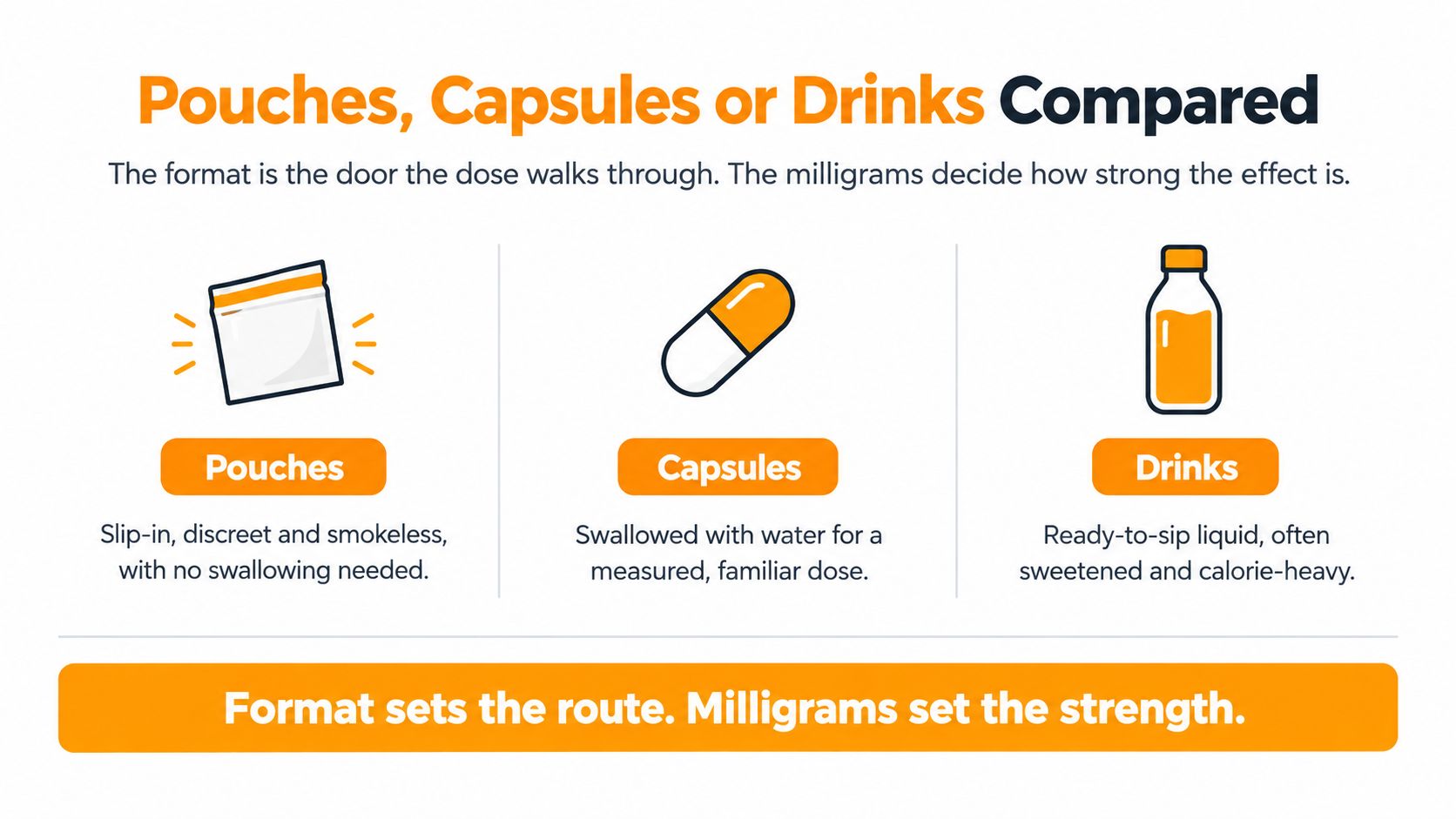
| Format | Caffeine onset | Sugar and calories | Portability | Dose consistency |
|---|---|---|---|---|
| Oral pouch | No proven speed advantage over swallowing | Usually none, check label | High, no liquid | Printed mg per pouch |
| Capsule or tablet | Often peaks around 30 to 60 minutes | Usually none | High | Fixed dose per capsule |
| Canned energy drink | Often peaks around 30 to 60 minutes | Regular cans often 25 g or more sugar | Medium, needs a can | Printed on the label, but can sizes differ |
| Brewed coffee | Often peaks around 30 to 60 minutes | None if black | Medium | Depends on brew strength and cup size |
A 2025 controlled study of sublingual caffeine delivery via oral spray found it did not raise blood caffeine faster than ingestion, with peak concentration around 90 minutes and no significant advantage at 5 minutes. Evidence on oral caffeine formats, including sprays and gums, remains limited and mostly comes from small trials.
A short video walkthrough can help readers visualize the format differences before judging onset claims.
So how quickly does an oral pouch work, and how long does it last? Faster onset isn't guaranteed. Saliva, placement, swallowing, food and caffeine tolerance may change the experience, but a possible absorption route isn't the same as a demonstrated real-world effect. The honest expectation is the same window capsules and coffee already offer: somewhere in the 30 to 90 minute range, not instant alertness. Readers drawn to speed claims should read this overview of fast-acting energy supplements with that limit in mind.
Format changes convenience, not chemistry.
Pouches still offer clear practical traits. They need no liquid or refrigeration, usually carry no sugar, and print a dose per pouch. That printed number is what makes a pouch easy to judge: add it to the morning coffee and the afternoon tea, and the true daily total becomes visible instead of guessed. Convenience and ritual are genuine gains, even without a proven speed advantage. That matters for emergency personnel, drivers, military users and operators who can't afford to assume buccal means immediate.
Who Benefits Most From a Clean Energy Routine
Routines decide fit. In 2024, 74% of U.S. supplement users reported taking supplements every day, according to findings from the Council for Responsible Nutrition's Ipsos survey. A product used daily has to survive real schedules, not a single good morning.
Five Situations, Five Different Tradeoffs
Shift-based first responders, including doctors, nurses, paramedics, firefighters and police, work long and irregular hours. A predictable morning dose and a firm caffeine cutoff can help structure a shift. The risk sits at the other end, where a poorly timed evening dose adds drowsiness to a commute.
Office, remote and deep-work professionals often reach for a third or fourth coffee in the afternoon. Replacing that habit with an earlier, measured dose protects sleep better than adding a supplement on top of coffee. Stacking is the failure mode, not the format.
High-output operators moving between meetings and travel value portability. A pouch or capsule fits a pocket and needs no café stop. Total caffeine across a long travel day is easy to undercount, especially when airport coffee sizes grow.
Former nicotine pouch users already know the under-lip ritual, so adoption feels familiar. Familiarity doesn't change the evidence. Focus benefit still rests on caffeine and its partner ingredients, as with any other delivery route.
Gamers and streamers on late sessions get alertness now and pay later. Late caffeine delays sleep, and poor sleep reduces next-day focus more reliably than a supplement restores it.
Benefit depends on fit to schedule and total intake, not on the product name.
Judge a Label and Run a One-Week Test
Start with a decision rule. A product that fails the first check, with no caffeine stated in milligrams per serving, gets skipped. A product that passes four of five checks with no red flag earns a closer look.
| Check | What good looks like | Red flag |
|---|---|---|
| Caffeine disclosure | Milligrams per serving printed on the label | Only "energy blend" with no caffeine figure |
| Ingredient amounts | Each active listed with its own dose | Proprietary blend with a total but no breakdown |
| Daily total guidance | Tells readers to count coffee, tea and other supplements | Silent on total daily intake |
| Third-party testing | NSF Certified for Sport, USP Verified or Informed Choice mark | No testing mark and no batch records |
| Claims | Temporary alertness or calm, with human studies named | Treats, cures or prevents a condition, or "clinically proven" with no study |
Read the Five Checks in Order
Caffeine disclosure comes first because every later calculation depends on it. A serving that lists no caffeine figure can't be stacked safely against coffee or tea.
Ingredient amounts come next. Each active should carry its own dose. A 500 mg proprietary blend with no breakdown could contain a meaningful amount of one ingredient and a dusting of the rest.
Daily total guidance shows whether a brand expects real-world use. Strong labels tell readers to count coffee, tea, energy drinks, pre-workout and medication. Silence on total intake pushes all the risk onto the buyer.
Third-party testing adds independent verification. Marks such as NSF Certified for Sport, USP Verified or Informed Choice don't prove a product works, but they do support that the contents match the label. Manufacturing detail helps too, including good manufacturing practice and a stated manufacturing location.
Claims should stay narrow. Temporary alertness or calm, with named human studies, is defensible. "Clinically proven energy" with no study named is not. Sugar or calories hidden behind "natural" flavors also count as a red flag for a product calling itself clean.
Run the One-Week Test
- Score one candidate: Mark pass or fail against the five checks before buying a second product.
- Total a typical day: Add every caffeine source and compare the sum with the 400 mg reference.
- Log seven days: Record time taken, dose, total caffeine, perceived onset, focus at one and two hours, side effects and sleep that night.
- Adjust on sleep: If sleep slips, move the caffeinated dose earlier or drop it instead of adding an evening fix.
- Review with a clinician: Prescription medication, pregnancy, or heart, anxiety or sleep concerns come before self-testing.
Optimal Native works as a checkable example because its pouches print caffeine per pouch, 200 mg for Morning Energy, 75 mg for Daily Flow and none in Evening Relax, with assigned time windows for each formula. Those figures can be scored and logged like any other candidate. Its faster-absorption positioning isn't established by ingredient evidence alone, so the one-week log, not the delivery claim, should decide.
Keep the shortlist small. Two products that pass the label checks and survive seven logged days give a clearer answer than a cupboard of half-tested options. The cleanest choice is the one with disclosed milligrams, a realistic window and a daily total that still leaves room for sleep.
Readers who want a timed, nicotine-free pouch routine with printed caffeine per pouch can review the morning, daytime and caffeine-free evening formulas from Optimal Native and score them against the five checks above. Bring a typical day's coffee and tea total to that comparison, then run the seven-day log before committing to a daily routine.