

What Is Caffeine Sensitivity Explained for You
If you’ve ever felt your heart race after a single cup of coffee while a friend drinks three and feels nothing, you’ve already experienced what is caffeine sensitivity explained in real life. Caffeine sensitivity is not a weakness or a quirk. It’s a genuine physiological condition rooted in your genetics, enzyme activity, and how your nervous system processes adenosine. Understanding it can change how you fuel your day, protect your sleep, and stop blaming yourself for reactions that are simply biology at work.
Table of Contents
- Key takeaways
- What is caffeine sensitivity explained through biology
- Recognizing caffeine sensitivity symptoms
- Factors that shift your caffeine sensitivity over time
- Managing caffeine sensitivity practically
- My take on the caffeine sensitivity conversation
- A smarter approach to daily energy
- FAQ
Key takeaways
| Point | Details |
|---|---|
| Genetics drive sensitivity | Your CYP1A2 enzyme speed and adenosine receptor variants determine how strongly caffeine hits you. |
| Symptoms can appear at low doses | Jitteriness, anxiety, and insomnia can occur well below the 400 mg daily threshold considered safe for most adults. |
| Sensitivity is not fixed | Age, stress, sleep deprivation, and medications all shift how your body responds to caffeine over time. |
| Sensitivity differs from tolerance | Tolerance builds through receptor upregulation; sensitivity is innate and tied to your baseline biology. |
| Management is practical | Adjusting dose, timing, and beverage choice can reduce symptoms without eliminating caffeine entirely. |
What is caffeine sensitivity explained through biology
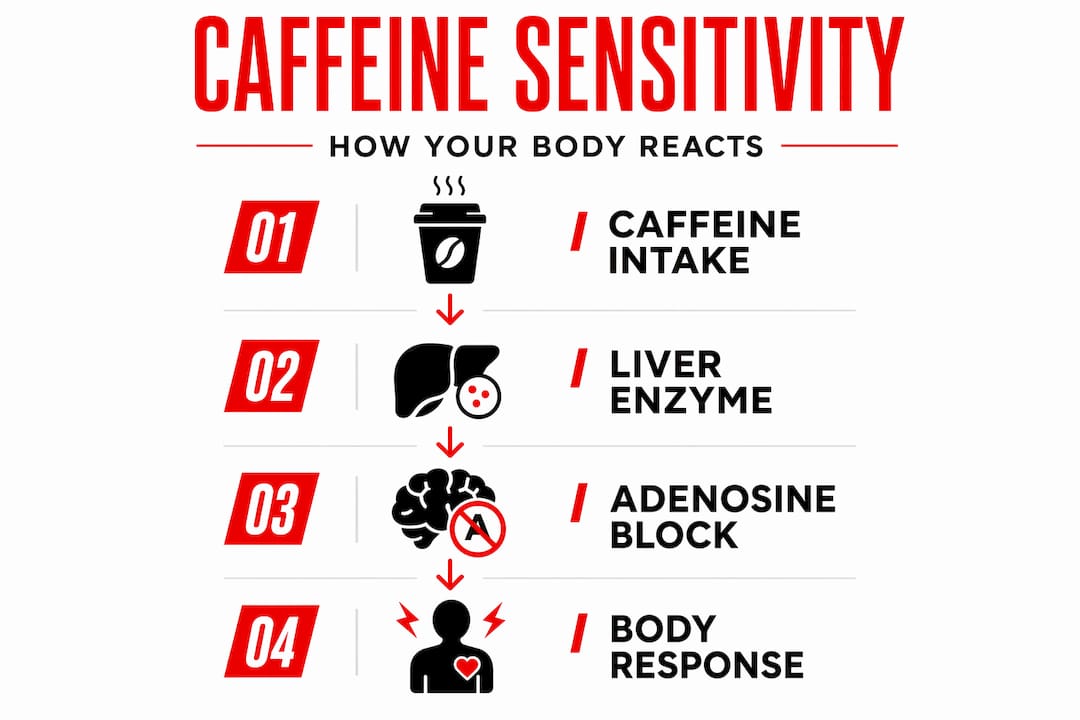
Most people believe caffeine gives them energy. It doesn’t. Caffeine blocks adenosine receptors, which are the receptors that signal your brain to feel sleepy. When those signals are blocked, you feel alert. But the fatigue hasn’t gone anywhere. Once caffeine clears your system, accumulated adenosine floods back in, which is exactly why the crash feels so hard.
This mechanism is the same for everyone. What differs dramatically is how your body handles it.
The CYP1A2 enzyme: your caffeine processing speed
Your liver uses an enzyme called CYP1A2 to break down caffeine. Some people carry a genetic variant that makes this enzyme fast. Others have a slower version, and slow metabolizers retain caffeine in their system 8 to 14 hours longer than fast metabolizers. That afternoon espresso? For a slow metabolizer, it’s still circulating at midnight.
Fast metabolizers often feel a quick burst of alertness and then a relatively clean comedown. Slow metabolizers experience a prolonged stimulant effect that can disrupt sleep, increase anxiety, and make the next morning feel rougher than it should.
Adenosine receptor sensitivity and genetic variants
Beyond metabolism speed, your adenosine receptors themselves can be more or less reactive to caffeine. 10 to 15% of people carry genetic variants that make their adenosine receptors hypersensitive. These individuals feel the full force of caffeine at doses far below what most people consider significant.
Multiple genes play into this picture. Variants in CYP1A2, ADORA2A, COMT, and SLC6A4 can interact cumulatively to amplify sensitivity. Someone with several of these variants isn’t just a little more sensitive. They may react to a single cup the way someone else reacts to four.
Pro Tip: If you consistently feel wired, anxious, or sleepless after small amounts of caffeine, a consumer DNA test that includes CYP1A2 and ADORA2A variants can give you a concrete answer rather than leaving you guessing.
Recognizing caffeine sensitivity symptoms
Knowing the biology is useful. Knowing what to look for in your own body is more immediately practical.

Common symptoms
Caffeine sensitivity symptoms can appear after a single cup and typically include:
- Jitteriness or shakiness
- Rapid or irregular heartbeat
- Anxiety or a sense of dread without a clear cause
- Difficulty falling or staying asleep
- Digestive discomfort, including nausea or loose stools
- Headaches following consumption
- Difficulty concentrating despite feeling stimulated
What makes these symptoms distinct is that they arise at low doses. You don’t need to overconsume caffeine to experience them if you’re genuinely sensitive.
Sensitivity vs. intolerance vs. toxicity
These three terms get used interchangeably, but they describe different things.
| Condition | Cause | Dose threshold | Typical onset |
|---|---|---|---|
| Caffeine sensitivity | Genetic receptor or enzyme variation | Low doses, sometimes one cup | Within 30 to 60 minutes |
| Caffeine intolerance | Digestive or immune response | Variable, often dose-dependent | 2 to 48 hours post-consumption |
| Caffeine toxicity | Excessive intake exceeding safe limits | Above 400 mg for most adults | Rapid, dose-related |
Gastrointestinal distress appearing 2 to 48 hours after drinking coffee points more toward intolerance than sensitivity. Caffeine intolerance explained simply means your digestive system is reacting to caffeine or other compounds in coffee rather than your nervous system being hypersensitive.
Toxicity is a different category entirely. Up to 400 mg daily is safe for healthy adults, but sensitive individuals may experience symptoms at 50 to 100 mg. Toxicity symptoms like tremors, rapid breathing, and chest pain occur at much higher doses and represent a medical concern.
Tolerance is also worth separating from sensitivity. Tolerance develops via upregulation of adenosine receptors, meaning your body creates more receptors so caffeine has less impact over time. Sensitivity is the opposite. It’s an innate, baseline heightened response that doesn’t normalize with regular use the way tolerance does.
Factors that shift your caffeine sensitivity over time
Here’s what most articles miss: caffeine sensitivity is not a static trait. Yes, your genetics set a baseline. But several external factors push that baseline up or down, sometimes dramatically.
Age is one of the most consistent drivers. As you get older, your liver processes caffeine more slowly and your cardiovascular system becomes more reactive to stimulants. A dose you tolerated easily at 25 may feel overwhelming at 45.
Sleep deprivation compounds the effect significantly. When you’re sleep-deprived, adenosine has already built up to high levels. Caffeine blocking those receptors creates a more intense contrast, and the subsequent crash is harder. Stress works through a similar pathway. Stress and poor sleep heighten caffeine’s physiological impact by amplifying the fight-or-flight response, which caffeine already stimulates.
Certain medications also interact directly with CYP1A2 activity, either speeding it up or slowing it down. Oral contraceptives, some antidepressants, and specific antibiotics can slow caffeine metabolism, effectively turning a moderate consumer into a slow metabolizer overnight.
Finally, brewing methods influence caffeine extraction more than most people realize. A French press produces significantly more caffeine per cup than a drip machine using the same beans. Cold brew concentrate can contain two to three times the caffeine of a standard hot brew. The beverage matters as much as the dose.
Pro Tip: If you notice your caffeine sensitivity has increased recently without changing your intake, check whether you’ve started a new medication, gone through a period of high stress, or accumulated a sleep debt. These are the most common hidden triggers.
Managing caffeine sensitivity practically
Knowing what triggers your sensitivity is the foundation. Acting on it is where real change happens.
-
Track your intake and symptoms for two weeks. Write down what you consumed, when, and how you felt in the hours that followed. Patterns become obvious fast. Most people underestimate their daily caffeine intake because they forget about tea, soft drinks, and pre-workout supplements.
-
Adjust your timing before your dose. Consuming caffeine within 90 minutes of waking floods adenosine receptors before your cortisol peak has passed, which amplifies jitteriness. Waiting 90 to 120 minutes after waking lets cortisol do its job first and makes caffeine feel smoother.
-
Lower your dose incrementally. If you’re consuming 300 mg daily and experiencing symptoms, drop to 200 mg for two weeks before evaluating. Cutting too fast triggers withdrawal headaches, which appear 12 to 24 hours after cessation and can last several days.
-
Switch to lower-caffeine options strategically. Green tea contains 25 to 40 mg per cup versus 80 to 100 mg in drip coffee. Half-caff blends let you keep the ritual without the full dose. Note that switching to decaf may not resolve digestive symptoms if your reaction is to other compounds in coffee rather than caffeine itself.
-
Stabilize sleep and stress first. No amount of dose adjustment fully compensates for chronic sleep deprivation. Prioritizing 7 to 9 hours of sleep reduces your baseline adenosine load, which makes caffeine hit less aggressively and crash less severely.
-
Consider a caffeine sensitivity test. Consumer genetic testing now covers the key variants in CYP1A2 and ADORA2A. Knowing your metabolizer status removes the guesswork and gives you a personalized ceiling to work within.
Pro Tip: If you want the focus and energy benefits of caffeine without the sensitivity-driven side effects, explore nootropic-based alternatives that work through different neurological pathways. The Optimal Native Morning Energy pouch uses adaptogens and nootropics rather than stimulants, making it worth considering if caffeine consistently works against you.
My take on the caffeine sensitivity conversation
I’ve spent a long time watching people treat caffeine sensitivity like a personal failing. They push through the anxiety, the racing heart, and the wrecked sleep because everyone around them seems fine. That framing is wrong, and it causes real harm.
What I’ve learned is that the people who struggle most with caffeine are often the ones who are most biologically responsive to stimulation. That’s not a weakness. It’s a trait. The same receptor sensitivity that makes caffeine feel overwhelming can make focus-enhancing tools work exceptionally well when they’re the right kind.
The uncomfortable truth I’ve found is that most people never actually test their own sensitivity. They assume their experience is normal because they’ve never had a reference point. Two weeks of careful tracking almost always reveals something surprising, whether it’s a hidden source of caffeine they didn’t account for or a clear correlation between afternoon coffee and 2 a.m. wakefulness.
Genetic testing has changed this conversation meaningfully. Knowing your CYP1A2 status gives you a framework instead of a mystery. I’ve seen people go from frustrated and exhausted to genuinely in control of their energy just by understanding their metabolizer type and adjusting accordingly.
My honest advice: stop trying to match someone else’s caffeine tolerance. Build a protocol around your own biology, and you’ll perform better than you ever did trying to keep up with the average.
— Optimal
A smarter approach to daily energy
If caffeine sensitivity is limiting your performance, you don’t have to choose between feeling wired and feeling flat. Optimalnative was built for exactly this situation.
The Optimal Native Morning Energy pouch delivers clean, sustained focus through a blend of nootropics and adaptogens, with no caffeine, no nicotine, and no crash. It works with your body’s natural biochemical states rather than overriding them. For entrepreneurs and athletes who need reliable output without the jitter-and-crash cycle, it’s a practical alternative worth trying. Explore the Subscribe and Save option to build it into your daily routine at a lower cost and with zero friction.
FAQ
What is caffeine sensitivity?
Caffeine sensitivity is a heightened biological response to caffeine caused by genetic variants in enzymes like CYP1A2 or in adenosine receptors, leading to stronger symptoms at lower doses than most people experience.
Is caffeine sensitivity real or psychological?
Caffeine sensitivity is real and measurable. It has a genetic basis involving enzyme activity and receptor responsiveness, and symptoms like anxiety, rapid heartbeat, and insomnia are physiological, not imagined.
How do I know if I have caffeine sensitivity?
Common signs include jitteriness, anxiety, or sleep disruption after small amounts of caffeine. A consumer genetic test covering CYP1A2 and ADORA2A variants can confirm your metabolizer status and receptor sensitivity.
What is the difference between caffeine sensitivity and caffeine intolerance?
Caffeine sensitivity involves nervous system and cardiovascular reactions at low doses due to genetics. Caffeine intolerance explained refers to digestive reactions that can appear 2 to 48 hours after consumption and may involve other compounds in coffee beyond caffeine itself.
Can caffeine sensitivity get worse over time?
Yes. Age, chronic stress, sleep deprivation, and certain medications can all increase how strongly your body reacts to caffeine, even if your genetic baseline stays the same.